Which Stress-Management Approach Fits Your Situation?
A quick pause, a structured skills program, and a change to the demands around you address different parts of stress.
Choose based on what needs to change. A brief pause is an optional way to make room before your next step, but the trials here tested programs over weeks, not isolated exercises. Structured programs have shown benefits for particular groups with recurring distress. When work or caregiving demands keep producing stress, look for ways to share or change the load as well as cope with it. 1234

Stress can follow a single difficult moment, or it can build when demands from work, money, or family keep coming. Those situations call for different responses. Before choosing a technique, ask: Do I need a moment to respond, help with a recurring pattern, or a change in what’s being asked of me? 1
A pause gives you room, not a fix
If you feel overwhelmed before a meeting or after a difficult conversation, you could step away briefly, breathe, or notice what you’re feeling before deciding what to do next. Treat that as an optional pause. The trials discussed below tested multicomponent programs practiced over weeks; they don’t establish that one isolated breathing or mindfulness exercise reduces stress in the moment. 234
That distinction matters if you’ve tried a quick exercise and still feel stressed. The exercise may not have addressed the deadline, the argument, or the care task waiting for you. You haven’t failed a technique by needing a different kind of help.
For recurring distress, look at the whole program
Structured approaches offer more than a calming exercise. They may give you repeated practice, ways to work through problems, and support from another person. The strongest choice depends partly on whether a program resembles the problem you’re trying to address.
For example, a randomized trial in 140 Chinese adults with generalized anxiety disorder tested an eight-week, self-guided online program combining mindfulness and movement exercises in addition to usual treatment, which included routine medication. Compared with usual treatment alone, the added program led to greater reductions in perceived stress, anxiety, and depressive symptoms after treatment. It did not show a significant benefit for sleep quality or social functioning. This is evidence for that combined program as an addition to care, not for mindfulness alone or as a replacement for treatment. The report did not provide a women-specific result. 4
In a smaller randomized pilot, 70 young adults with moderate-to-high stress were assigned either an eight-week virtual-reality mindfulness program with access to coaching or no intervention. Those offered the program reported greater reductions in stress, anxiety, and depressive symptoms over the study period. Most participants were women and students, but the trial did not establish whether women responded differently. It also can’t tell us whether the virtual-reality format, the mindfulness practice, the coaching, or their combination made the difference. 2
Not every appealing self-guided program has demonstrated stress relief. A randomized trial of a four-week mobile program combining positive-psychology activities and behavioral activation in 179 young adults in South Korea found a small improvement in resilience, but no statistically significant reduction in stress compared with a wait-list group. A program’s goal and its measured result aren’t always the same. 5
When the problem needs action and support
If stress keeps returning because a problem remains unresolved, a program that includes problem-solving and social support may be more relevant than one focused only on how you feel. Problem Management Plus for Immigrants combined problem-solving, activity-based skills, breathing exercises, and support-building across five peer-delivered sessions. In a pilot randomized trial among Bhutanese adults resettled in Massachusetts, participants had greater improvements in stress, anxiety, and depressive symptom scores than those offered a talk program and a community-services pamphlet. Benefits were measured six weeks and three months after the intervention. The trial cannot identify which part of the program helped most, or show that it works equally well in other communities. 3
Caregiving can also involve a problem shared by two people. In a trial involving older adults with chronic pain and their informal caregivers, a program involving both members of each pair improved stress outcomes compared with pamphlets; caregiver burden was also lower at follow-up. That finding applies to a specific pain-management program, not to every caregiving situation. It does illustrate why support that includes both people may be worth considering when the demands are shared. 6
The same principle applies at work. If two urgent assignments repeatedly collide, an example of addressing the source is asking which one takes priority or whether a recurring task can be reassigned. A coping skill can help you approach that conversation; it cannot resolve an impossible workload on its own. Ongoing work and family demands are recognized sources of long-term stress. 1
Fit the choice to your life now
Reproductive transitions can change what a practical choice looks like without proving that women need a different stress technique. For example, if you’re postpartum and unpredictable care demands keep interrupting your day, a lengthy self-guided program may be hard to use. You might focus first on who can take one repeatable care task, then consider whether a supported program fits the distress that remains. That’s a way to match an approach to your circumstances, not a claim that any program studied here was tested specifically postpartum.
If severe symptoms continue for two weeks or more, particularly if you can’t do your usual activities, seek help rather than relying on stress techniques alone. Get help right away if you have thoughts of suicide or feel you can’t cope. 1
What kind of change do you need?
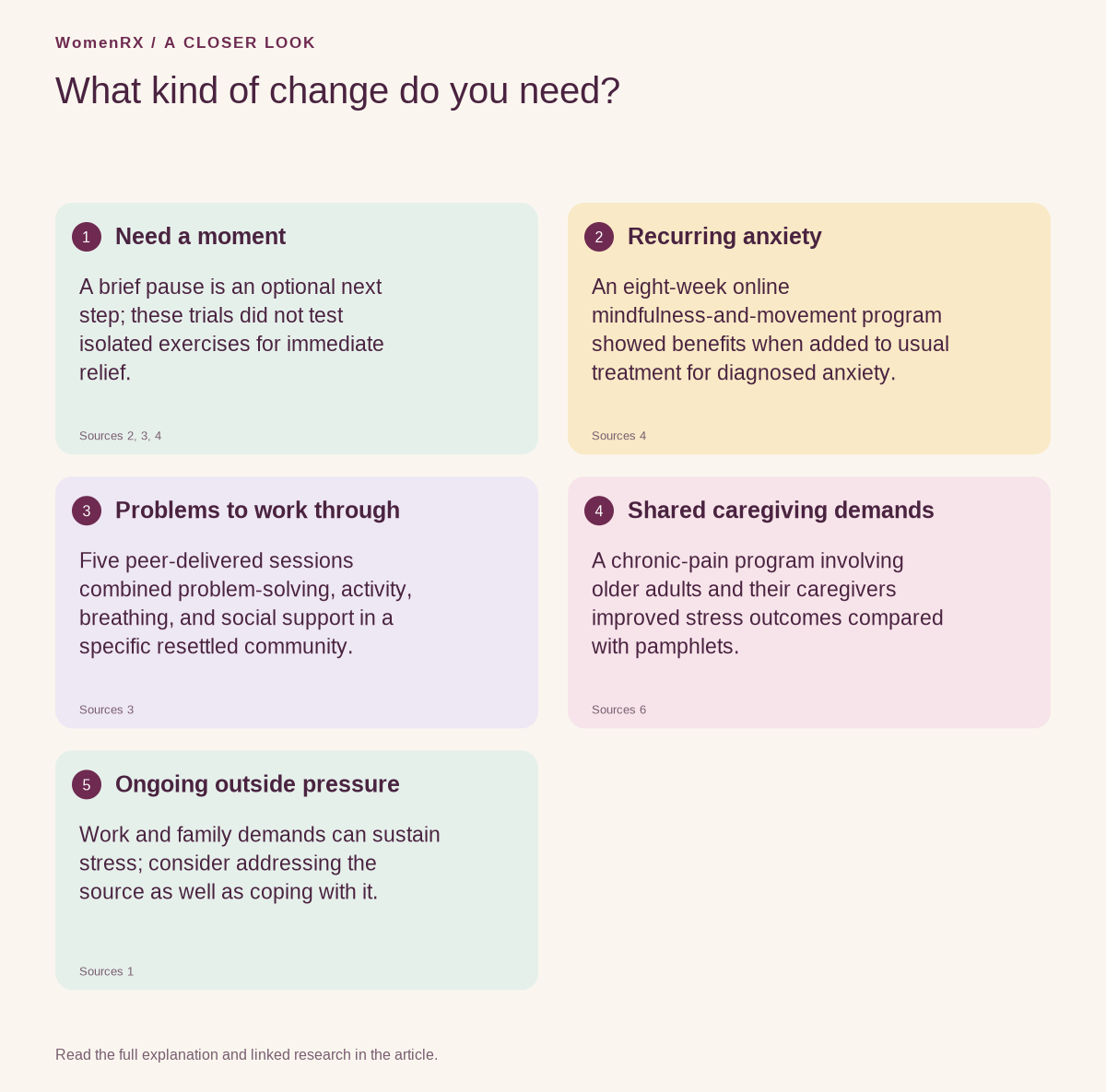
Need a moment: A brief pause is an optional next step; these trials did not test isolated exercises for immediate relief.234
Recurring anxiety: An eight-week online mindfulness-and-movement program showed benefits when added to usual treatment for diagnosed anxiety.4
Problems to work through: Five peer-delivered sessions combined problem-solving, activity, breathing, and social support in a specific resettled community.3
Shared caregiving demands: A chronic-pain program involving older adults and their caregivers improved stress outcomes compared with pamphlets.6
Ongoing outside pressure: Work and family demands can sustain stress; consider addressing the source as well as coping with it.1
Read the figure as text
These options differ in what they ask of you and what the cited research actually tested.- Need a moment: A brief pause is an optional next step; these trials did not test isolated exercises for immediate relief.234
- Recurring anxiety: An eight-week online mindfulness-and-movement program showed benefits when added to usual treatment for diagnosed anxiety.4
- Problems to work through: Five peer-delivered sessions combined problem-solving, activity, breathing, and social support in a specific resettled community.3
- Shared caregiving demands: A chronic-pain program involving older adults and their caregivers improved stress outcomes compared with pamphlets.6
- Ongoing outside pressure: Work and family demands can sustain stress; consider addressing the source as well as coping with it.1
Sources you can check
- Stress: MedlinePlusAccessed 2026-09-25Return to first citation
- A Mobile Virtual Reality-Based Intervention for Stress Reduction Among Young Adults: Pilot Randomized Controlled Trial.Hong H, Lootens MR, Bachman R, Olivera Leon LD, Dunlap AF, Goldenhersch E, Rosencovich N, Waitman C, Wyka KE, Huang TT. · JMIR mHealth and uHealth · 2026Return to first citation
- Effectiveness of peer-delivered Problem Management Plus for Immigrants (PMP-I) in reducing stress, anxiety, and depressive symptoms among Bhutanese adults resettled in Massachusetts, United States: a pilot randomized controlled trial.Poudel-Tandukar K, Laws H, Martell CR, Rai S, Ramdam R, Meyer JS, Bertone-Johnson ER, Jacelon CS, Hollon SD. · Epidemiology and psychiatric sciences · 2026Return to first citation
- Self-Guided Internet-Based Mindfulness-Informed Stress Management for Generalized Anxiety Disorder: Randomized Controlled Trial With Longitudinal Network Analysis.Wang Z, Tong HQ, Yue J, Wu S, Xia Y, Zhang H, Yang Y. · Journal of medical Internet research · 2026Return to first citation
- Effects of a mobile-based self-management program on mental health in young adults: a randomized controlled trial.Oh D, Choi HS, Mohr DC, Na H. · Frontiers in public health · 2026Return to first citation
- Effectiveness of a Dyadic Pain Management Program for Community-Dwelling Older Adults with Chronic Pain: A Cluster Randomized Controlled Trial.Tse MMY, Ng SSM, Lee PH, Tang ASK, Tse PP, To KP, Ho S, Wu TCM. · Healthcare (Basel, Switzerland) · 2026Return to first citation