Estradiol testing in menopause: does the number explain your symptoms?
An estradiol result is one piece of information, not a stand-alone menopause diagnosis or a measure of whether treatment is right for you.
Usually, one estradiol (E2) blood test can’t confirm menopause or explain every symptom. Menopause is defined by 12 months without a period, while perimenopause can bring changing periods and hormone levels. E2 may be included in an evaluation of missed periods, especially when menopause is unusually early or another cause is possible, but it needs context. 1 4 5
What a single E2 result can, and can’t, tell you
Estradiol, often shortened to E2, is a form of estrogen measured in blood. During the menopausal transition, ovarian hormone production changes and periods may become irregular. A blood test captures a measurement at one point; it doesn’t tell you whether you’ve gone 12 months without a period, the defining milestone for menopause. 1
For the specific question “Have I reached menopause?”, an E2 value by itself isn’t a dependable yes-or-no answer. A study assessing hormone tests for distinguishing menopause from amenorrhea found that adding estradiol to follicle-stimulating hormone (FSH) testing did not improve the diagnostic information. 4
That doesn’t mean hormone testing never has a purpose. It means the useful question is what the test is meant to clarify, rather than whether a number falls above or below a presumed menopause cutoff.
When an estradiol test may be part of the workup
A missed or stopped period can have causes besides the usual menopausal transition. In an evaluation of amenorrhea, laboratory testing may include estradiol along with FSH, luteinizing hormone, prolactin, thyroid-stimulating hormone, and a pregnancy test. The clinician uses the history and other findings to decide what else to investigate. That broader workup is different from using E2 alone to confirm ordinary menopause. 5
Age matters. Menopause before age 45 is considered early, and before age 40 it is considered premature. If periods stop unusually early, or you have a pattern that doesn’t fit the expected transition, it’s worth asking what causes need to be considered and whether hormone tests would help distinguish them. 1
A study of women assessed for premature ovarian insufficiency and early menopause included E2 among several tests, but it was a retrospective study of patients at a specialist clinic, not evidence that one E2 result diagnoses those conditions by itself. 2
If you’re using hormones or contraception
Tell the clinician ordering the test about menopause hormone treatment and hormonal contraception, including what you use. Ask whether the result can answer the question being asked while you’re using it. For example, a study of premature ovarian insufficiency and early menopause excluded women who had used hormone therapy or hormonal contraception since their last period, so its results describe an untreated group and shouldn’t be assumed to apply directly to someone using those hormones. 2
A practical question is: “What would you do differently depending on this result?” If there isn’t a clear answer, the test may not resolve your concern. If there is, ask how the result will be interpreted alongside your menstrual history, symptoms, age, and treatment use.
Treatment decisions aren’t a hormone-number test
Whether menopause hormone therapy is appropriate depends on more than an E2 value. The North American Menopause Society’s position statement describes treatment as individualized, with benefits and risks shaped by factors including the type and route of therapy, duration, timing, and whether a progestogen is used. It also recommends periodic reassessment of benefits and risks. 3
So if you’re still having hot flashes, sleep disruption, or other symptoms while on treatment, an estradiol result alone can’t show why they’re happening or establish whether your treatment is suitable. A useful discussion starts with which symptoms are bothering you, what treatment you use, and what decision a test would change. 3
A quick way to frame the question
- Trying to confirm typical menopause? Start with your menstrual history: menopause is reached after 12 months without a period. 1
- Periods stopped unexpectedly or at a younger age? Ask whether an amenorrhea evaluation is needed and whether E2 is one part of it. 1 5
- Using hormone treatment or contraception? Share that context and ask what the result can tell you while you’re using it. 2
- Considering or adjusting treatment? Ask what decision the test would change; treatment benefits and risks are individualized and reassessed over time. 3
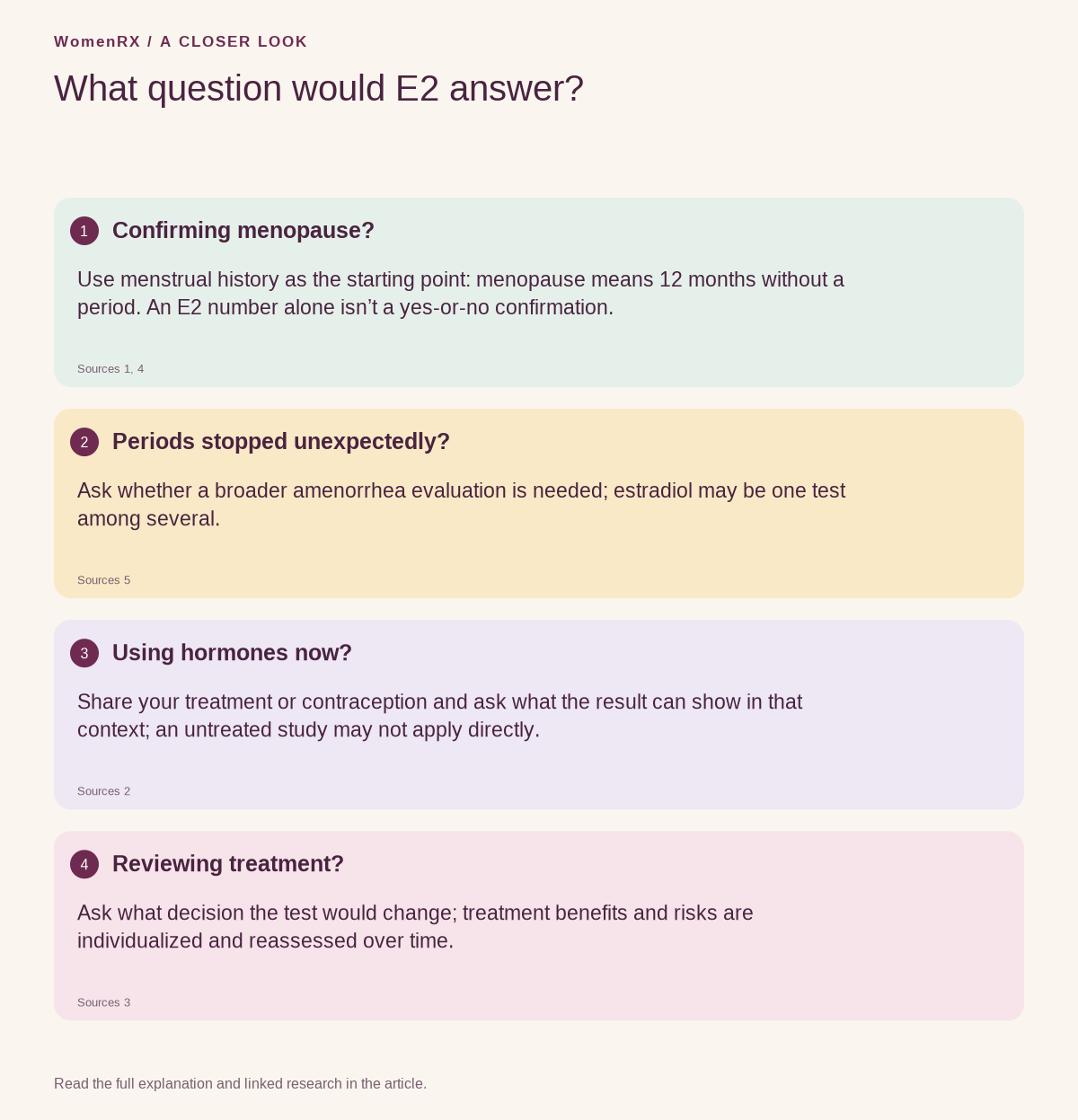
What question would E2 answer?
Confirming menopause?: Use menstrual history as the starting point: menopause means 12 months without a period. An E2 number alone isn’t a yes-or-no confirmation.14
Periods stopped unexpectedly?: Ask whether a broader amenorrhea evaluation is needed; estradiol may be one test among several.5
Using hormones now?: Share your treatment or contraception and ask what the result can show in that context; an untreated study may not apply directly.2
Reviewing treatment?: Ask what decision the test would change; treatment benefits and risks are individualized and reassessed over time.3
Read the figure as text
Start with the reason you’re considering a blood test. The next step depends on whether you’re asking about menopause, missed periods, hormone use, or treatment.- Confirming menopause?: Use menstrual history as the starting point: menopause means 12 months without a period. An E2 number alone isn’t a yes-or-no confirmation.14
- Periods stopped unexpectedly?: Ask whether a broader amenorrhea evaluation is needed; estradiol may be one test among several.5
- Using hormones now?: Share your treatment or contraception and ask what the result can show in that context; an untreated study may not apply directly.2
- Reviewing treatment?: Ask what decision the test would change; treatment benefits and risks are individualized and reassessed over time.3
Sources you can check
- Menopause | Menopause Symptoms | MedlinePlusAccessed 2026-09-25Return to first citation
- Prevalence of Impaired Bone Health in Premature Ovarian Insufficiency and Early Menopause and the Impact of Time to Diagnosis.Csehely S, Kun A, Orbán E, Katona T, Orosz M, Herman T, Krasznai ZT, Deli T, Jakab A. · Journal of clinical medicine · 2025Return to first citation
- The 2022 hormone therapy position statement of The North American Menopause Society.“The 2022 Hormone Therapy Position Statement of The North American Menopause Society” Advisory Panel. · Menopause (New York, N.Y.) · 2022Return to first citation
- The efficacy of hormone assays in the differential diagnosis of amenorrhea and menopause.Chiecchio A, Malvano R, Vignati G. · Clinical chemistry and laboratory medicine · 2000Return to first citation
- Amenorrhea: A Practical Approach to Diagnosis and Management.Klein DA, Sylvester JE, Paradise SL. · American family physician · 2026Return to first citation