Perimenopause Symptom Lists: Is There a Fixed Number?
A 34-item checklist has been used in research, but the study doesn’t present it as a diagnostic tool or establish a clinical symptom count.
A 2015 study used a 34-item checklist to ask which changes participants associated with menopause; it did not present the checklist as a diagnostic tool. That supports describing 34 as the number of items in that research checklist, not as a validated clinical count. Other measures count selected symptoms for different purposes, such as rating symptom severity. 2 3
A 34-item checklist used in research
A 2015 study of 257 British Pakistani women used a standard checklist of 34 symptoms to ask which changes participants associated with menopause. The study presents the checklist as a research tool, not a diagnostic tool. It also doesn’t establish that this checklist originated the popular claim that perimenopause has exactly 34 symptoms. 2
The study illustrates why a checklist isn’t a neutral inventory. Participants interpreted some items differently from the checklist developers, and many described changes that weren’t listed at all. The researchers concluded that standard checklists have limitations for understanding women’s symptom experiences. 2
Different tools count different things
A symptom list may be designed to gather reports, compare groups, or rate how much symptoms affect someone. Those are related tasks, but they aren’t interchangeable. For example, the Menopause Rating Scale is described as a validated measure with 11 items across somatic, psychological, and urogenital domains. It’s a way to score selected symptoms, not a claim that menopause has exactly 11 symptoms. 3
Research also groups symptoms in different ways. In a US longitudinal cohort that included people with and without HIV, researchers reported frequent vasomotor, mood, and musculoskeletal symptoms across reproductive-aging stages. These are broad categories the study tracked, not a complete symptom inventory or a claim that those symptoms occur only during perimenopause. The study’s categories and participants are one view of symptom reporting, not a complete inventory for all women in perimenopause. 1
So a list’s length depends partly on what its authors choose to include and how they ask about it. A longer list isn’t automatically more complete or more medically authoritative.
A symptom can be real without proving its cause
A checklist records experiences; it doesn’t establish that perimenopause caused each one. In a large US survey, women described uncertainty about their reproductive stage, with symptom confusion and attribution among the reasons they gave. That helps explain why a list can feel both familiar and hard to interpret: symptoms and bodily changes may overlap, while a checklist can’t determine their cause for an individual. 4
Even when a symptom is recognized in menopause research, that doesn’t mean it happens to every woman or that it has only one explanation. A study of people at different reproductive-aging stages, for example, reported a range in how often participants experienced frequent symptoms rather than one universal pattern. Its results came from a particular cohort, so they shouldn’t be read as population-wide predictions. 1
A better way to read a symptom list
When you see a number such as 34, check what the list is meant to do:
- Is it a research checklist or a diagnostic claim? The 2015 study used a 34-item checklist to ask about menopause-associated changes; it did not present that checklist as a diagnostic tool. 2
- What does it measure? A scale may rate selected symptoms or their severity rather than claim to cover every possible experience. 3
- Who was studied, and how were symptoms defined? Findings may reflect a particular group and the researchers’ questions, not every woman’s experience. 1 2
- Does the list imply that every item has one cause? It shouldn’t. A symptom report is worth taking seriously, but the number of boxes checked can’t establish why it’s happening. 2 4
The useful takeaway isn’t to memorize a number. It’s to treat symptom lists as ways of organizing reports, and to check whether a list is being used to describe experiences, score symptoms, or make a clinical claim.
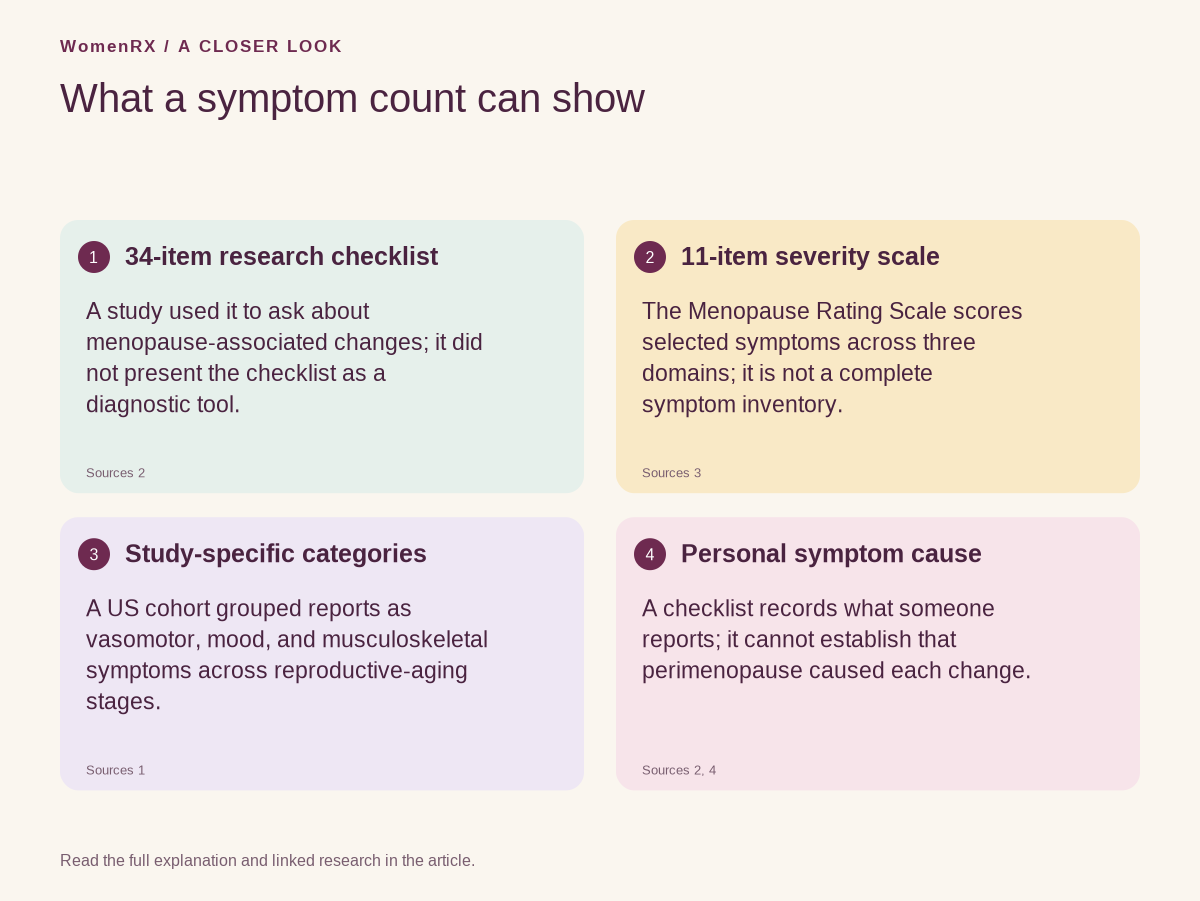
What a symptom count can show
34-item research checklist: A study used it to ask about menopause-associated changes; it did not present the checklist as a diagnostic tool.2
11-item severity scale: The Menopause Rating Scale scores selected symptoms across three domains; it is not a complete symptom inventory.3
Study-specific categories: A US cohort grouped reports as vasomotor, mood, and musculoskeletal symptoms across reproductive-aging stages.1
Personal symptom cause: A checklist records what someone reports; it cannot establish that perimenopause caused each change.24
Read the figure as text
These examples distinguish a research checklist from symptom scoring and show why neither number establishes an individual symptom’s cause.- 34-item research checklist: A study used it to ask about menopause-associated changes; it did not present the checklist as a diagnostic tool.2
- 11-item severity scale: The Menopause Rating Scale scores selected symptoms across three domains; it is not a complete symptom inventory.3
- Study-specific categories: A US cohort grouped reports as vasomotor, mood, and musculoskeletal symptoms across reproductive-aging stages.1
- Personal symptom cause: A checklist records what someone reports; it cannot establish that perimenopause caused each change.24
More questions, answered
What does a validated menopause symptom scale tell you?
It can measure selected symptoms in a consistent way. The Menopause Rating Scale, for example, has 11 items across three domains and is described as a measure of symptom severity. That kind of score doesn’t by itself establish what caused a particular symptom. 3
Sources you can check
- Substance use and menopausal symptoms among people with and without HIV in the US, 2008-2020.Knittel AK, Knittel AK, Bullington BW, Edmonds A, Rahangdale L, Neal-Perry G, Ramirez C, Konkle-Parker D, Jones DL, Moran CA, Topper EF, Cejtin H, Seidman D, Kasseye SG, Wilson TE,... · Menopause (New York, N.Y.) · 2024Return to first citation
- Menopausal symptoms among British Pakistani women: a critique of the standard checklist approach.Blell MT. · Menopause (New York, N.Y.) · 2015Return to first citation
- Menopausal Symptom Burden, Quality of Life, Healthcare-Seeking Behavior, and Treatment Satisfaction: A Cross-Sectional Study of Romanian Women.Pescaru A, Crișan F, Lala RI, Ilie AC, Wellmann N, Marițescu A, Faur AM, Popa DI, Folescu R. · Healthcare (Basel, Switzerland) · 2026Return to first citation
- Exploring prevalence and drivers of perimenopause uncertainty among US Women: a mixed-methods study.Xu Y, Fergus D, Hewings-Martin Y, Hedges M, Prentice C, Cunningham A, Zhaunova L, Shufelt C, Faubion S. · Menopause (New York, N.Y.) · 2026Return to first citation