Can Itchy Skin Be Linked to Perimenopause?
Itching can occur alongside menopause-related skin changes, but a new itch is not proof that hormones are the cause.
Itchy skin may coincide with the menopausal transition, especially when dryness is part of the picture, but itching alone isn’t an established way to identify perimenopause. Menopause-related skin changes have been associated with dryness and itch; common skin irritants, skin conditions, allergies, and medicines are other possibilities. Notice where the itch is, whether there’s a rash, and what changed recently. 1 3
When the timing may be relevant
If your skin feels drier or itchier as your cycles change, the timing may be worth mentioning. Reviews of menopause and skin describe associations between menopause, dry skin, and itching. Estrogen is thought to play a role in skin structure and its water barrier, but the details are not fully understood. These findings make a menopause connection plausible; they don’t show that an isolated itch is caused by perimenopause or make it a reliable sign of the transition. 3 4
It also helps to distinguish skin itch from vulvar or vaginal irritation. In a study of peri- and postmenopausal women, those with moderate or severe symptoms of vulvovaginal atrophy, including vulvar or vaginal itching, had more lower urinary tract symptoms. That association doesn’t establish the cause of an individual person’s itch, but genital itching with urinary or vaginal symptoms is a different pattern from itch across the arms, legs, or trunk. 5
What else could explain the itch?
Dry or irritated skin, eczema, psoriasis, allergic reactions, insect bites, irritating products, and medicines are among the possible causes. Itching can also happen with hives or other rashes. Less commonly, conditions affecting the thyroid, liver, or kidneys can be involved. 1 2
A rash, a new skin product, or a medication change can offer useful clues, but none proves the cause. If you can’t see a rash, that doesn’t rule out a cause either. Pay attention to whether the itch is in one spot or widespread, whether the skin looks different, and whether the sensation began after a change in products, clothing, environment, or medicines.
A short record can make the pattern clearer
Before seeking care, jot down a few details when the itch appears:
- Where it is: one small area, several areas, or most of your body; note if it’s on vulvar or vaginal skin.
- What the skin looks like: dry, red, bumpy, swollen, or unchanged.
- When it happens: when it began, whether it comes and goes, and whether it seems to change with your cycle.
- What changed: new medicines, skin or laundry products, or other possible irritants.
This isn’t a diagnostic test. It’s a practical way to describe the pattern and any changes that might help identify a cause.
What you can try, and when to get help
For mild itching, a cool compress may bring relief. Avoid scratching when you can, and consider whether heat, irritating fabrics, or perfumed soaps, deodorants, or moisturizers make it worse. 1 2
Seek medical evaluation if the itch is severe, affects daily life, lasts for a few weeks, or has no apparent cause. Persistent or unexplained itching deserves attention even if you suspect it started with cycle changes. 1 2
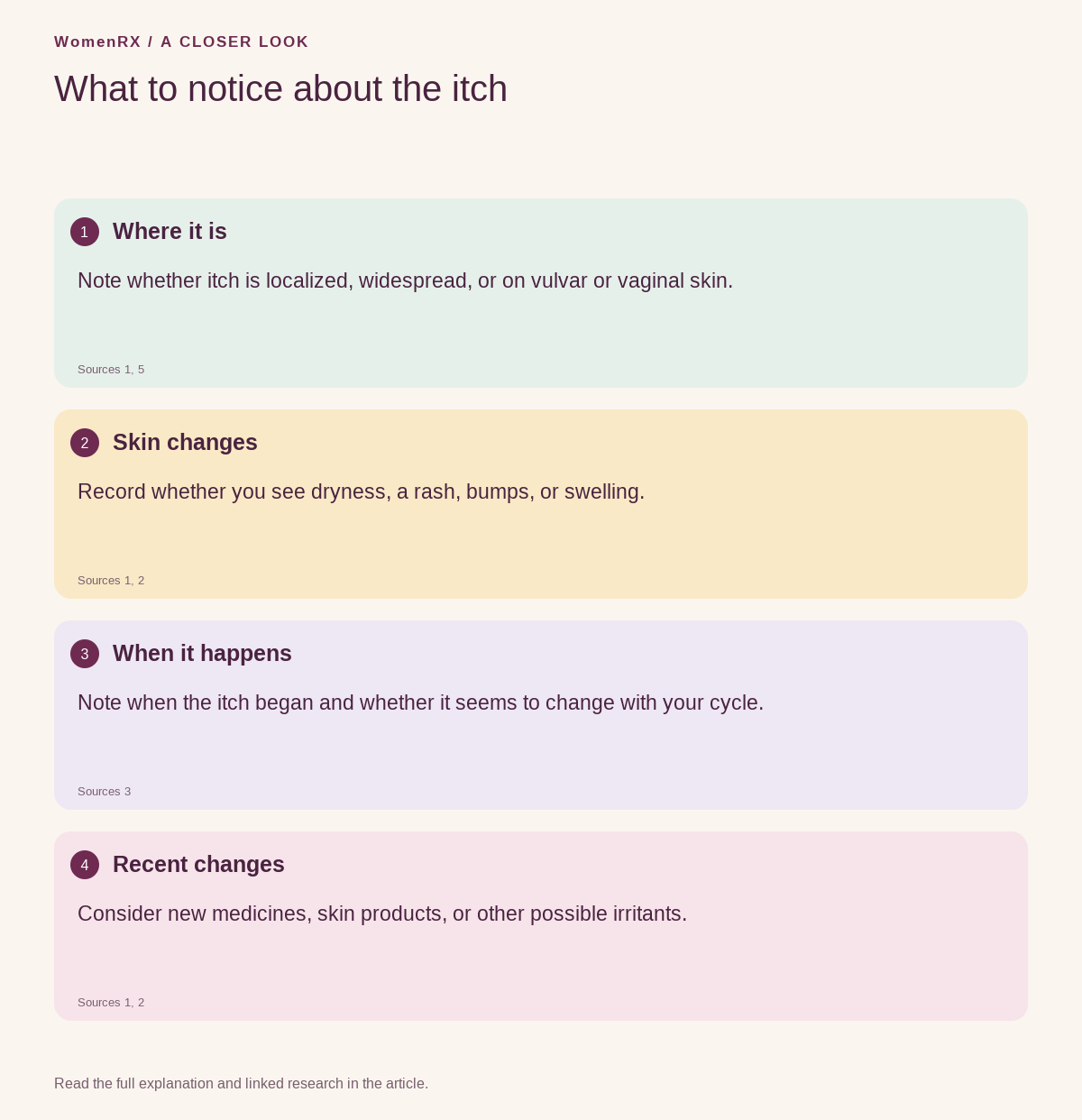
What to notice about the itch
Where it is: Note whether itch is localized, widespread, or on vulvar or vaginal skin.15
Skin changes: Record whether you see dryness, a rash, bumps, or swelling.12
When it happens: Note when the itch began and whether it seems to change with your cycle.3
Recent changes: Consider new medicines, skin products, or other possible irritants.12
Read the figure as text
These details can help describe a pattern and possible causes; they don’t diagnose whether hormones are responsible.- Where it is: Note whether itch is localized, widespread, or on vulvar or vaginal skin.15
- Skin changes: Record whether you see dryness, a rash, bumps, or swelling.12
- When it happens: Note when the itch began and whether it seems to change with your cycle.3
- Recent changes: Consider new medicines, skin products, or other possible irritants.12
Sources you can check
- Itching | Pruritus | Itchy skin | MedlinePlusAccessed 2026-09-25Return to first citation
- Itchy skin - NHSAccessed 2026-09-25Return to first citation
- Menopause, skin and common dermatoses. Part 2: skin disorders.Kamp E, Ashraf M, Musbahi E, DeGiovanni C. · Clinical and experimental dermatology · 2022Return to first citation
- Skin, hair and beyond: the impact of menopause.Zouboulis CC, Blume-Peytavi U, Kosmadaki M, Roó E, Vexiau-Robert D, Kerob D, Goldstein SR. · Climacteric : the journal of the International Menopause Society · 2022Return to first citation
- Lower Urinary Tract Symptoms in Greek Women After Menopause: The LADY Study.Lambrinoudaki I, Mili N, Augoulea A, Armeni E, Vakas P, Panoulis K, Vlahos N, Mikos T, Grimbizis G, Rodolakis A, Athanasiou S. · International urogynecology journal · 2024Return to first citation