Itchy Skin in Midlife: Menopause or Something Else?
Where you itch, what you can see on the skin, and whether it’s keeping you awake can help you decide what to do next.
Itch can occur after menopause, but an itch that starts during perimenopause or later isn’t proof that hormones are the cause. Arrange an assessment if it’s severe, unexplained, lasts more than a few weeks, keeps returning, or disrupts sleep or daily life. A visible rash is another useful clue to describe, especially if the itch isn’t improving. 12
First, locate the itch
Is it all over, limited to a patch of skin, or mainly on the vulva? That distinction is more useful than assuming the timing tells you the cause. Itchy skin is common after menopause, but dry skin, eczema, psoriasis, reactions to products or medicines, infections, and other conditions can also cause it. Less commonly, thyroid, liver, or kidney problems may be involved. If itching begins during perimenopause, the same caution applies: its timing doesn’t establish a hormonal cause. 12
If you can see a rash, describe it before naming it
A rash, hives, swelling, or dry and irritated skin may offer clues, but appearance alone won’t reliably identify the cause. Think about where the change started and whether the itch and visible change appeared together. Has the area spread or changed? Does the rash come and go? Also note a new cosmetic, soap, detergent, or medicine, since products and medicines can trigger itching or skin reactions. These are possibilities to discuss, not proof that you’ve found the culprit. 12
A rash doesn’t automatically mean you need an appointment. But itch with a rash deserves assessment if it’s severe, keeps returning, isn’t improving with simple care, lasts more than a few weeks, or affects your daily life. That includes itching that repeatedly interrupts your sleep. A clinician can look at the skin and ask about the pattern and other symptoms rather than relying on a description of the rash alone. 12
If the itch is widespread and you can’t see an obvious rash, don’t dismiss it as menopause either. An itch with no apparent cause, particularly one that persists, is a reason to get it checked. A clinician may consider blood tests to help look for a cause. 12
If the itch is mainly vulvar, treat it as a separate question
After menopause, estrogen-related vulvovaginal changes can involve dryness, irritation, itching, and pain. But vulvar itch can also come from contact dermatitis or skin conditions such as lichen sclerosus and lichen planus. These conditions can be mistaken for one another, so repeatedly trying different products may delay a useful examination. 34
If vulvar itching persists or returns, or you notice pain or a skin change, arrange an examination and say clearly that the vulva is where it itches. Mention dryness or discomfort too. An examination can help distinguish possible causes; sometimes a clinician may consider a biopsy to clarify a vulvar skin diagnosis, but that isn’t an automatic step for every itch. 34
Make the next step fit what’s happening
For a mild, recent itch that seems linked to dry or irritated skin, cool or lukewarm washing and avoiding perfumed skin products may help. Try not to scratch, which can further irritate the area. If the itch doesn’t improve, comes back, becomes severe, or interferes with sleep or ordinary activities, get it assessed rather than continuing to guess. 12
You don’t need an elaborate symptom diary. Before an appointment, jot down when the itch began, exactly where it occurs, whether there was a rash or swelling, and whether it’s affecting sleep. Add any new products or medicines and, for vulvar itch, any dryness or pain. Those details give the clinician a clearer starting point without asking you to diagnose yourself. 1234
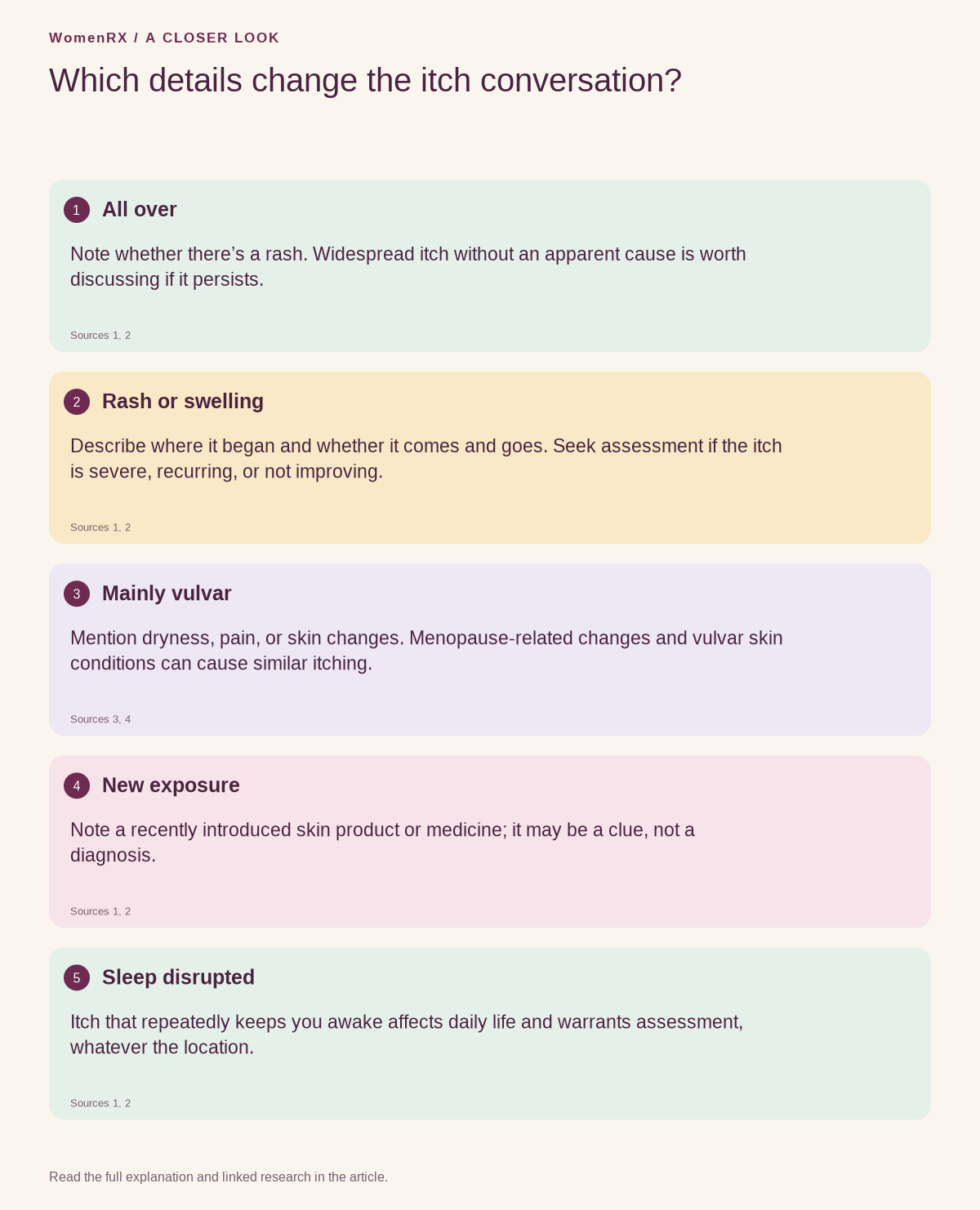
Which details change the itch conversation?
All over: Note whether there’s a rash. Widespread itch without an apparent cause is worth discussing if it persists.12
Rash or swelling: Describe where it began and whether it comes and goes. Seek assessment if the itch is severe, recurring, or not improving.12
Mainly vulvar: Mention dryness, pain, or skin changes. Menopause-related changes and vulvar skin conditions can cause similar itching.34
New exposure: Note a recently introduced skin product or medicine; it may be a clue, not a diagnosis.12
Sleep disrupted: Itch that repeatedly keeps you awake affects daily life and warrants assessment, whatever the location.12
Read the figure as text
Start with location, then note visible changes and associated symptoms. The final decision is whether the itch persists or disrupts your life.- All over: Note whether there’s a rash. Widespread itch without an apparent cause is worth discussing if it persists.12
- Rash or swelling: Describe where it began and whether it comes and goes. Seek assessment if the itch is severe, recurring, or not improving.12
- Mainly vulvar: Mention dryness, pain, or skin changes. Menopause-related changes and vulvar skin conditions can cause similar itching.34
- New exposure: Note a recently introduced skin product or medicine; it may be a clue, not a diagnosis.12
- Sleep disrupted: Itch that repeatedly keeps you awake affects daily life and warrants assessment, whatever the location.12
Sources you can check
- Itching | Pruritus | Itchy skin | MedlinePlusAccessed 2026-09-25Return to first citation
- Itchy skin - NHSAccessed 2026-09-25Return to first citation
- Benign vulvar dermatoses.Rodriguez MI, Leclair CM. · Obstetrical & gynecological survey · 2012Return to first citation
- Evaluation of the effect of multipoint intra-mucosal vaginal injection of a specific cross-linked hyaluronic acid for vulvovaginal atrophy: a prospective bi-centric pilot study.Berreni N, Salerno J, Chevalier T, Alonso S, Mares P. · BMC women's health · 2021Return to first citation