Dry Skin and Diet: What to Try First
A moisturizer and gentler washing are often more useful first steps than changing your diet, but a restricted diet or persistent itch changes the picture.
If your skin feels dry, start with skin care: use an unperfumed moisturizer regularly, keep showers lukewarm and avoid long baths or showers. Diet deserves a closer look if you’ve been eating a very restricted range of foods or have a condition linked to vitamin A inadequacy, such as Crohn’s disease or celiac disease. Drinking extra water or relying on a particular food should not replace direct skin care. Seek assessment if itching is severe, widespread, persistent or occurs during pregnancy. 52
Start with what’s happening on your skin
Dry, itchy skin doesn’t automatically mean you’re missing a nutrient. Sometimes the skin is dry, cracked or irritated. Itching can also come from eczema, a reaction to something touching your skin, a fungal infection or another skin condition. Those possibilities call for different responses, which is why a change in diet isn’t the most useful first move for every dry patch. 5
For an everyday example, if your legs feel tight and itchy after bathing, try a simpler skin-care routine: take cool or lukewarm showers, avoid spending a long time in the water and use an unperfumed moisturizer regularly. If a perfumed soap or moisturizer seems to irritate your skin, leave it out. These steps address the skin directly rather than assuming you need to drink more water or buy a supplement. 56
When food intake is worth a closer look
Nutrition matters to health, and an eating pattern needs to provide enough energy and nutrients, including fats, vitamins and water. That’s different from claiming that one food treats dry skin. If you’ve recently cut out many foods, are eating very little or struggle to eat a varied diet, it’s reasonable to consider whether your overall intake meets your needs. Your skin symptoms alone can’t tell you which nutrient, if any, is low. 1
Vitamin A illustrates why context matters. It comes from foods including eggs and dairy products, as well as vegetables such as carrots, sweet potatoes and leafy greens. Clinical vitamin A deficiency is uncommon in the United States. People with certain gastrointestinal conditions, including Crohn’s disease and celiac disease, have a higher risk of vitamin A inadequacy. If you have one of these conditions and are concerned about your intake, that’s a more specific reason to discuss nutrition than dry skin by itself. 2
Don’t try to test the vitamin A theory with a high-dose supplement. Too much preformed vitamin A can itself cause dry skin, and high intakes are especially concerning if you’re pregnant or might become pregnant. If you already take supplements, check whether more than one contains vitamin A before adding anything for your skin. 2
What about foods or supplements sold for skin hydration?
Skin hydration can be measured in studies, but an improvement on a skin measure doesn’t establish a treatment for your particular dry, itchy skin. A 2019 review of 11 randomized, placebo-controlled collagen studies, involving 805 participants in total, reported some improvements in hydration and elasticity. The studies examined several skin concerns, and the review called for more research on skin-barrier diseases. It didn’t establish collagen as a first-line answer to ordinary dry skin in women. 4
A human trial of oyster hydrolysate reported improved skin moisturization and integrity. Separate experiments examined UV-exposed mice. The human finding does not establish oyster hydrolysate as a treatment for everyday dry, itchy skin. 3
The practical distinction is simple: eating enough and eating a variety of foods supports your overall nutrition; it’s not the same thing as treating a skin condition. Likewise, drinking water is part of adequate nutrition, but drinking extra water should not replace direct skin care for dry, itchy skin. 15
When skin care isn’t enough
Pay attention to what comes with the dryness. If itching is severe, affects much of your body, disrupts daily life, keeps returning or doesn’t improve with self-care, arrange a medical assessment. A new rash, lump or swelling that worries you is another reason to get it checked. These are cues to look for a cause, not signs of a particular nutrient deficiency. 5
Life stage can change the context without making diet the explanation. Itchy skin can occur after menopause. Itching is also common during pregnancy, but it should be checked with your pregnancy care team because it can sometimes signal a liver condition called intrahepatic cholestasis of pregnancy. Don’t assume pregnancy-related itching is simply dry skin or try to address it with vitamin A. 52
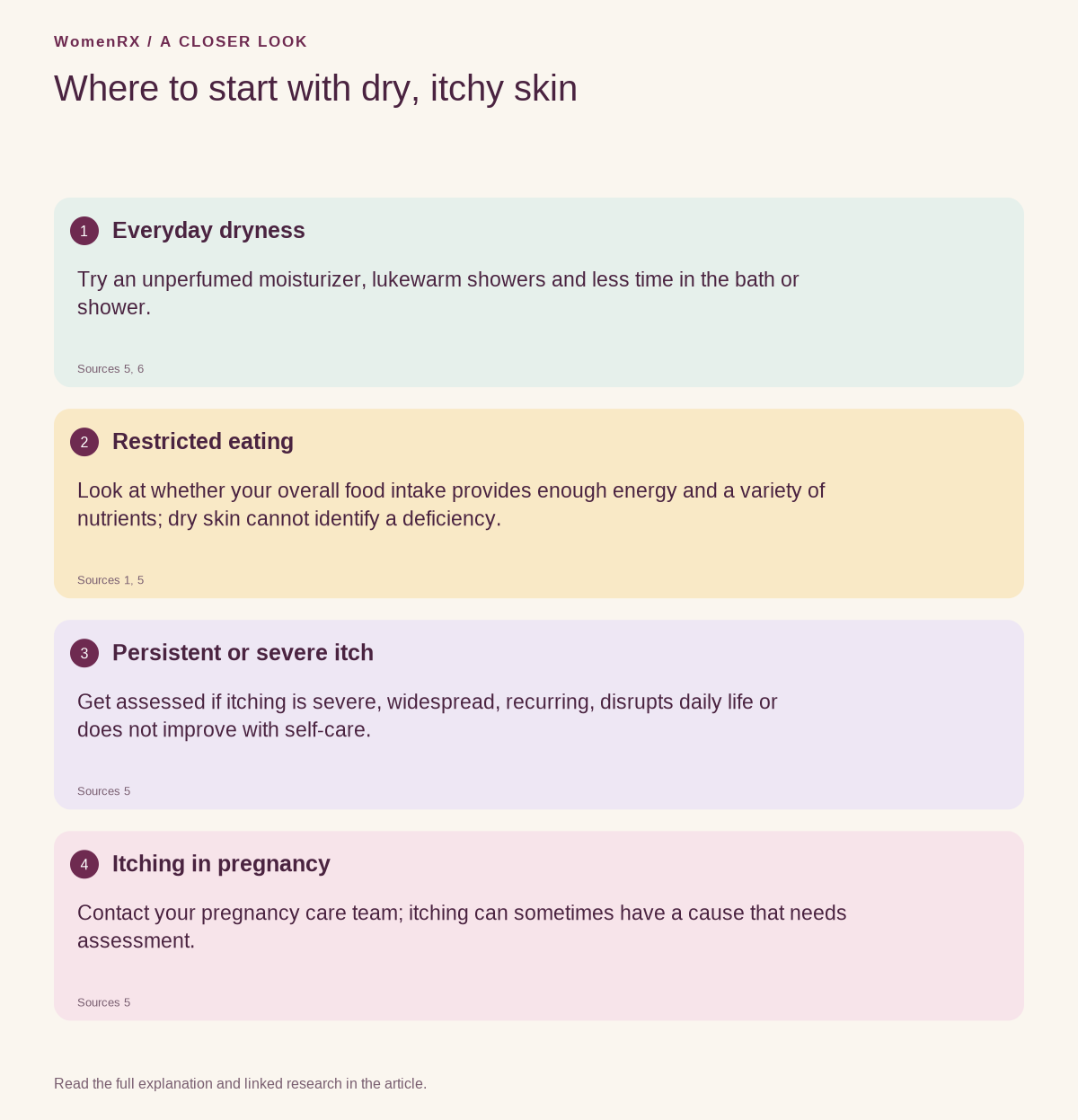
Where to start with dry, itchy skin
Everyday dryness: Try an unperfumed moisturizer, lukewarm showers and less time in the bath or shower.56
Restricted eating: Look at whether your overall food intake provides enough energy and a variety of nutrients; dry skin cannot identify a deficiency.15
Persistent or severe itch: Get assessed if itching is severe, widespread, recurring, disrupts daily life or does not improve with self-care.5
Itching in pregnancy: Contact your pregnancy care team; itching can sometimes have a cause that needs assessment.5
Read the figure as text
Use the pattern around your symptoms to choose a first step; the paths are practical distinctions, not a diagnostic test.- Everyday dryness: Try an unperfumed moisturizer, lukewarm showers and less time in the bath or shower.56
- Restricted eating: Look at whether your overall food intake provides enough energy and a variety of nutrients; dry skin cannot identify a deficiency.15
- Persistent or severe itch: Get assessed if itching is severe, widespread, recurring, disrupts daily life or does not improve with self-care.5
- Itching in pregnancy: Contact your pregnancy care team; itching can sometimes have a cause that needs assessment.5
More questions, answered
Should I take vitamin A for dry skin?
Not on the basis of dry skin alone. Vitamin A deficiency is uncommon in the United States, while too much preformed vitamin A can cause dry skin and poses particular risks during pregnancy. Food intake, supplements and conditions linked to vitamin A inadequacy provide more useful context. 2
Sources you can check
- Nutrition: MedlinePlusAccessed 2026-09-25Return to first citation
- Vitamin A and Carotenoids - Health Professional Fact SheetAccessed 2026-09-25Return to first citation
- Oyster hydrolysate ameliorates UVB-induced skin dehydration and barrier dysfunction.Dusabimana T, Karekezi J, Nugroho TA, Ndahigwa EN, Choi YJ, Kim H, Kim HJ, Park SW. · Life sciences · 2024Return to first citation
- Oral Collagen Supplementation: A Systematic Review of Dermatological ApplicationsChoi FD, Sung CT, Juhasz ML, Mesinkovsk NA. · Journal of drugs in dermatology : JDD · 2019Return to first citation
- Itchy skin - NHSAccessed 2026-09-25Return to first citation
- Skin Conditions | Hives | Acne | MedlinePlusAccessed 2026-09-25Return to first citation