Does Niacinamide Work Differently for Women’s Skin?
Studies include women with concerns like uneven pigmentation and dry skin, but they don’t establish that niacinamide works differently by sex or menopause stage.
The cited studies don’t establish that topical niacinamide works differently by sex or menopause stage. Some studies tested niacinamide-containing products in women, but they didn’t compare women’s results with men’s or separate outcomes by life stage. The practical question is whether a product’s tested use matches your concern, and whether niacinamide was tested alone or alongside other ingredients. 2 4
What the studies can tell you
The cited studies support a narrower conclusion than “niacinamide works differently for women.” Studies have tested topical products containing niacinamide for concerns such as hydration, skin-barrier measures, and uneven pigmentation. But female-only studies can show what happened in the women who took part; by themselves, they can’t show that the effect is unique to women. These studies also don’t establish a different response during pregnancy, perimenopause, or after menopause.
For example, an eight-week trial enrolled 42 Korean women and compared a moisturizer with 2% niacinamide plus 2% tranexamic acid against its vehicle; both groups also used assigned sunscreen. The combination product reduced the appearance of irregular pigmentation more than the vehicle. That’s relevant if discoloration is your concern, but it doesn’t tell us how much of the result came from niacinamide rather than tranexamic acid, or whether men would respond differently. Pregnant and nursing participants weren’t included, so this trial doesn’t answer questions about use during those stages. 4
A separate eight-week study included 67 women ages 30 to 60 and tested a niacinamide-containing formulation, with or without an ultrasound procedure, against placebo-formulation groups. The researchers reported improved skin hydration and reduced sebum with the formulation. Those findings are a signal for the tested product and study setup, not proof that niacinamide works differently in women or at a particular life stage. 2
Match the product evidence to your concern
Dryness or barrier support: A 28-day trial in people with xerosis tested a formula containing niacinamide, panthenol, and dipotassium glycyrrhizate. Thirty-one of the 35 participants were women. The treated area had better hydration and lower water loss than the untreated area, but without a vehicle-control area, the results can’t be attributed to niacinamide alone. This is evidence about a multi-ingredient moisturizer, not a comparison of women and men. 3
Uneven facial pigmentation: The niacinamide-and-tranexamic-acid study is a closer match to this concern than a general “anti-aging” claim. It tested the combination alongside sunscreen, so it doesn’t establish the effect of niacinamide by itself. 4
Aging skin: In the study of women ages 30 to 60, the product was assessed over eight weeks, and the formulation’s results were not separated by menopause stage. Age range alone doesn’t tell you whether participants were cycling, perimenopausal, or postmenopausal. 2
Actinic keratoses: These are lesions studied as a medical condition, not a routine cosmetic concern. In a small randomized trial, topical 1% niacinamide gel was less effective than 5% fluorouracil cream, although treatment complications were more frequent with fluorouracil. Most participants were male, and the trial doesn’t establish a women-specific response. 1
A useful way to choose
Start with the concern you want to address, then look for evidence on a product used for that same concern. For pigmentation, the relevant study tested niacinamide with tranexamic acid and sunscreen. For dryness, the study tested a moisturizer with three active ingredients against untreated skin. Neither trial isolates niacinamide’s contribution, and neither demonstrates a sex-specific effect. 3 4
So, niacinamide may be a reasonable ingredient to consider as part of a product aimed at your particular skin concern. But these studies don’t support paying extra for it because you’re a woman, or choosing it on the assumption that menopause makes it work better or worse.
What Niacinamide Studies Actually Test
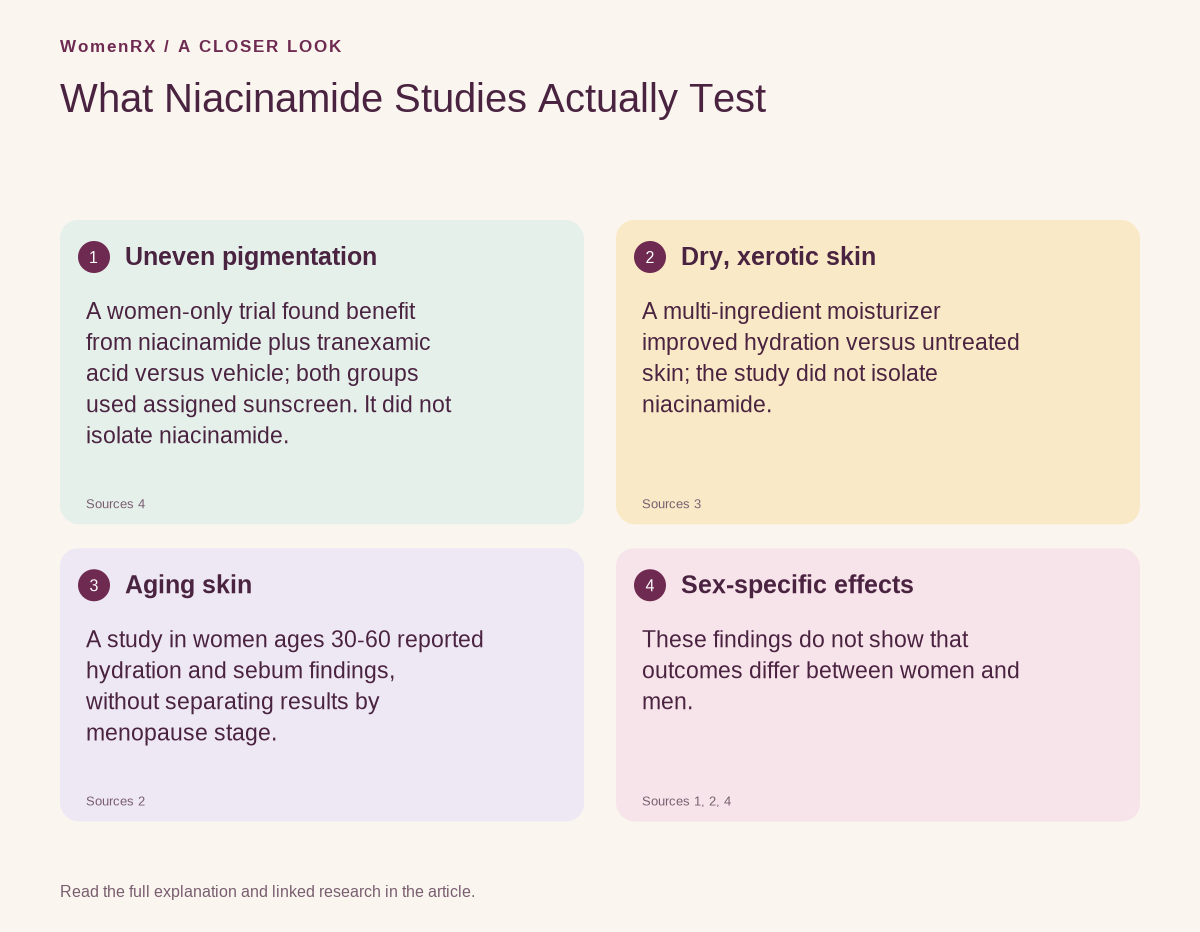
Uneven pigmentation: A women-only trial found benefit from niacinamide plus tranexamic acid versus vehicle; both groups used assigned sunscreen. It did not isolate niacinamide.4
Dry, xerotic skin: A multi-ingredient moisturizer improved hydration versus untreated skin; the study did not isolate niacinamide.3
Aging skin: A study in women ages 30-60 reported hydration and sebum findings, without separating results by menopause stage.2
Sex-specific effects: These findings do not show that outcomes differ between women and men.124
Read the figure as text
The findings point to some concern-specific uses of niacinamide-containing products, but not to different effects by sex or menopause stage.- Uneven pigmentation: A women-only trial found benefit from niacinamide plus tranexamic acid versus vehicle; both groups used assigned sunscreen. It did not isolate niacinamide.4
- Dry, xerotic skin: A multi-ingredient moisturizer improved hydration versus untreated skin; the study did not isolate niacinamide.3
- Aging skin: A study in women ages 30-60 reported hydration and sebum findings, without separating results by menopause stage.2
- Sex-specific effects: These findings do not show that outcomes differ between women and men.124
More questions, answered
Does evidence in women mean niacinamide is safe during pregnancy?
No. One pigmentation study excluded pregnant and nursing participants, so its results don’t answer safety questions for those stages. 4
Sources you can check
- Clinical and Dermoscopic Comparison of the Efficacy and Safety of 5% Fluorouracil Topical Cream and 1% Niacinamide Topical Gel in the Treatment of Actinic Keratosis: A Randomized Controlled Trial.Poostiyan N, Barati M, Shahmoradi Z, Saber M. · Journal of cosmetic dermatology · 2025Return to first citation
- Topical Formulation with Niacinamide Combined with 5 MHz Ultrasound for Improving Skin Ageing: A Double-blind, Randomised, Placebo-controlled Clinical Study.Vergilio MM, Leonardi GR. · Current medicinal chemistry · 2025Return to first citation
- Efficacy of a Topical Formulation on Skin Hydration and Barrier Function in Individuals With Xerosis: A 28-Day Randomized, Split-Leg, Untreated-Controlled Trial.Morgado-Carrasco D, Balado-Simó P, Vivancos Cuadras F, Furmanczyk M, Delgado Ojeda J. · Journal of cosmetic dermatology · 2026Return to first citation
- Reduction in facial hyperpigmentation after treatment with a combination of topical niacinamide and tranexamic acid: a randomized, double-blind, vehicle-controlled trial.Lee DH, Oh IY, Koo KT, Suk JM, Jung SW, Park JO, Kim BJ, Choi YM. · Skin research and technology : official journal of International Society for Bioengineering and the Skin (ISBS) [and] International Society for Digital Imaging of Skin (ISDIS) [and] International Society for Skin Imaging (ISSI) · 2014Return to first citation