Does Ozempic Work Differently in Women? What Evidence Shows
Sex alone doesn’t appear to change semaglutide exposure, but that doesn’t settle every question about weight response or reproductive safety.
Ozempic does not appear to need a different dose for women based on sex: its US prescribing information says sex has no clinically meaningful effect on semaglutide levels in the body. That doesn’t prove weight loss or side effects are identical. A small real-world obesity study found no significant difference in anthropometric outcomes by sex, while pregnancy and breastfeeding raise separate, formulation-specific questions. 2 4
What “works differently” can mean
There are a few separate questions here: whether women’s bodies are exposed to a different amount of the medicine, whether weight or blood-sugar outcomes differ, and whether side effects differ. Evidence about one doesn’t answer all three.
For drug exposure, the Ozempic prescribing information says age, sex, race, and ethnicity do not have a clinically meaningful effect on semaglutide pharmacokinetics. That finding doesn’t support changing the dose just because someone is a woman. It also isn’t evidence that every person will respond the same way. 2
What weight-loss evidence can, and can’t, tell you
A retrospective real-world study followed 248 adults with overweight or obesity who did not have diabetes; 77.5% were female. The researchers reported no significant differences in anthropometric outcomes by sex. That’s reassuring, but it isn’t proof that women and men have identical responses: a single retrospective study can’t establish equivalence or tell us how well the result applies to every patient or treatment setting. It also doesn’t establish whether side effects or other clinical outcomes differ by sex. 4
The study was about semaglutide used in adults with overweight or obesity, not a reason to assume every semaglutide product or prescribed use has the same evidence. Keep the question specific: are you asking about semaglutide levels, blood-sugar control, weight change, or a side effect? The answer may depend on the outcome and the population studied.
Pregnancy and breastfeeding are different questions
Sex-based pharmacokinetics don’t answer what to do during pregnancy. The Ozempic injection prescribing information says human pregnancy data are limited and that the medicine should be used during pregnancy only if the potential benefit justifies the potential risk to the fetus. It also describes potential fetal risks in animal reproduction studies. If you’re planning a pregnancy, discuss the treatment plan in advance rather than assuming the usual sex-based dosing information settles the question. 2 3
Breastfeeding information needs careful attention to the product form. The prescribing information for oral semaglutide tablets reports that semaglutide was below the level that could be measured in human milk in a clinical lactation study, but it also reports SNAC or its metabolites in milk and says breastfeeding is not recommended with those tablets. That oral-tablet information does not establish whether Ozempic injection is appropriate during breastfeeding. 1
A practical way to frame the decision
If you’re discussing Ozempic with your prescriber, separate the questions instead of asking only whether it “works differently for women”: does sex change the prescribed dose, what outcome is the medicine intended to address, and are pregnancy or breastfeeding part of the decision? The evidence supports no clinically meaningful sex-based difference in semaglutide exposure; evidence about weight-related outcomes is less definitive, and reproductive questions need their own, product-specific discussion.
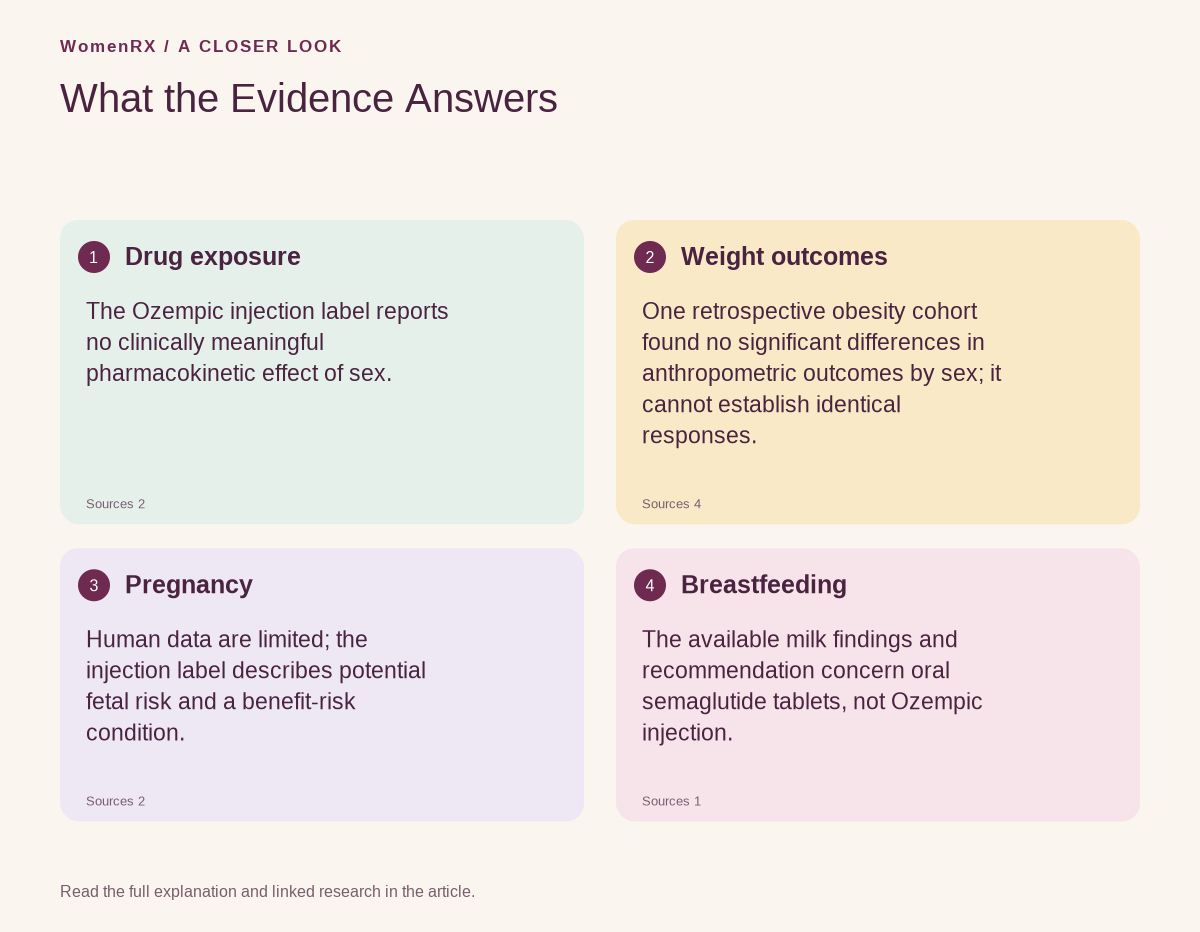
What the Evidence Answers
Drug exposure: The Ozempic injection label reports no clinically meaningful pharmacokinetic effect of sex.2
Weight outcomes: One retrospective obesity cohort found no significant differences in anthropometric outcomes by sex; it cannot establish identical responses.4
Pregnancy: Human data are limited; the injection label describes potential fetal risk and a benefit-risk condition.2
Breastfeeding: The available milk findings and recommendation concern oral semaglutide tablets, not Ozempic injection.1
Read the figure as text
These questions have different kinds of evidence. A finding about drug exposure is not a finding about every outcome or life stage.- Drug exposure: The Ozempic injection label reports no clinically meaningful pharmacokinetic effect of sex.2
- Weight outcomes: One retrospective obesity cohort found no significant differences in anthropometric outcomes by sex; it cannot establish identical responses.4
- Pregnancy: Human data are limited; the injection label describes potential fetal risk and a benefit-risk condition.2
- Breastfeeding: The available milk findings and recommendation concern oral semaglutide tablets, not Ozempic injection.1
Sources you can check
- OZEMPIC (ORAL SEMAGLUTIDE) TABLET RYBELSUS (ORAL SEMAGLUTIDE) TABLET [NOVO NORDISK PHARMACEUTICAL INDUSTRIES, LP] | US prescribing information and patient instructionsAccessed 2026-09-25Return to first citation
- OZEMPIC (SEMAGLUTIDE) INJECTION, SOLUTION [A-S MEDICATION SOLUTIONS] | US prescribing information and patient instructionsAccessed 2026-09-25Return to first citation
- Pregnancy and Medicines | MedlinePlusAccessed 2026-09-25Return to first citation
- Real-world semaglutide in obesity cohort: effectiveness, safety and persistence across sex, BMI, and prior GLP-1RA treatment.Milani I, Parrotta ME, Chinucci M, Franzò E, Gintoli E, Franco F, Sbraccia P, Guglielmi V, Capoccia D. · Frontiers in endocrinology · 2026Return to first citation