Does Wegovy Work Differently in Women?
The available evidence doesn’t show that women lose more or less weight on Wegovy, but direct sex comparisons remain limited.
There isn’t strong evidence that Wegovy works differently in women. A small retrospective study of semaglutide treatment for obesity found no significant weight-loss difference by sex, but it wasn’t a randomized Wegovy-specific comparison, so it can’t prove outcomes are identical. Pregnancy and breastfeeding are separate questions: weight-loss results don’t establish reproductive safety, and the lactation evidence is very limited. A scoping review describes pregnancy during or soon after weight-loss medication treatment, particularly with GLP-1 medicines, as contraindicated because of potential teratogenicity. It does not provide a Wegovy-specific stopping interval. 6 2 4
What the sex-specific evidence can tell you
One limited direct comparison comes from a retrospective study of 248 adults with overweight or obesity who used weekly semaglutide. About 78% were women, and the researchers found no significant difference in weight outcomes by sex. That’s reassuring as an early signal, but it isn’t proof that women and men respond identically: the study was not randomized, and it examined semaglutide in routine care rather than a Wegovy-specific randomized trial. 6
A broader review of obesity-medication trials found that women were often well represented, while men were underrepresented. Having many women in a study helps show how a treatment performs in women overall, but it doesn’t answer whether the treatment works differently by sex unless results are compared between groups. 5
So the practical answer is: there’s no solid basis to expect women to lose more or less weight than men on Wegovy. There’s also not enough evidence to rule out smaller differences. The available sex comparison doesn’t answer whether response varies with menstrual-cycle stage or menopause.
Pregnancy is a different evidence question
Weight-loss trials cannot establish whether a medicine is safe during pregnancy. A 2026 systematic review found that, in large observational cohorts, adjusted analyses did not consistently link periconceptional or early-pregnancy exposure to GLP-1-based medicines with major congenital malformations. Findings for fetal growth restriction, stillbirth, and neonatal mortality likewise showed no consistent association compared with insulin-treated or disease-matched controls. But the review combines different medicines and study populations, and evidence on continued use throughout pregnancy remains limited. It does not establish that Wegovy is safe to use during pregnancy. 3
A scoping review describes pregnancy during or soon after treatment with weight-loss medicines, particularly GLP-1 receptor agonists, as contraindicated because of potential teratogenicity. That caution is not overturned by observational findings on early exposure. 4 For someone planning to conceive, ask your prescriber when to stop injectable Wegovy before conception. The cited evidence does not establish a Wegovy-specific stopping interval, and timing for other semaglutide products should not be assumed to apply. The scoping review found no primary data on GLP-1 medicines and reproductive outcomes in women without PCOS among the studies it included. 4
If you become pregnant while taking semaglutide, contact the clinician managing the prescription to discuss what to do next. Early-exposure research can help describe what has been observed, but it does not settle the question of continued treatment during pregnancy. 3
Breastfeeding: milk transfer isn’t the same as infant safety
One pharmacokinetic study identified in a systematic review found semaglutide below the level of detection in breast-milk samples. That finding suggests little or no measurable transfer in those samples; it does not, by itself, show that exposure is harmless for a nursing infant. The review describes the lactation evidence as scarce, and it doesn’t establish Wegovy-specific breastfeeding advice. 2 3
It’s also worth distinguishing injectable Wegovy from oral semaglutide products. The US information about oral semaglutide discusses an ingredient used in those tablets, so its formulation-specific breastfeeding cautions shouldn’t automatically be treated as Wegovy guidance. 1
If you’re breastfeeding or expect to breastfeed, ask specifically about the injectable product, the limited infant-outcome evidence, and how the timing of treatment fits with your feeding plans. A single milk-transfer result is not a complete safety assessment.
A short set of questions for your prescriber
- What evidence applies to injectable Wegovy, rather than semaglutide tablets or other GLP-1 medicines?
- If I’m planning pregnancy, what treatment change and timing should we consider for my situation?
- If I’m breastfeeding, what is known about milk transfer, and what is still unknown about effects on infants?
- If my plans change or I become pregnant, who should I contact about my treatment?
The main distinction is simple: a limited study offers an early clue about sex and weight response; pregnancy and breastfeeding require their own evidence, and that evidence is still incomplete.
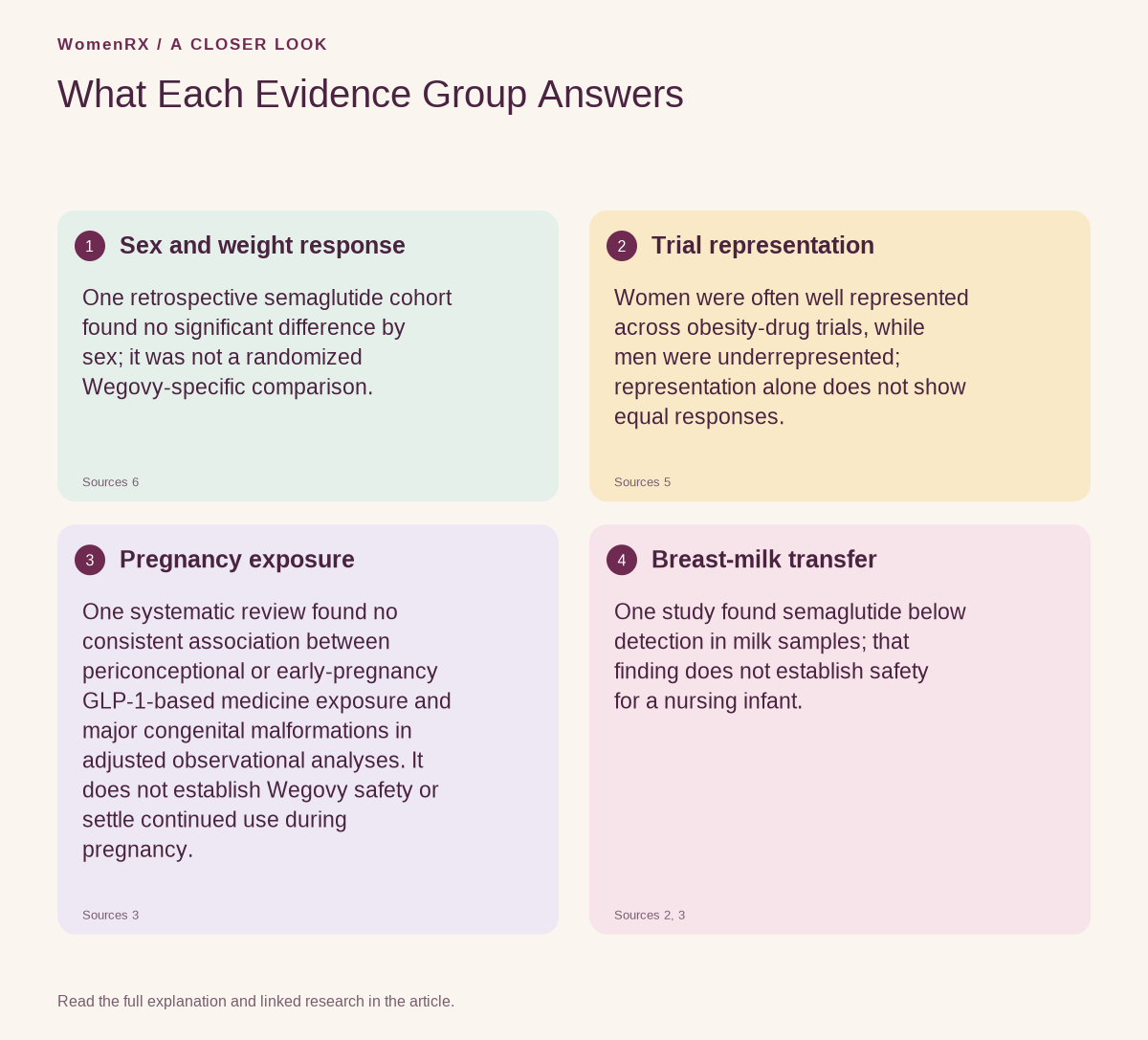
What Each Evidence Group Answers
Sex and weight response: One retrospective semaglutide cohort found no significant difference by sex; it was not a randomized Wegovy-specific comparison.6
Trial representation: Women were often well represented across obesity-drug trials, while men were underrepresented; representation alone does not show equal responses.5
Pregnancy exposure: One systematic review found no consistent association between periconceptional or early-pregnancy GLP-1-based medicine exposure and major congenital malformations in adjusted observational analyses. It does not establish Wegovy safety or settle continued use during pregnancy.3
Breast-milk transfer: One study found semaglutide below detection in milk samples; that finding does not establish safety for a nursing infant.23
Read the figure as text
These findings address different questions. A weight-response comparison cannot answer pregnancy safety, and a milk-transfer result cannot establish infant outcomes.- Sex and weight response: One retrospective semaglutide cohort found no significant difference by sex; it was not a randomized Wegovy-specific comparison.6
- Trial representation: Women were often well represented across obesity-drug trials, while men were underrepresented; representation alone does not show equal responses.5
- Pregnancy exposure: One systematic review found no consistent association between periconceptional or early-pregnancy GLP-1-based medicine exposure and major congenital malformations in adjusted observational analyses. It does not establish Wegovy safety or settle continued use during pregnancy.3
- Breast-milk transfer: One study found semaglutide below detection in milk samples; that finding does not establish safety for a nursing infant.23
More questions, answered
Does the study mean women and men lose exactly the same amount?
No. The retrospective semaglutide study found no significant difference by sex, but a finding of no significant difference doesn’t prove the outcomes are identical. It also wasn’t a randomized, Wegovy-specific comparison. 6
Does undetectable semaglutide in breast milk prove Wegovy is safe while breastfeeding?
No. One pharmacokinetic study found semaglutide below detection in milk samples, which addresses measurable transfer, not whether treatment is safe for a nursing infant. The available lactation evidence remains limited. 2 3
Sources you can check
- OZEMPIC (ORAL SEMAGLUTIDE) TABLET RYBELSUS (ORAL SEMAGLUTIDE) TABLET [NOVO NORDISK PHARMACEUTICAL INDUSTRIES, LP] | US prescribing information and patient instructionsAccessed 2026-09-25Return to first citation
- Maternal-to-Infant Transfer of Medications for Type 2 Diabetes Mellitus Via Breastmilk: A Systematic Review of Available Evidence and Clinical Guidelines.Richardson K, Kiptoo J, Mpora Odongkara B, Ojara FW, Waitt C. · Clinical pharmacology and therapeutics · 2026Return to first citation
- Safety of GLP-1 and Dual GLP-1/GIP Receptor Agonists in Preconception, Pregnancy, and Lactation: A Systematic Review of Maternal, Fetal, and Neonatal Outcomes.Ozbek L, Shah E, Al-Shiab R, Inal A, Guldan M, Afsar B, Covic A, Kanbay M. · Diabetes, obesity & metabolism · 2026Return to first citation
- What is known about the use of weight loss medication in women with overweight/obesity on fertility and reproductive health outcomes? A scoping review.Maslin K, Alkutbe R, Gilbert J, Pinkney J, Shawe J. · Clinical obesity · 2024Return to first citation
- Sex, race, and BMI in clinical trials of medications for obesity over the past three decades: a systematic review.Alsaqaaby MS, Cooney S, le Roux CW, Pournaras DJ. · The lancet. Diabetes & endocrinology · 2024Return to first citation
- Real-world semaglutide in obesity cohort: effectiveness, safety and persistence across sex, BMI, and prior GLP-1RA treatment.Milani I, Parrotta ME, Chinucci M, Franzò E, Gintoli E, Franco F, Sbraccia P, Guglielmi V, Capoccia D. · Frontiers in endocrinology · 2026Return to first citation