A Practical Treatment Path for Adult Acne
Adult acne often responds to steady topical care, but deep, scarring, or suddenly changing breakouts deserve a closer look.
For mild acne, benzoyl peroxide is a practical starting option. Improvement may begin after four weeks; if acne worsens or hasn’t improved after 12 weeks, seek advice. Topical retinoids are guideline-supported for clogged pores, while deep or scarring acne may need clinician-directed treatment. If acne appears suddenly, especially alongside new excess hair growth or scalp hair thinning, discuss the changes with a clinician. 1 3 5
Adult acne can be frustrating, especially when it appears after years of clear skin or returns around your period. A useful first step is to match treatment to the kind of acne you have and how much it is affecting you. Blackheads and whiteheads, inflamed spots, and deep nodules don’t always call for the same approach. 3
Start with a steady topical plan
Benzoyl peroxide is one option for acne. It helps reduce acne-causing bacteria and can improve spots and clogged pores. If you try it, follow the product directions and start with the lowest strength available; using more than directed won’t make it work faster and can increase irritation. It can dry or peel the skin, make it more sensitive to sunlight, and bleach fabric or hair. 1
Give treatment time. With benzoyl peroxide, improvement may start after about four weeks. If acne is worsening or hasn’t improved after 12 weeks, the NHS guidance advises seeking advice from a pharmacist or doctor. That timeline is for benzoyl peroxide, not a guarantee that every acne treatment follows the same schedule. 1
For acne that is mostly blackheads and whiteheads, topical retinoids are a guideline-supported treatment option. The guideline also names a topical retinoid alone or combined with benzoyl peroxide as an option for maintenance. A clinician can help decide whether a retinoid fits your acne and circumstances; don’t assume that every product or medication is suitable for everyone. 3
As a practical way to judge what’s helping, consider trying one product according to its directions before adding another. Benzoyl peroxide can irritate skin, so this approach may make it easier to tell what your skin tolerates. It isn’t a rule against combination treatment: the acne guideline includes benzoyl peroxide with a topical retinoid for some acne types. 1 3
When acne needs more than self-care
Consider clinical review sooner if you have deep, painful nodules, acne that is leaving scars, or persistent acne that hasn’t improved with a reasonable topical trial. The guideline distinguishes mild acne from nodular and more extensive forms that may call for clinician-directed treatment. It also includes treatment of acne scarring as part of acne care. 3
A clinician may consider treatments beyond topical products when acne is more severe or persistent. The guideline describes different treatment approaches according to acne type, including prescription combinations for more inflamed or nodular acne. Those choices depend on the individual situation; this is a reason to get an assessment, not to start a prescription treatment on your own. 3
If acne starts suddenly after years without it, consider a clinical review rather than assuming it needs the same approach as an occasional breakout. This is particularly useful if you also notice new excess facial or body hair or scalp hair thinning: acne and those changes can occur together in conditions involving androgen excess, and a clinician can assess the full pattern. There isn’t a specific sudden-onset timeframe that, by itself, identifies a cause. 5
Period-linked flares and midlife changes
Some women notice acne worsening before a period. A small retrospective review looked at 41 women with cyclical acne who received spironolactone alongside a topical retinoid; it reported improvement in many participants, but its design cannot show how well that approach works compared with other treatments. A prescriber can discuss whether a prescription option is appropriate, rather than assuming every adult breakout is hormonal. 6
Perimenopause can also coincide with skin changes. A 2026 review describes hormonal fluctuation and relative androgen effects as possible contributors to adult and perimenopausal acne. That context may help explain why acne changes in midlife, but it doesn’t identify the cause of an individual breakout. 4
Spironolactone is a prescription medicine, not a self-start treatment. It isn’t suitable for everyone, and a prescriber needs to consider your health and other medicines. If pregnancy is possible, raise that before starting or continuing any prescribed acne medicine. 2
If you’re pregnant or might be
For benzoyl peroxide specifically, the NHS says it can usually be used during pregnancy but recommends checking with a doctor or pharmacist first. If you’re considering a topical retinoid, check whether it’s suitable before using it during pregnancy or when pregnancy is possible. Advice about benzoyl peroxide doesn’t establish the suitability of a retinoid or another acne medicine. 1 3
A helpful next move is to choose one appropriate topical option if your acne is mild, use it consistently as directed, and reassess based on its expected timeline. Deep or scarring acne, persistent breakouts, or sudden acne that comes with other changes calls for a more tailored assessment.
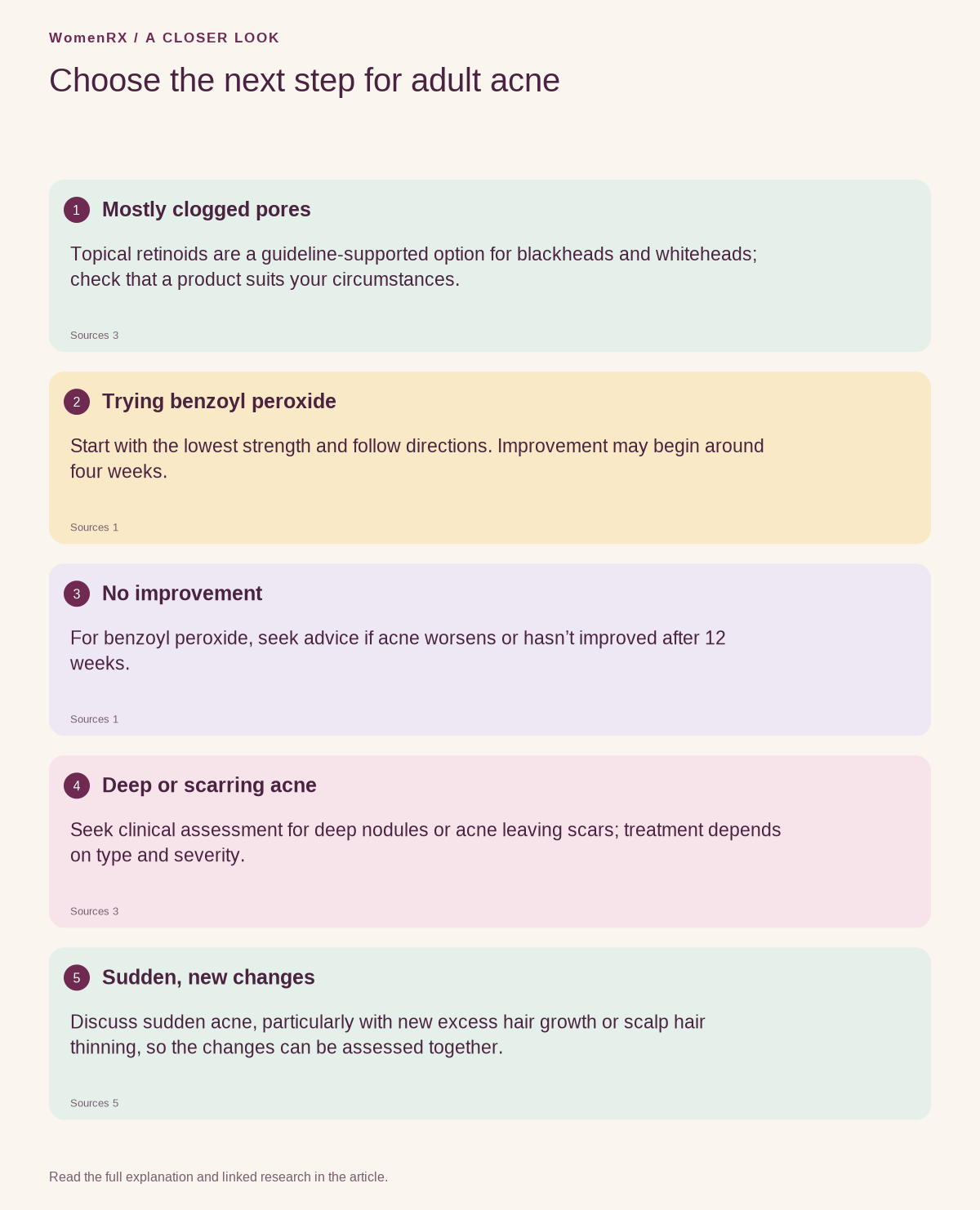
Choose the next step for adult acne
Mostly clogged pores: Topical retinoids are a guideline-supported option for blackheads and whiteheads; check that a product suits your circumstances.3
Trying benzoyl peroxide: Start with the lowest strength and follow directions. Improvement may begin around four weeks.1
No improvement: For benzoyl peroxide, seek advice if acne worsens or hasn’t improved after 12 weeks.1
Deep or scarring acne: Seek clinical assessment for deep nodules or acne leaving scars; treatment depends on type and severity.3
Sudden, new changes: Discuss sudden acne, particularly with new excess hair growth or scalp hair thinning, so the changes can be assessed together.5
Read the figure as text
Use acne type, response to topical treatment, and new accompanying changes to decide when a tailored assessment would help.- Mostly clogged pores: Topical retinoids are a guideline-supported option for blackheads and whiteheads; check that a product suits your circumstances.3
- Trying benzoyl peroxide: Start with the lowest strength and follow directions. Improvement may begin around four weeks.1
- No improvement: For benzoyl peroxide, seek advice if acne worsens or hasn’t improved after 12 weeks.1
- Deep or scarring acne: Seek clinical assessment for deep nodules or acne leaving scars; treatment depends on type and severity.3
- Sudden, new changes: Discuss sudden acne, particularly with new excess hair growth or scalp hair thinning, so the changes can be assessed together.5
More questions, answered
Do period-linked flares mean you need a hormone treatment?
Not necessarily. Treatment still depends on the kind and severity of your acne. A small retrospective study examined spironolactone with a topical retinoid in women with cyclical acne, but it cannot establish that this combination is the right choice for every period-linked flare. 3 6
How long should you try benzoyl peroxide?
Improvement may begin after about four weeks. If acne is worsening or hasn’t improved after 12 weeks, the NHS guidance advises seeking advice. These timeframes apply to benzoyl peroxide, not necessarily to other treatments. 1
Sources you can check
- Benzoyl peroxide: a medicine to treat acne - NHSAccessed 2026-09-25Return to first citation
- Spironolactone - NHSAccessed 2026-09-25Return to first citation
- [S2k-guideline for therapy of acne].Nast A, Bayerl C, Borelli C, Degitz K, Dirschka T, Erdmann R, Fluhr J, Gieler U, Hartwig R, Meigel EM, Möller S, Ochsendorf F, Podda M, Rabe T, Rzany B, Sammain A, Schink S, Zoubou... · Journal der Deutschen Dermatologischen Gesellschaft = Journal of the German Society of Dermatology : JDDG · 2010Return to first citation
- Adult and perimenopausal acne and the nurse's role in management.Parkinson H. · British journal of nursing (Mark Allen Publishing) · 2026Return to first citation
- An updated clinico-investigative approach to diagnosis of cutaneous hyperandrogenism in relation to adult female acne, female pattern alopecia & hirsutism a primer for dermatologists.Sardana K, Muddebihal A, Sehrawat M, Bansal P, Khurana A. · Expert review of endocrinology & metabolism · 2024Return to first citation
- Spironolactone and topical retinoids in adult female cyclical acne.Lessner E, Fisher S, Kobraei K, Osleber M, Lessner R, Elliott L, Wesson S. · Journal of drugs in dermatology : JDD · 2014Return to first citation