Adult Acne: What Triggers Breakouts and What Helps
A breakout’s timing can offer clues, but the type of spot, recent changes, and scarring risk are more useful for choosing what to do next.
Adult acne can flare around a period, but it also involves oil production, blocked follicles, and inflammation. Pregnancy-related changes, some contraceptives, and pore-blocking products may affect breakouts. A few surface-level spots may respond to topical care; deep, painful bumps, scarring, or persistent acne deserve an assessment. Jawline acne alone doesn’t prove an androgen problem. 2 4
Start with the kind of spot
Blackheads and whiteheads are blocked pores. Acne can also cause inflamed spots, while nodules are larger, hard, painful lumps beneath the skin. Cyst-like lesions carry a greater risk of permanent scarring. Acne can show up on your face, chest, or back, so where it appears matters too. 2
These differences help you decide whether to try a topical treatment or seek care sooner. A few blackheads and spots are different from recurring deep lumps or marks that are becoming scars. Don’t squeeze spots to try to clear them: picking can make acne worse and contribute to scarring. 2
What changed before the breakout?
Acne isn’t caused by poor hygiene. Androgens can increase skin oil, while material building up in a follicle blocks the pore and contributes to inflammation. Washing harder won’t remove that blockage, and over-washing can irritate skin. A gentle cleanser is a more useful starting point than scrubbing. 2 4
Look for changes you can actually identify, without assuming any one of them explains everything. For example, do breakouts tend to flare around your period? Menstrual-cycle and pregnancy-related hormone changes can coincide with acne episodes. Have you switched to an oil-based moisturizer, makeup, or sunscreen? Products labeled non-comedogenic are less likely to block pores. A change to a progestin-only contraceptive may also be relevant, since these methods can worsen acne for some people. 2 4
If acne starts or changes around perimenopause, it’s reasonable to mention the timing. Adult acne can persist or begin later, but a breakout at that age doesn’t establish that the menopause transition caused it. The spots themselves and any other recent changes still matter. 2 4
When is an androgen-related concern worth raising?
Jawline-predominant acne and flares around a period can fit a hormone-sensitive pattern. They aren’t a diagnosis: hormones are one part of acne’s broader process, and the location of a breakout can’t tell you your androgen levels. 4
A different conversation is warranted if acne appears alongside new coarse facial or body hair or female-pattern scalp hair loss. These can occur among the signs of androgen excess associated with conditions such as polycystic ovary syndrome (PCOS). That combination is worth describing to a clinician, but acne or hair changes alone don’t establish PCOS. 7
Match treatment to the breakout and your circumstances
For a few blackheads, whiteheads, or spots, benzoyl peroxide is a topical option. It reduces acne-associated bacteria and can help with blocked pores and inflammation. Its tradeoffs are dryness or irritation and bleaching of fabric. It often starts to work within four weeks, so a few days isn’t a fair test. 1 3
Topical retinoids such as adapalene help prevent material from building up inside follicles. They’re commonly used as part of acne treatment, sometimes in combination with another topical medicine. They can irritate skin, and they’re avoided during pregnancy as a precaution. If you’re pregnant or planning pregnancy, make that part of the treatment discussion before starting one. Azelaic acid is another topical option a clinician may consider when benzoyl peroxide or a retinoid is too irritating. 3 6
Persistent or more substantial acne may need prescription treatment. A combined oral contraceptive can help some women with acne; spironolactone is another option for some women with persistent acne, often alongside topical care. They’re distinct choices, not proof that a breakout has a single hormonal cause. Spironolactone must not be used during pregnancy, so pregnancy plans are central to deciding whether it fits. 3 4 5
For more severe acne, a clinician may consider an oral antibiotic together with topical treatment rather than an antibiotic alone. Updated European guidance generally limits systemic antibiotics to three months unless specific circumstances justify longer treatment. Severe or scarring acne may call for other specialist treatment instead of repeated antibiotic courses. 3 4 5
Get an assessment if you have painful nodules, cyst-like lesions, scarring, or acne that persists despite treatment. You don’t have to wait for a scar if breakouts are making you feel low or anxious. These are reasons to find a treatment that better fits what’s happening, not to scrub harder. 2 3
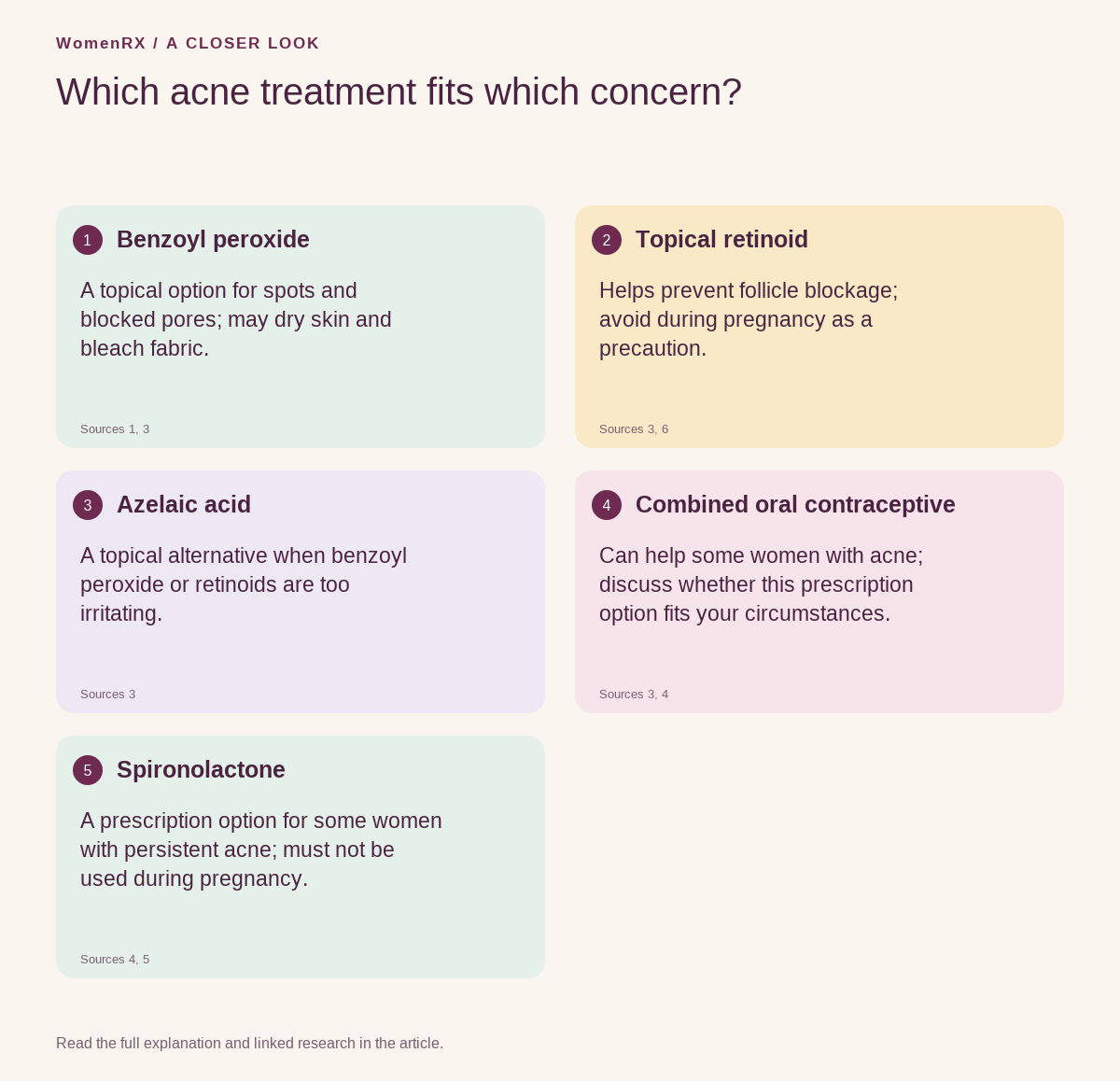
Which acne treatment fits which concern?
Benzoyl peroxide: A topical option for spots and blocked pores; may dry skin and bleach fabric.13
Topical retinoid: Helps prevent follicle blockage; avoid during pregnancy as a precaution.36
Azelaic acid: A topical alternative when benzoyl peroxide or retinoids are too irritating.3
Combined oral contraceptive: Can help some women with acne; discuss whether this prescription option fits your circumstances.34
Spironolactone: A prescription option for some women with persistent acne; must not be used during pregnancy.45
Read the figure as text
These approaches address different parts of acne. Severity, irritation, and pregnancy plans can change the choice.- Benzoyl peroxide: A topical option for spots and blocked pores; may dry skin and bleach fabric.13
- Topical retinoid: Helps prevent follicle blockage; avoid during pregnancy as a precaution.36
- Azelaic acid: A topical alternative when benzoyl peroxide or retinoids are too irritating.3
- Combined oral contraceptive: Can help some women with acne; discuss whether this prescription option fits your circumstances.34
- Spironolactone: A prescription option for some women with persistent acne; must not be used during pregnancy.45
More questions, answered
What if I used a topical retinoid before realizing I was pregnant?
Topical retinoids are avoided during pregnancy as a precaution, so tell your pregnancy care clinician what you used. A large Nordic cohort did not find an increased rate of major congenital malformations among births with first-trimester topical-retinoid exposure, but the researchers noted that studying only pregnancies resulting in birth could underestimate risk. That finding doesn’t make continued use advisable. 6
Sources you can check
- Benzoyl peroxide: a medicine to treat acne - NHSAccessed 2026-09-25Return to first citation
- Acne - NHSAccessed 2026-09-25Return to first citation
- Acne - Treatment - NHSAccessed 2026-09-25Return to first citation
- Acne vulgaris: a clinical update.Iyengar L, Welsh B. · Australian prescriber · 2026Return to first citation
- Update of the EuroGuiDerm evidence-based guideline for the treatment of acne-Short version.Nast A, Al Wattar BH, Beylot Barry M, Brüggemann H, Bukvić Mokos Z, Caruana DM, Degitz K, Dessinioti C, Dréno B, Driessen RJB, Gollnick H, Hædersdal M, Katoulis A, Läuchli S, Lambe... · Journal of the European Academy of Dermatology and Venereology : JEADV · 2026Return to first citation
- Topical retinoid use in women of reproductive age and risk of major congenital malformations in exposed pregnancies: a Nordic cohort study.Refsum E, Furu K, Cesta CE, Nørgaard M, Wittström F, Zoega H, Ulrichsen SP, Cohen JM. · The British journal of dermatology · 2026Return to first citation
- Anti-androgen therapy in polyendocrine metabolic ovary syndrome (PMOS, formerly PCOS): efficacy, safety, and phenotype-oriented clinical decision-making.Peng H, Jiang J, Wang Z, Wang W. · Journal of ovarian research · 2026Return to first citation