Deep, Painful Acne: When to Get Treatment
A painful lump beneath the skin deserves a different plan from an occasional surface pimple, especially if scars are starting to form.
A deep, painful acne lump may be a nodule: a firm lesion beneath the skin. A true acne cyst is a large, pus-filled lesion, not simply another name for any deep pimple. Both warrant assessment because severe acne can scar. If you’re getting nodules or cysts, or seeing scars develop, seek care rather than relying on spot treatments alone. 23
What makes a deep lump different?
An occasional pimple may be a small inflamed bump or a pustule with a visible white tip. A nodule is a large, firm lump that develops beneath the skin and can hurt. An acne cyst is a large, pus-filled lump with a particularly high risk of permanent scarring. People often use “cystic acne” to describe any deep breakout, but the distinction matters when you’re describing what’s happening to a clinician. You don’t need to identify the lesion perfectly before asking for help. 2
Acne involves the hair follicle and its oil-producing gland. Hormonal changes can increase oil production, while inflammation contributes to the range of lesions you see and feel. Acne isn’t caused by poor hygiene. Picking or squeezing can increase the chance of scarring. 24
Don’t wait for scars to prove it’s serious
If you’re developing nodules or cysts, arrange a medical assessment even if the rest of your acne looks fairly mild. Existing scars, signs that new scars are forming, or painful lesions that keep returning are reasons to discuss stronger treatment or a dermatology referral. The effect on your life counts, too: US acne guidelines recommend oral isotretinoin as an option for acne causing substantial psychosocial burden, as well as acne that is severe, scarring, or unresponsive to standard treatment. 236
For a few blackheads, whiteheads, and smaller spots without deep lumps or scarring, an over-the-counter treatment may be a reasonable starting point. Benzoyl peroxide is one evidence-supported option. It can irritate or dry skin and bleach fabrics; using more than directed won’t make it work faster. Acne treatment often takes time, but that’s not a reason to postpone assessment when deep lesions or scars are already appearing. 126
What treatment might look like after assessment
The next step depends on the mix of lesions, how often they return, what you’ve already tried, and whether scarring is a concern. It isn’t simply a choice between a drugstore cream and isotretinoin. 36
- Topical treatment: Benzoyl peroxide and topical retinoids have strong recommendations in US acne guidelines. Azelaic acid is another option with a conditional recommendation. A clinician may combine topical treatments that work in different ways rather than rely on one product. These treatments can help manage acne, but painful nodules or emerging scars need assessment rather than repeated attempts to spot-treat them. 26
- An oral antibiotic alongside topical treatment: Oral doxycycline has a strong guideline recommendation for acne. Guidelines also advise limiting systemic antibiotic use and combining it with topical therapy. That makes an antibiotic a considered part of a plan, not an indefinite stand-alone fix. 6
- A treatment aimed at an especially troublesome lesion: A clinician may consider a corticosteroid injection into a larger acne lesion. This is a treatment for an individual lesion, not a replacement for a plan to control recurring breakouts. 6
- Isotretinoin: US guidelines strongly recommend considering oral isotretinoin when acne is severe, causing scarring or substantial distress, or hasn’t responded to standard oral or topical therapy. It requires clinician-guided decisions and monitoring, including careful attention to pregnancy prevention. 46
If your acne predictably flares around your period, mention that pattern. Menstrual-cycle changes can contribute to breakouts, and combined oral contraceptives or spironolactone are among the guideline-supported options clinicians may consider for appropriate patients. A period-linked flare is useful information to share when discussing treatment options. 26
Pregnancy plans change the conversation
Tell the prescriber if you’re pregnant, might become pregnant, or are planning pregnancy before choosing an acne treatment. Oral isotretinoin must not be used during pregnancy because it can seriously harm a developing baby; pregnancy prevention is an essential part of its safe use. Don’t assume that a treatment suitable for someone else’s acne is suitable while you’re planning a pregnancy. 45
Benzoyl peroxide can usually be used during pregnancy, but the NHS advises checking first. If pregnancy is part of your plans, bring it up before starting or changing a prescription treatment, including a hormonal option. That lets the acne plan address both the risk of scarring and what’s appropriate for you now. 16
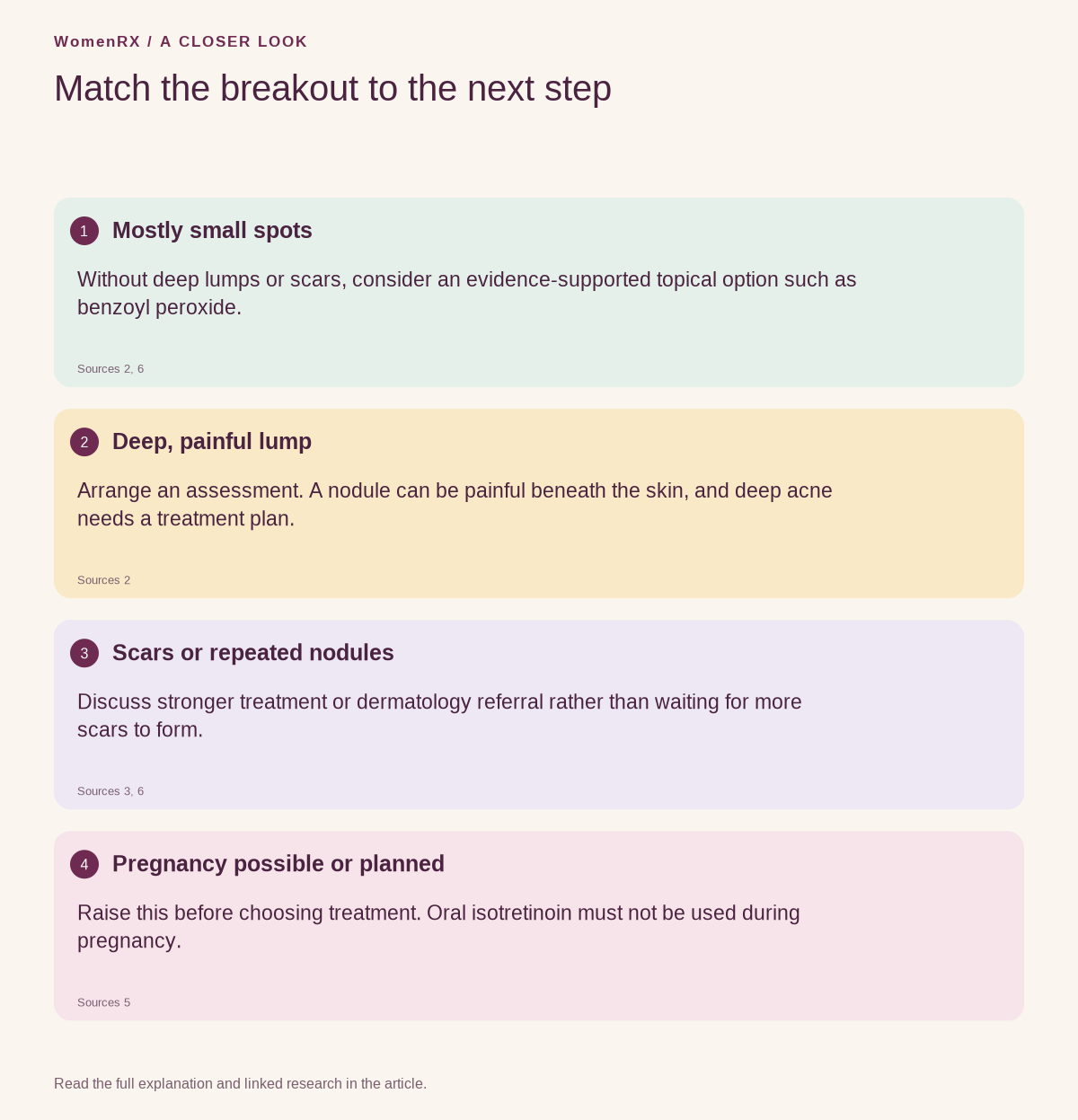
Match the breakout to the next step
Mostly small spots: Without deep lumps or scars, consider an evidence-supported topical option such as benzoyl peroxide.26
Deep, painful lump: Arrange an assessment. A nodule can be painful beneath the skin, and deep acne needs a treatment plan.2
Scars or repeated nodules: Discuss stronger treatment or dermatology referral rather than waiting for more scars to form.36
Pregnancy possible or planned: Raise this before choosing treatment. Oral isotretinoin must not be used during pregnancy.5
Read the figure as text
A practical route based on lesion depth and scarring risk, not a self-diagnosis tool.- Mostly small spots: Without deep lumps or scars, consider an evidence-supported topical option such as benzoyl peroxide.26
- Deep, painful lump: Arrange an assessment. A nodule can be painful beneath the skin, and deep acne needs a treatment plan.2
- Scars or repeated nodules: Discuss stronger treatment or dermatology referral rather than waiting for more scars to form.36
- Pregnancy possible or planned: Raise this before choosing treatment. Oral isotretinoin must not be used during pregnancy.5
More questions, answered
Should I try to drain a deep acne lump?
No. Squeezing or picking acne can lead to permanent scarring. If a lump is deep or painful, an assessment is more useful than trying to empty it yourself. 2
Sources you can check
- Benzoyl peroxide: a medicine to treat acne - NHSAccessed 2026-09-25Return to first citation
- Acne - NHSAccessed 2026-09-25Return to first citation
- Acne - Treatment - NHSAccessed 2026-09-25Return to first citation
- Competencies and clinical guidelines for managing acne with isotretinoin in general practice: a scoping review.Quinlan D, Sahm L, O'Keeffe L, Santer M, Layton AM, Foley T. · The British journal of general practice : the journal of the Royal College of General Practitioners · 2025Return to first citation
- Compliance with Pregnancy Prevention Recommendations for Isotretinoin Following the Amendment of the European Union Pregnancy Prevention Program: A Repeat Study in Estonia.Ivask M, Kurvits K, Uusküla M, Juppo A, Laius O, Siven M. · Drugs - real world outcomes · 2024Return to first citation
- Guidelines of care for the management of acne vulgaris.Reynolds RV, Yeung H, Cheng CE, Cook-Bolden F, Desai SR, Druby KM, Freeman EE, Keri JE, Stein Gold LF, Tan JKL, Tollefson MM, Weiss JS, Wu PA, Zaenglein AL, Han JM, Barbieri JS. · Journal of the American Academy of Dermatology · 2024Return to first citation