Benzoyl Peroxide for Acne: Strength, Dryness, and Bleaching
Start with a lower strength you can tolerate, then pay attention to the whole product, not just the percentage on its label.
Start with the lowest benzoyl peroxide strength available and follow that product’s directions. A higher percentage isn’t automatically better: a review reports comparable acne results with 2.5% and 5%. Benzoyl peroxide can dry or irritate skin and bleach fabric and hair, so make room for moisturizer and keep it away from anything you don’t want discolored. Check before combining it with other acne treatments. 1 2 6

Choose a strength your skin can live with
Benzoyl peroxide reduces bacteria on the skin and helps with inflamed spots, whiteheads, and blackheads. If you’re choosing your first product, the lowest available strength is a sensible place to start so you can see how your skin tolerates it. 1 3
The percentage on the label isn’t a promise of better results. A review of benzoyl peroxide research reported comparable acne efficacy at 2.5% and 5%. That comparison doesn’t tell you which individual product will suit your skin, but it gives you a reason not to reach automatically for the stronger one. Using more product than directed won’t make it work faster and can increase side effects. 1 6
A wash and a leave-on product aren’t interchangeable
You’ll find benzoyl peroxide in washes as well as leave-on creams and gels. The format changes how the product fits into your routine, but a wash isn’t guaranteed to be gentler just because you rinse it off. The full formulation matters too. 3 4 5
For example, a randomized study assigned 133 adults with mild-to-moderate acne to a reformulated 4% wash, a reformulated 10% wash, or an older 10% wash. After about three weeks, researchers found no clinically significant difference in measured irritation among the washes. They studied tolerance, not which wash cleared acne better, and didn’t compare washes with leave-on products. 4
Choose a format whose directions work for you, then use it as labeled. If you pick a leave-on treatment, acne guidance describes applying it after washing to the acne-affected areas, rather than piling extra product onto individual spots. 3
Keep the routine gentle if skin feels dry
Dryness and tightness are common side effects of benzoyl peroxide. Peeling can occur if you use more than directed. If dryness develops, a fragrance-free, water-based moisturizer is one option recommended in acne guidance. Washing more often isn’t a fix: washing acne-affected skin more than twice a day can add irritation. 1 2 3
Also look at the rest of your routine before adding benzoyl peroxide. Other acne treatments can dry or irritate skin too. If you’re already using one, check with a pharmacist or clinician about how the products fit together rather than assuming that more active ingredients will work better. 1
Keep benzoyl peroxide away from your eyes and mouth. It can also make skin more sensitive to sunlight, so use sun protection and avoid sunbeds or sunlamps. 1
Treat bleaching as a product-handling issue
Benzoyl peroxide can bleach hair, clothing, towels, and bedding. Take care not to get it on hair or fabrics while applying it. 1 3
Know when the plan needs a second look
Benzoyl peroxide usually starts to work within four weeks. If acne is getting worse or hasn’t improved after 12 weeks, ask about another approach rather than simply moving to a higher percentage. Nodules or cysts, which carry a greater risk of scarring, also deserve medical attention. 1 2
If you’re pregnant or become pregnant, review your whole acne regimen. Benzoyl peroxide can usually be used during pregnancy, but guidance recommends checking; other medicines in your routine may need separate consideration. That’s a reason to review the combination, not a sign that benzoyl peroxide treats women’s acne differently. 1 3
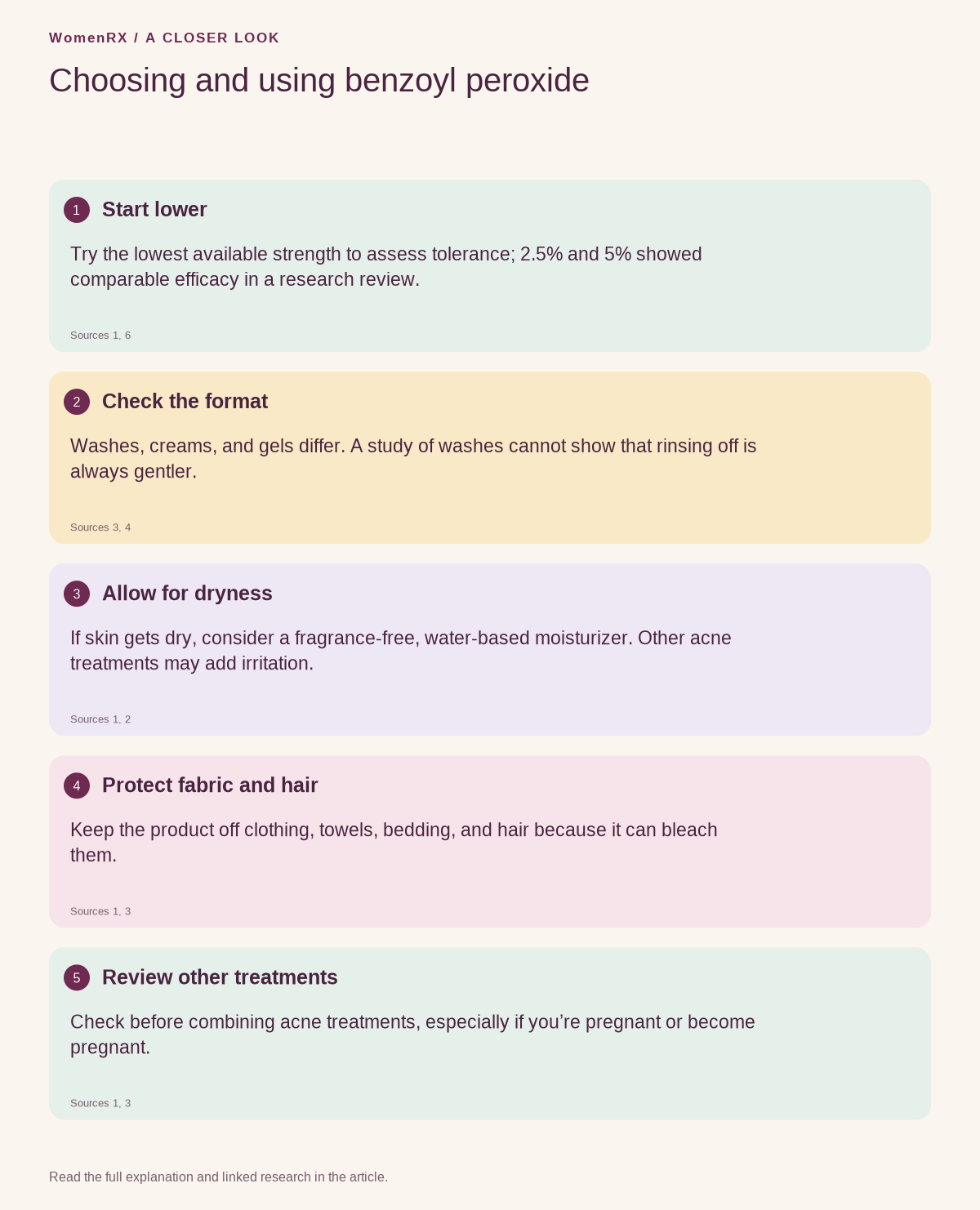
Choosing and using benzoyl peroxide
Start lower: Try the lowest available strength to assess tolerance; 2.5% and 5% showed comparable efficacy in a research review.16
Check the format: Washes, creams, and gels differ. A study of washes cannot show that rinsing off is always gentler.34
Allow for dryness: If skin gets dry, consider a fragrance-free, water-based moisturizer. Other acne treatments may add irritation.12
Protect fabric and hair: Keep the product off clothing, towels, bedding, and hair because it can bleach them.13
Review other treatments: Check before combining acne treatments, especially if you’re pregnant or become pregnant.13
Read the figure as text
Five decisions that affect how manageable the treatment feels in everyday use.- Start lower: Try the lowest available strength to assess tolerance; 2.5% and 5% showed comparable efficacy in a research review.16
- Check the format: Washes, creams, and gels differ. A study of washes cannot show that rinsing off is always gentler.34
- Allow for dryness: If skin gets dry, consider a fragrance-free, water-based moisturizer. Other acne treatments may add irritation.12
- Protect fabric and hair: Keep the product off clothing, towels, bedding, and hair because it can bleach them.13
- Review other treatments: Check before combining acne treatments, especially if you’re pregnant or become pregnant.13
Sources you can check
- Benzoyl peroxide: a medicine to treat acne - NHSAccessed 2026-09-25Return to first citation
- Acne - NHSAccessed 2026-09-25Return to first citation
- Acne - Treatment - NHSAccessed 2026-09-25Return to first citation
- A Randomized Controlled Tolerability Study to Evaluate Reformulated Benzoyl Peroxide Face Washes for Acne VulgarisSantos-Caetano JP, Cargill MR. · Journal of drugs in dermatology : JDD · 2019Return to first citation
- A New, Once-daily, Optimized, Fixed Combination of Clindamycin Phosphate 1.2% and Low-concentration Benzoyl Peroxide 2.5% Gel for the Treatment of Moderate-to-Severe Acne.Gold MH. · The Journal of clinical and aesthetic dermatology · 2009Return to first citation
- Old molecule, new scrutiny: Benzoyl peroxide in dermatology.Lim AXH, Raza S, Al-Niaimi F, Ali FR. · Clinical and experimental dermatology · 2026Return to first citation