What Can You Try for Acne Instead of Spironolactone?
Nonprescription acne treatments have stronger evidence than supplements, but the right choice depends on your breakouts and whether pregnancy is possible.
Benzoyl peroxide and over-the-counter adapalene are more established acne treatments than oral zinc. Azelaic acid is another topical treatment to discuss with a clinician, but a product bearing its name isn’t necessarily equivalent to a studied treatment. Zinc studies suggest a benefit for inflammatory pimples, not that an oral supplement can replace spironolactone. Painful nodules, scarring, or persistent acne deserve a discussion about other treatments.15671011
If you’d rather not take spironolactone, you have real options beyond supplements. The most useful distinction is between treatments applied to acne-prone skin and a pill marketed for clearer skin. Both may sound like alternatives, but the evidence behind them is different.
Start with the kind of acne you have
For a few blackheads, whiteheads, and pimples, a nonprescription topical treatment is a reasonable place to start. More widespread inflamed breakouts, painful nodules, or scarring change the calculation: those are reasons to discuss treatment beyond the drugstore aisle rather than keep adding products.578
Benzoyl peroxide is available without a prescription in the US and has an established role in treating acne. It reduces acne-associated bacteria and can help with inflamed spots as well as blocked pores. It comes in leave-on products and washes. Dryness, peeling, and stinging are common drawbacks, and it can bleach fabric and hair. Using more won’t make it work faster; if your skin becomes irritated, a pharmacist can help you choose a product or adjust how you use it.517
Adapalene is a topical retinoid available over the counter in the US. Retinoids help prevent dead skin cells from building up in follicles, making adapalene particularly relevant when clogged pores are part of the picture. Irritation can make retinoids hard to stick with. Adapalene isn’t a pregnancy option: clinical guidance advises against topical retinoids during pregnancy.57
Azelaic acid is a treatment to discuss with a clinician if benzoyl peroxide or a retinoid feels too irritating. It treats acne through effects on dead skin cells and bacteria, but can itself cause stinging, itching, or dryness. Evidence for azelaic acid as an acne treatment doesn’t establish that every cream sold without a prescription bearing its name contains an effective formula or will work as well as a prescribed treatment. For example, one US product label says “Azelaic Acid 10%” and claims to treat acne, yet its listed ingredients do not identify azelaic acid; another product bearing the name also omits it from its ingredient list. A label claim isn’t a clinical test of that product. Check the specific product’s ingredient information rather than treating its name as proof.7642
These topicals aren’t guaranteed replacements for a prescription. They act on acne-prone skin, but the cited evidence does not test them as replacements for spironolactone. If you already take spironolactone, talk through a change in treatment rather than stopping it on the assumption that a supplement or cream will do the same job.7910
Where oral zinc fits, and where it doesn’t
Zinc has some human acne evidence, not none. A systematic review and meta-analysis found that people treated with zinc had fewer inflammatory papules on average than those who weren’t treated with zinc. But the research included both oral and topical zinc, so it doesn’t show how much an oral supplement helps on its own or whether it can replace spironolactone for acne. An earlier systematic review rated the evidence for both oral and topical zinc as inconsistent or limited-quality.1011
That makes zinc a less certain choice if your goal is to replace a prescribed acne treatment. It also matters what you hope it will treat: the clearest reported outcome in the meta-analysis was inflammatory papules, not a demonstrated solution for every type of acne. The finding that people with acne had lower zinc levels than controls doesn’t, by itself, tell you that your zinc level is low or that taking zinc will clear your skin.103
A supplement also has a safety tradeoff that a face wash doesn’t. Too much zinc can adversely affect copper status; the NIH lists an adult upper intake level of 40 mg per day from food and supplements for healthy people, not a suggested acne dose. Zinc can also interfere with absorption of tetracycline antibiotics, a drug class used for acne. If you’re taking an acne antibiotic or a supplement that already contains zinc, check the combination before adding another zinc product.37
If you’re pregnant or breastfeeding
“Nonprescription” doesn’t settle the safety question. Benzoyl peroxide can usually be used during pregnancy according to NHS medicine guidance, though it recommends checking first. During breastfeeding, that guidance advises checking before use and, if it’s appropriate, keeping it off the breasts. Topical retinoids such as adapalene are not suitable during pregnancy. If you’re considering azelaic acid, discuss the specific treatment rather than assuming a cream bearing its name has the same ingredients or evidence as a prescribed medicine. One US azelaic-acid-labeled product instructs people who are pregnant or nursing to ask a doctor before using it; that is a product-specific warning.1764
Zinc is a nutrient, but that doesn’t establish that taking extra zinc for acne is a safer swap during pregnancy or breastfeeding. A product’s amount and your total intake still matter. If pregnancy or breastfeeding is shaping your decision, say so when you discuss acne treatment. Spironolactone itself is not usually recommended during pregnancy, while breastfeeding decisions call for individual advice.39
Know when the choice is bigger than a product
If nonprescription treatment hasn’t helped, or you have painful nodules, scarring, or acne that’s making you feel low or anxious, ask about other treatments. The point isn’t that you’ve failed at skin care; different acne severity calls for different care. If acne starts suddenly in adulthood alongside irregular periods or increased body hair, mention those changes too. They can affect which underlying causes and treatment options are worth discussing.78
How the acne options compare
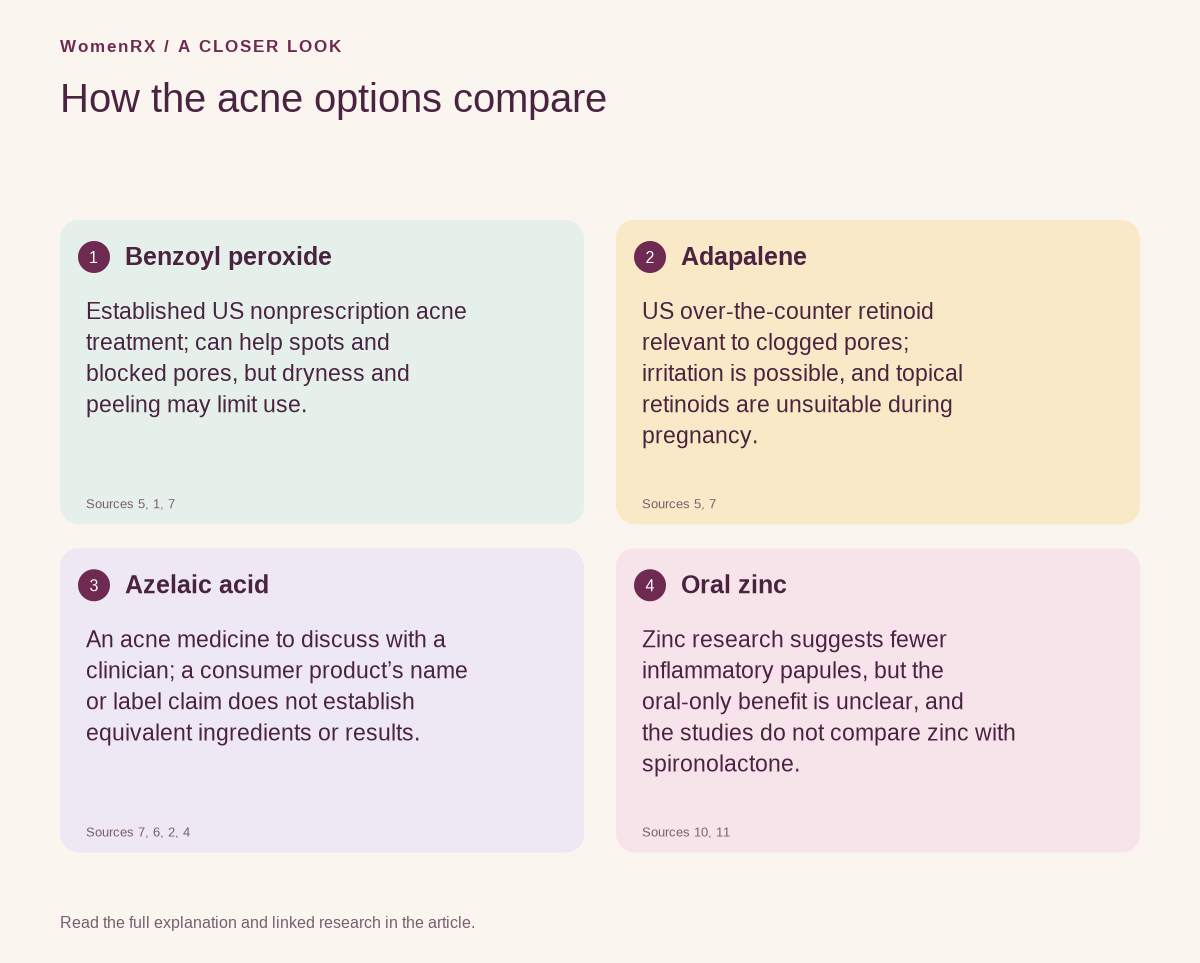
Benzoyl peroxide: Established US nonprescription acne treatment; can help spots and blocked pores, but dryness and peeling may limit use.517
Adapalene: US over-the-counter retinoid relevant to clogged pores; irritation is possible, and topical retinoids are unsuitable during pregnancy.57
Azelaic acid: An acne medicine to discuss with a clinician; a consumer product’s name or label claim does not establish equivalent ingredients or results.7624
Oral zinc: Zinc research suggests fewer inflammatory papules, but the oral-only benefit is unclear, and the studies do not compare zinc with spironolactone.1011
Read the figure as text
These options do not have the same evidence, availability, or role in acne treatment.- Benzoyl peroxide: Established US nonprescription acne treatment; can help spots and blocked pores, but dryness and peeling may limit use.517
- Adapalene: US over-the-counter retinoid relevant to clogged pores; irritation is possible, and topical retinoids are unsuitable during pregnancy.57
- Azelaic acid: An acne medicine to discuss with a clinician; a consumer product’s name or label claim does not establish equivalent ingredients or results.7624
- Oral zinc: Zinc research suggests fewer inflammatory papules, but the oral-only benefit is unclear, and the studies do not compare zinc with spironolactone.1011
Sources you can check
- Benzoyl peroxide: a medicine to treat acne - NHSAccessed 2026-09-25Return to first citation
- BLOOMELLEE 12%GEL AZELAIC ACID ACNE (12%AZELAIC ACID) CREAM [SHENZHEN LANXI TRADING CO., LTD.] | US prescribing information and patient instructionsAccessed 2026-09-25Return to first citation
- Zinc - Health Professional Fact SheetAccessed 2026-09-25Return to first citation
- 10% AZELAIC ACID (AZELAIC ACID CREAM) CREAM 14% AZELAIC ACID (AZELAIC ACID) CREAM [GUANGZHOU ARIEL MEDICAL TECHNOLOGY CO., LTD.] | US prescribing information and patient instructionsAccessed 2026-09-25Return to first citation
- Prescribing Trends for Acne Vulgaris Visits in the United States.Perche PO, Peck GM, Robinson L, Grada A, Fleischer AB, Feldman SR. · Antibiotics (Basel, Switzerland) · 2023Return to first citation
- Cosmeceuticals in acne vulgaris: from mechanism of action to clinical application.Searle TN, Al-Niaimi F, Ali FR. · Skin health and disease · 2026Return to first citation
- Acne - Treatment - NHSAccessed 2026-09-25Return to first citation
- Acne - Diagnosis - NHSAccessed 2026-09-25Return to first citation
- Spironolactone - NHSAccessed 2026-09-25Return to first citation
- Serum zinc levels and efficacy of zinc treatment in acne vulgaris: A systematic review and meta-analysis.Yee BE, Richards P, Sui JY, Marsch AF. · Dermatologic therapy · 2020Return to first citation
- The clinical effects of zinc as a topical or oral agent on the clinical response and pathophysiologic mechanisms of acne: a systematic review of the literature.Brandt S. · Journal of drugs in dermatology : JDD · 2013Return to first citation