Can Zinc Help Acne? What the Studies Actually Tested
Oral zinc has been compared with an acne antibiotic, while topical zinc has only limited study evidence, so neither should be treated as a proven fix.
Zinc might help some inflammatory acne, but one three-month trial found oral zinc less likely than minocycline to produce a large reduction in inflamed spots. A small topical study did not show a statistically significant benefit for zinc sulfate. These studies don’t establish a best dose, a benefit specific to women, or a reason to delay acne treatment. 3 5
What oral zinc did in a direct comparison
The strongest direct comparison in these studies was a randomized trial of 332 people with inflammatory acne. For three months, participants received zinc gluconate or minocycline. The trial counted “clinical success” as more than a two-thirds reduction in inflamed spots, such as papules and pustules, by day 90. That outcome occurred in 31.2% of the zinc group and 63.4% of the minocycline group. Zinc performed less well on this measure, though the result doesn’t tell us how it compares with every other acne treatment. 3
The trial used 30 mg of elemental zinc. That’s a description of the study regimen, not a recommended amount for you. The abstract reports gastrointestinal effects among the adverse effects and five withdrawals in the zinc group, but it doesn’t establish a generally appropriate dose or duration. If you’re considering a supplement, ask about the amount of elemental zinc on the label, how long you would take it, and whether it fits with your medications and other supplements. The studies summarized here don’t establish particular medicine interactions, so don’t assume the trial answers that question. 3
Topical zinc is not the same treatment
A small trial compared a 5% zinc sulfate solution with a tea lotion in people with papulopustular acne. Of 47 participants enrolled, 40 completed the two-month study; severe acne was excluded. Inflammatory spots improved in the zinc group, but the improvement did not reach statistical significance, and the tea lotion performed better. Since the study compared two products rather than zinc with standard care or no treatment, it can’t show how much improvement came from zinc itself. 5
These oral and topical studies shouldn’t be read as a head-to-head contest: they used different forms of zinc, different comparisons, and different study groups. Also, a zinc supplement listed among several ingredients in a study of adult women can’t show zinc’s individual effect. That study tested a combination of zinc, prebiotics, lactoferrin, and niacinamide alongside a topical cream. 4
A cycle-related flare doesn’t establish a zinc fix
Acne can flare with hormonal changes during the menstrual cycle or pregnancy. That pattern may help explain when spots appear, but it doesn’t show that zinc balances hormones or is especially effective for women. The oral trial did not report a women-only result, and the topical study doesn’t establish a different response by sex. 1 3 5
The zinc studies focused on inflammatory acne lesions. They don’t establish that zinc helps blackheads, lingering marks, or other skin concerns. If your main frustration is clogged pores or marks after spots heal, these results don’t answer whether zinc would help that specific concern. 3 5
When acne treatment matters more than a supplement
Acne can be controlled with treatment. Options used for acne include topical benzoyl peroxide and retinoids, and the right approach depends in part on severity. Improvement may take several weeks or months, so persistent acne doesn’t have to be managed by waiting to see whether a supplement works. 1 2
Consider seeking treatment advice if you have deep, painful lumps, acne on your chest or back, spots that are leaving scars, or acne that is making you feel very low or anxious. These are reasons to look beyond a supplement and consider acne care suited to the problem. 1 2
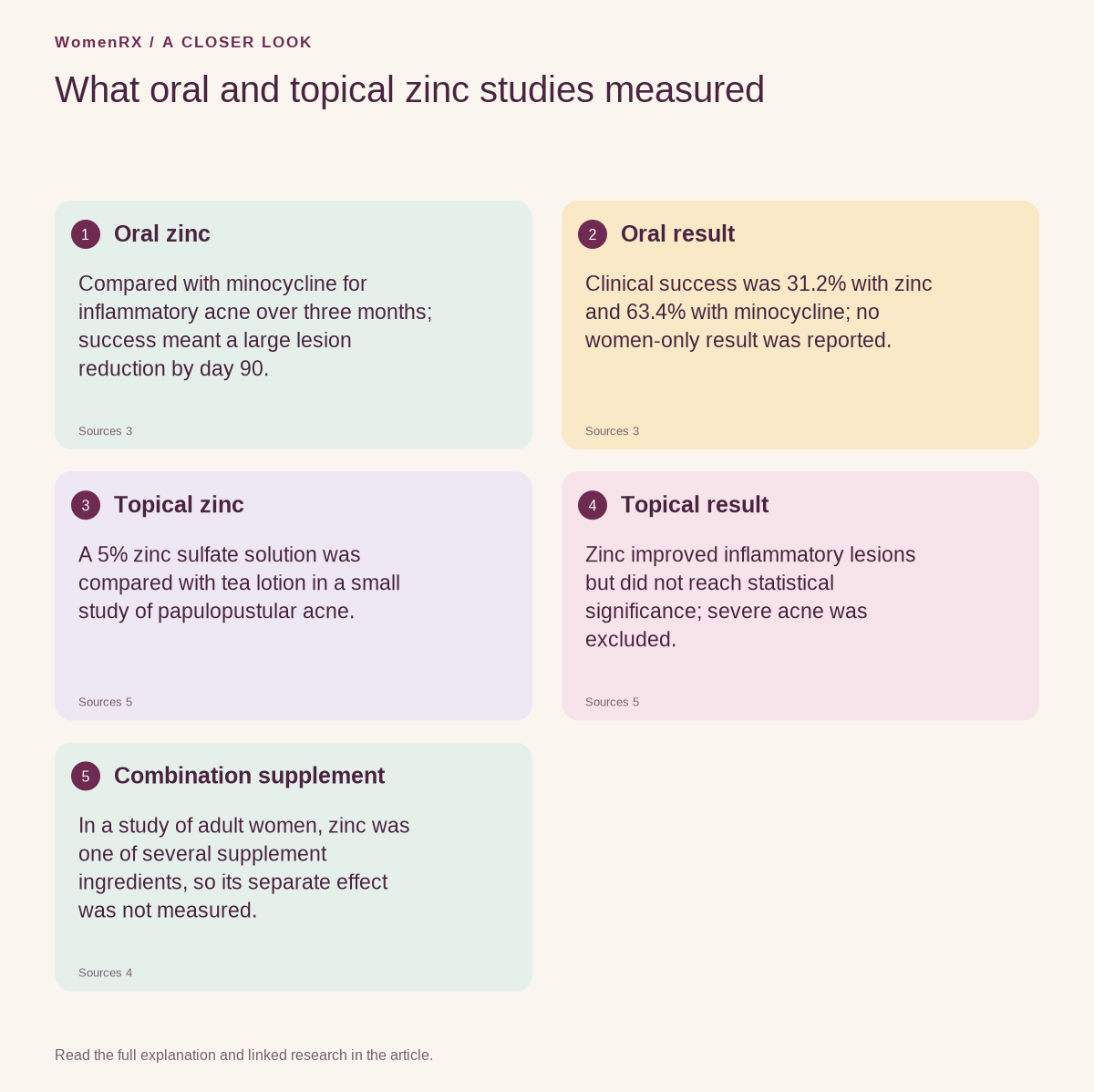
What oral and topical zinc studies measured
Oral zinc: Compared with minocycline for inflammatory acne over three months; success meant a large lesion reduction by day 90.3
Oral result: Clinical success was 31.2% with zinc and 63.4% with minocycline; no women-only result was reported.3
Topical zinc: A 5% zinc sulfate solution was compared with tea lotion in a small study of papulopustular acne.5
Topical result: Zinc improved inflammatory lesions but did not reach statistical significance; severe acne was excluded.5
Combination supplement: In a study of adult women, zinc was one of several supplement ingredients, so its separate effect was not measured.4
Read the figure as text
These studies tested different zinc forms against different comparators, so their results are not a direct comparison of oral versus topical treatment.- Oral zinc: Compared with minocycline for inflammatory acne over three months; success meant a large lesion reduction by day 90.3
- Oral result: Clinical success was 31.2% with zinc and 63.4% with minocycline; no women-only result was reported.3
- Topical zinc: A 5% zinc sulfate solution was compared with tea lotion in a small study of papulopustular acne.5
- Topical result: Zinc improved inflammatory lesions but did not reach statistical significance; severe acne was excluded.5
- Combination supplement: In a study of adult women, zinc was one of several supplement ingredients, so its separate effect was not measured.4
More questions, answered
Does zinc prevent period-related acne?
These studies don’t establish that zinc prevents cycle-related acne or changes hormones. Hormonal changes during the menstrual cycle can contribute to acne episodes, but that’s separate from showing that zinc treats them. 1 3
Can I compare oral and topical zinc study results?
Not directly. Oral zinc was compared with minocycline in one trial, while a topical zinc solution was compared with tea lotion in a small study. The participants, treatments, and comparisons differed. 3 5
Sources you can check
- Acne - NHSAccessed 2026-09-25Return to first citation
- Acne - Treatment - NHSAccessed 2026-09-25Return to first citation
- Multicenter randomized comparative double-blind controlled clinical trial of the safety and efficacy of zinc gluconate versus minocycline hydrochloride in the treatment of inflammatory acne vulgaris.Dreno B, Moyse D, Alirezai M, Amblard P, Auffret N, Beylot C, Bodokh I, Chivot M, Daniel F, Humbert P, Meynadier J, Poli F, Acne Research and Study Group. · Dermatology (Basel, Switzerland) · 2001Return to first citation
- Efficacy of a retinoid complex plus anti-inflammatory component cream alone or in combination with prebiotic food supplement in adult acne: A randomized, assessor-blinded, parallel-group, multicenter trial on 184 women.Kazandjieva J, Dimitrova J, Sankeva M, Yankov D, Bocheva V, Kircheva K, Gincheva V, Gospodinova K, Andasorova R, Milanova M, Jeleva D, Zlateva P, Vasileva I, Yankova R, Gotseva S, ... · Journal of cosmetic dermatology · 2022Return to first citation
- Topical therapy of acne vulgaris using 2% tea lotion in comparison with 5% zinc sulphate solution.Sharquie KE, Noaimi AA, Al-Salih MM. · Saudi medical journal · 2008Return to first citation