Does Zinc Help Acne, Hair Loss, or Brittle Nails?
Zinc has preliminary evidence for inflammatory acne; hair loss or brittle nails alone don’t show that zinc is the cause.
Zinc supplements have preliminary evidence for reducing inflammatory acne spots, but the findings don’t establish whether benefit depends on starting zinc levels. Zinc deficiency can be associated with hair loss in children, which doesn’t show that supplements treat common hair loss in adult women. Brittle nails alone don’t identify a zinc problem; a review of nutritional signs in eating disorders links brittle nails with calcium deficiency, not zinc treatment. 1 6 7 8
Three concerns, three different evidence stories
Zinc supports many normal body functions, but that doesn’t mean taking extra zinc will improve every concern involving skin, hair, or nails. The evidence differs by condition, and correcting a deficiency is a different question from adding a supplement when intake is already adequate.
Acne: a possible benefit, with unanswered questions
A meta-analysis found that people with acne had lower average serum zinc levels than people without acne. Across treatment studies, zinc was associated with improvement in inflammatory papule counts. A separate review found preliminary support for zinc in acne, while noting that larger studies with more consistent methods are needed. 6 7
That’s a reason to consider zinc as a possible part of the acne picture, not proof that it works equally well for everyone. The evidence summarized in these reviews doesn’t tell us whether people with low zinc benefit more than people with adequate zinc. It also doesn’t make zinc a replacement for established acne care. Acne involves blocked follicles, oil production, inflammation, and, for many women, hormonal changes around periods or pregnancy. 3 4
One distinction worth keeping clear: early research on topical zinc-oxide nanoparticles is about specially formulated products applied to skin. It doesn’t establish that an oral zinc supplement treats acne. 5
Hair loss: deficiency matters, but the cause matters too
Zinc deficiency can be associated with hair loss in children. That finding doesn’t show that zinc supplements treat hair loss in adult women, or that zinc is the cause whenever hair is thinning. 1
Hair loss has other possible explanations, including illness and inherited pattern hair loss. If you’re noticing ongoing or distressing loss, working out the cause is more useful than assuming a supplement will address it. 2
A deficiency is more plausible when there are relevant risk factors, such as a digestive condition or bariatric surgery that affects absorption, or a diet that may provide less absorbable zinc. Vegetarian and vegan diets can be lower in zinc bioavailability because phytates in legumes and whole grains reduce absorption. These are reasons to consider overall intake and health context, not proof of deficiency. 1
Brittle nails: not a zinc diagnosis
Brittle nails alone can’t tell you that your zinc is low. Skin, hair, and nail changes can occur in the setting of different nutritional deficiencies, and they don’t identify which nutrient, if any, is responsible. One review of nutritional signs in eating disorders, for example, lists brittle nails with calcium deficiency and describes other possible nutrient-related hair and nail changes. It doesn’t establish that zinc supplements strengthen brittle nails. 8
So if nails are your main concern, taking zinc just to see what happens may miss the reason for the change. Consider the bigger picture, including diet and health conditions that could affect nutrition.
When zinc status deserves a closer look
Most people in the United States get adequate zinc, but some situations raise the chance of inadequate intake or absorption. These include inflammatory bowel disease, some bariatric surgeries, vegetarian or vegan diets, and pregnancy or breastfeeding. Blood zinc measurements can help in clinical assessment, but they have limitations: results can vary with factors such as time of day, illness, and other changes in the body. 1
For adults, the recommended daily amount is 8 mg for women who aren’t pregnant or breastfeeding, 11 mg during pregnancy, and 12 mg while breastfeeding. These are total daily intake recommendations, not supplement doses. The adult upper limit is 40 mg a day from food and supplements combined. 1
More isn’t automatically better: taking 50 mg or more daily for weeks can interfere with copper absorption and cause other problems. Zinc can also interfere with the absorption of certain antibiotics and penicillamine, a medicine used for rheumatoid arthritis and Wilson disease. 1
Match zinc evidence to acne, hair or nails
If you’re considering zinc for acne, remember that the evidence suggests a possible improvement in inflammatory spots but doesn’t clearly identify who is most likely to benefit. For hair loss or brittle nails, don’t treat the symptom alone as proof of low zinc. If you have a risk factor for deficiency or are pregnant or breastfeeding, review your total intake and supplement ingredients with your care team before adding zinc. That’s especially useful because prenatal or multivitamin products may already contain it. 1 6 7
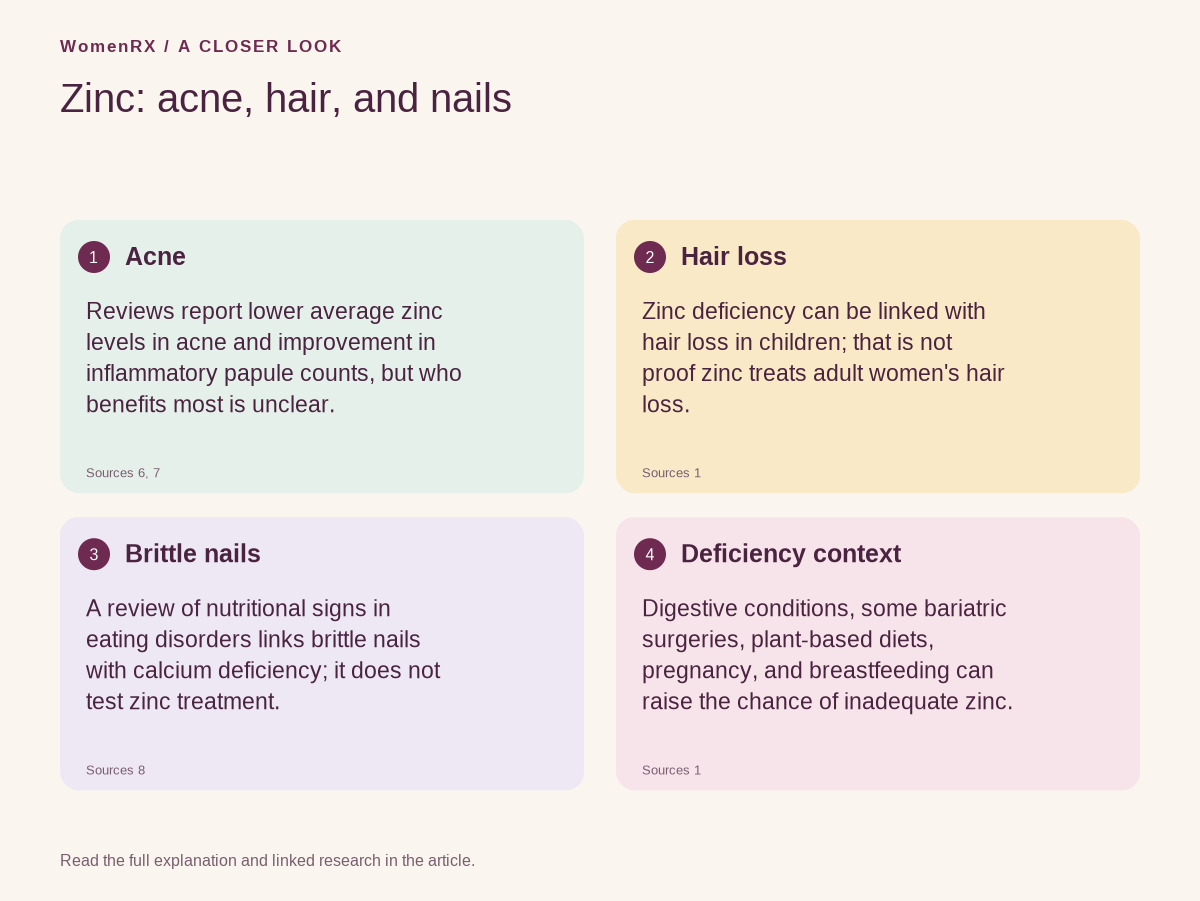
Zinc: acne, hair, and nails
Acne: Reviews report lower average zinc levels in acne and improvement in inflammatory papule counts, but who benefits most is unclear.67
Hair loss: Zinc deficiency can be linked with hair loss in children; that is not proof zinc treats adult women's hair loss.1
Brittle nails: A review of nutritional signs in eating disorders links brittle nails with calcium deficiency; it does not test zinc treatment.8
Deficiency context: Digestive conditions, some bariatric surgeries, plant-based diets, pregnancy, and breastfeeding can raise the chance of inadequate zinc.1
Read the figure as text
These concerns have different evidence. A possible acne benefit does not mean zinc treats hair loss or brittle nails.- Acne: Reviews report lower average zinc levels in acne and improvement in inflammatory papule counts, but who benefits most is unclear.67
- Hair loss: Zinc deficiency can be linked with hair loss in children; that is not proof zinc treats adult women's hair loss.1
- Brittle nails: A review of nutritional signs in eating disorders links brittle nails with calcium deficiency; it does not test zinc treatment.8
- Deficiency context: Digestive conditions, some bariatric surgeries, plant-based diets, pregnancy, and breastfeeding can raise the chance of inadequate zinc.1
More questions, answered
Does zinc oxide on the skin work like an oral zinc supplement?
No. Early studies of specially formulated zinc-oxide nanoparticles applied to acne-prone skin are a separate line of research; they don’t show that swallowing zinc treats acne. 5
Do zinc needs change during pregnancy or breastfeeding?
Yes. The recommended daily intake is 11 mg during pregnancy and 12 mg while breastfeeding, compared with 8 mg for other adult women. Routine supplementation during pregnancy does not appear to reduce low birthweight, stillbirth, or neonatal death, although it might lower preterm-birth risk. 1
Sources you can check
- Zinc - Health Professional Fact SheetAccessed 2026-09-25Return to first citation
- Hair loss - NHSAccessed 2026-09-25Return to first citation
- Acne - Causes - NHSAccessed 2026-09-25Return to first citation
- Acne - NHSAccessed 2026-09-25Return to first citation
- Topical Zinc Oxide Nanoparticle Formulations for Acne Vulgaris: A Systematic Review of Pre-Clinical and Early-Phase Clinical Evidence.Crainic D, Popescu R, Vlad CD, Serban DV, Popa D, Popa CA, Toma AO. · Biomedicines · 2025Return to first citation
- Serum zinc levels and efficacy of zinc treatment in acne vulgaris: A systematic review and meta-analysis.Yee BE, Richards P, Sui JY, Marsch AF. · Dermatologic therapy · 2020Return to first citation
- Effects of Zinc Supplementation on Inflammatory Skin Diseases: A Systematic Review of the Clinical Evidence.Dhaliwal S, Nguyen M, Vaughn AR, Notay M, Chambers CJ, Sivamani RK. · American journal of clinical dermatology · 2020Return to first citation
- The Nutrient-Skin Connection: Diagnosing Eating Disorders Through Dermatologic Signs.Rallis E, Lotsaris K, Grech VS, Tertipi N, Sfyri E, Kefala V. · Nutrients · 2024Return to first citation