Can Food Meet Your Vitamin E Needs?
For most healthy adults, vitamin E can come from food, and a few familiar portions make it easier to compare your eating pattern with the daily reference value.
For women 14 and older, the vitamin E RDA is 15 mg a day; it stays 15 mg during pregnancy and rises to 19 mg while breastfeeding. Sunflower seeds, almonds, some oils, peanut butter, and cooked spinach can all contribute. Use the numbers as a pattern check, not a deficiency test: food amounts vary, and a supplement can provide far more than the RDA. 12
Start with the right daily reference
For women and other adults age 14 and older, the recommended dietary allowance (RDA) for vitamin E is 15 mg of alpha-tocopherol a day. The RDA is set to meet the needs of nearly all healthy people. It is the same during pregnancy, while breastfeeding the RDA is 19 mg. 1
That number is a useful planning reference, not a score you need to hit exactly every day. A single meal or one day’s food list can’t tell you whether you have a deficiency. Think instead about the foods that regularly show up in your routine, and whether several good sources are represented.
Make a practical food-pattern check
Nuts and seeds are among the most concentrated familiar food sources in the reference table. One ounce of dry-roasted sunflower seeds provides 7.4 mg, and one ounce of dry-roasted almonds provides 6.8 mg. Two tablespoons of peanut butter provide 2.9 mg. Cooked spinach contributes 1.9 mg per half-cup; a tablespoon of sunflower oil provides 5.6 mg. 1
For example, sunflower seeds at one snack and peanut butter on toast at another would add up to 10.3 mg from those portions. That’s a substantial contribution, but it doesn’t reach the 15 mg RDA by itself. Adding foods such as cooked spinach or almonds at other meals can contribute more. These are illustrations, not a prescribed menu, and your actual intake depends on your portions and the rest of your diet.
You don’t have to rely on one “superfood” or add oil just to raise a number. Nuts, seeds, vegetable oils, and leafy greens contribute in different amounts, and fruits such as kiwifruit contribute smaller amounts. The useful question is whether sources like these fit naturally into your usual meals and snacks. 12
Food amounts and label values aren’t quite the same thing
The 15 mg Daily Value (DV) on U.S. nutrition labels is a reference for comparing products. It happens to match the RDA for adults and children age 4 and older in this case, but the RDA changes to 19 mg during breastfeeding. That means the same food portion makes a smaller share of the lactation RDA. Vitamin E isn’t required on a food label unless it has been added to the food, so a missing number on a label doesn’t necessarily mean the food contains none. 1
There’s also a difference between estimating what you eat and measuring vitamin E status in your body. The NIH Office of Dietary Supplements notes that surveys have sometimes estimated low intakes, but cooking fats may not have been fully counted. It also describes uncertainty about the biomarkers used to assess vitamin E requirements. A food calculation is useful for spotting possible gaps, but it isn’t a diagnosis. 1
Why a supplement isn’t just “food in a capsule”
Vitamin-E-only supplements typically provide at least 67 mg, substantially more than the 15 mg RDA for most adult women. Supplements usually provide alpha-tocopherol, while food oils and foods can contain other forms of vitamin E too. So evidence about eating foods that contain vitamin E doesn’t automatically show that taking a high-dose supplement will have the same effects. 1
That distinction matters for safety as well as benefit. High-dose alpha-tocopherol supplements can affect blood clotting, and the NIH fact sheet describes trials that found an increased risk of hemorrhagic stroke among some supplement users. MedlinePlus also warns that vitamin E supplements may be harmful with blood thinners and other medicines. Those concerns are about supplements, not ordinary vitamin E in food. 12
For most healthy people, food is a sensible place to start; MedlinePlus says most people get enough vitamin E from what they eat. If your usual pattern includes few nuts, seeds, oils, or leafy greens, you can first consider whether adding foods you enjoy is realistic. If you’re breastfeeding, have a condition such as Crohn’s disease, cystic fibrosis, or liver disease, or are considering a supplement while taking medicine, the right assessment may depend on your situation rather than this food comparison alone. 12
Vitamin E in familiar portions
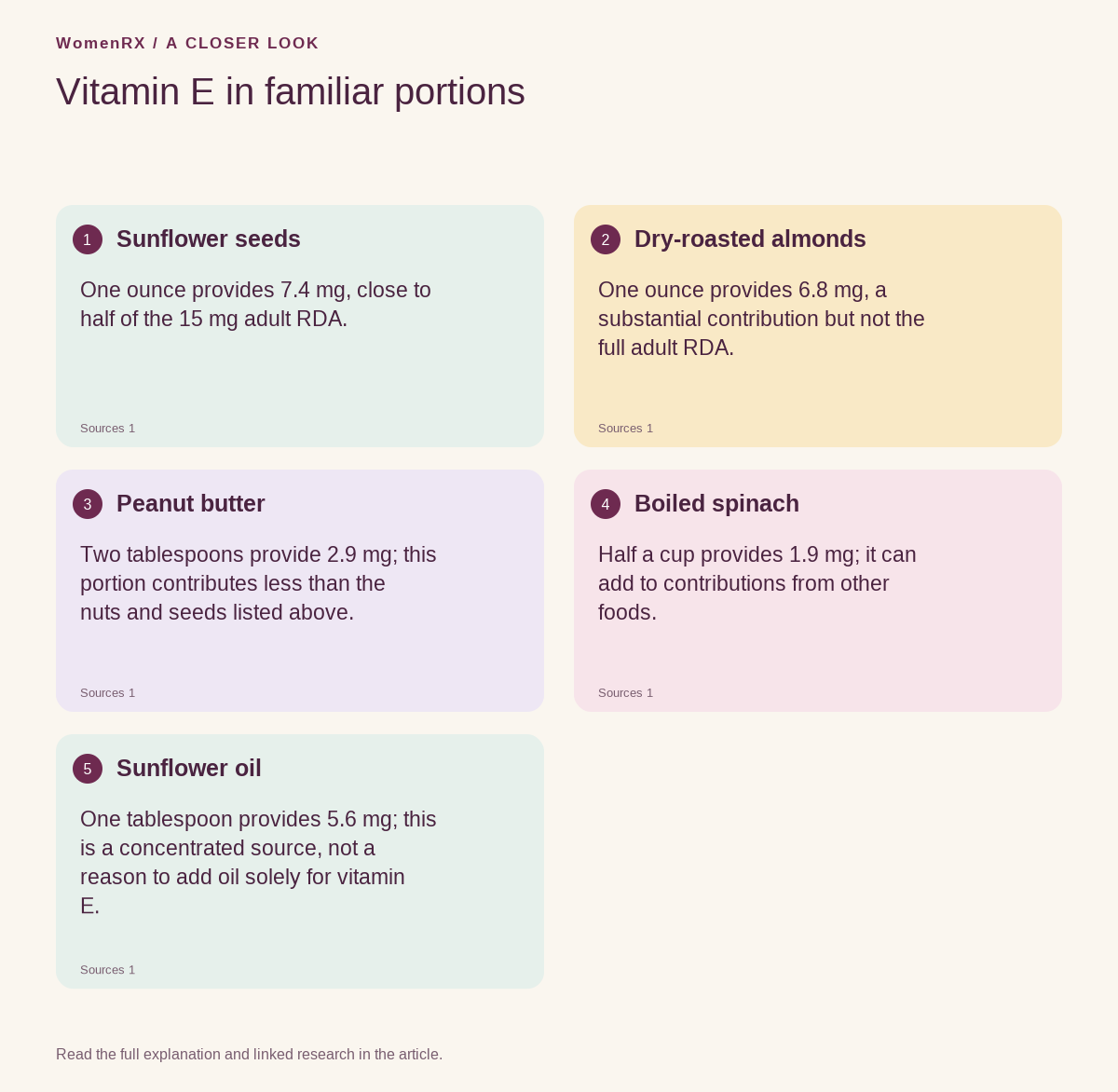
Sunflower seeds: One ounce provides 7.4 mg, close to half of the 15 mg adult RDA.1
Dry-roasted almonds: One ounce provides 6.8 mg, a substantial contribution but not the full adult RDA.1
Peanut butter: Two tablespoons provide 2.9 mg; this portion contributes less than the nuts and seeds listed above.1
Boiled spinach: Half a cup provides 1.9 mg; it can add to contributions from other foods.1
Sunflower oil: One tablespoon provides 5.6 mg; this is a concentrated source, not a reason to add oil solely for vitamin E.1
Read the figure as text
Compare selected food portions with the 15 mg adult RDA; breastfeeding has a higher 19 mg RDA, so each portion represents a smaller share of that target.- Sunflower seeds: One ounce provides 7.4 mg, close to half of the 15 mg adult RDA.1
- Dry-roasted almonds: One ounce provides 6.8 mg, a substantial contribution but not the full adult RDA.1
- Peanut butter: Two tablespoons provide 2.9 mg; this portion contributes less than the nuts and seeds listed above.1
- Boiled spinach: Half a cup provides 1.9 mg; it can add to contributions from other foods.1
- Sunflower oil: One tablespoon provides 5.6 mg; this is a concentrated source, not a reason to add oil solely for vitamin E.1
More questions, answered
Does a food list tell me whether I have vitamin E deficiency?
No. Comparing portions with the RDA can help you notice that your usual food pattern may be low, but it doesn’t diagnose deficiency or directly measure vitamin E status. 1
Should I take a supplement if I don’t reach 15 mg every day?
Not necessarily. The RDA is a planning reference, not a daily pass-or-fail test, and vitamin-E-only supplements often contain much more than the RDA. Consider your regular food pattern and any health conditions or medicines before deciding whether a supplement is appropriate. 12
Sources you can check
- Vitamin E - Health Professional Fact SheetAccessed 2026-09-25Return to first citation
- Vitamin E: MedlinePlusAccessed 2026-09-25Return to first citation