Does Vitamin E Need to Be Taken With Food?
A meal isn’t automatically required: the product’s own directions matter, and a small human study found that fasting did not reduce the amount of vitamin E absorbed.
If your vitamin E label doesn’t require food, you generally don’t need to add a meal just because vitamin E is fat-soluble. In a small study of healthy women, fasting did not lower the measured fraction of alpha-tocopherol absorbed, though it slowed its appearance in the blood. Follow your product’s directions, and ask about individual guidance if you have trouble absorbing fat. 21
Fat-soluble doesn’t mean “meal required”
Vitamin E is fat-soluble, and normal absorption involves the digestive tract and transport of the nutrient through the body. That’s why taking it with food may sound like a firm rule. But the term describes how the nutrient behaves; on its own, it doesn’t establish that every vitamin E capsule must be taken with a meal. 1
The most directly relevant human study was a small crossover trial in healthy women. Researchers measured absorption of labeled alpha-tocopherol under different conditions, including fasting and a liquid meal with or without fat. They found no lower measured fraction absorbed during fasting; the estimate was 56% while fasting, compared with 55% with the 40%-fat meal and 64% with the 0%-fat meal. Fasting did slow the nutrient’s appearance in the blood. 2
Those results argue against a blanket rule that vitamin E needs a fatty meal. They don’t show that every store-bought capsule behaves exactly the same way: the study tested labeled alpha-tocopherol, not a range of commercial products.
Let the label settle the everyday choice
Check the directions on your specific bottle. If they say to take it with food, follow them. If they don’t specify food, and you find the supplement easy to take without a meal, there’s no need to arrange a high-fat meal solely to take vitamin E. You could also pair it with a regular meal if that makes your routine easier to remember; the small study doesn’t establish that doing so improves absorption.
Vitamin E supplements can contain different forms, including alpha-tocopherol esters such as alpha-tocopheryl acetate or succinate. NIH guidance says the body absorbs these forms as efficiently as alpha-tocopherol. That supports not assuming that a familiar ingredient name means a special meal rule, but it does not replace the directions for your particular product. 1
When food timing may not be the main issue
If you have a condition that interferes with fat absorption, the question may be less about whether you ate a meal and more about whether a standard supplement form works for you. NIH guidance notes that people with fat-malabsorption disorders are more likely to become vitamin E deficient; some may require a water-soluble form. If you’re pregnant or breastfeeding and considering a vitamin E supplement, review the specific product and reason for taking it with a qualified clinician. 1
For most people choosing when to take an ordinary supplement, use the label as your first guide. A meal isn’t automatically necessary, and changing meal timing isn’t evidence of a health benefit.
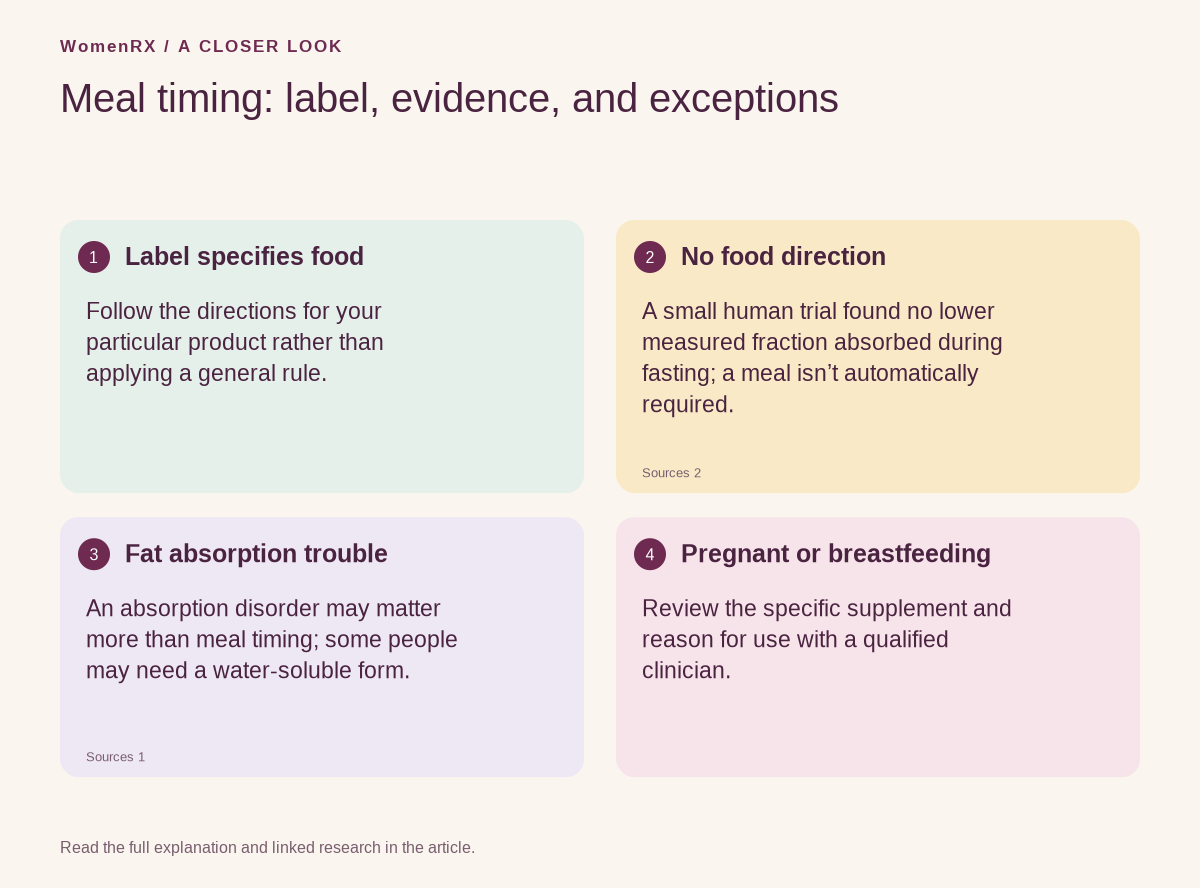
Meal timing: label, evidence, and exceptions
Label specifies food: Follow the directions for your particular product rather than applying a general rule.
No food direction: A small human trial found no lower measured fraction absorbed during fasting; a meal isn’t automatically required.2
Fat absorption trouble: An absorption disorder may matter more than meal timing; some people may need a water-soluble form.1
Pregnant or breastfeeding: Review the specific supplement and reason for use with a qualified clinician.
Read the figure as text
A quick comparison of what should guide the choice to take a vitamin E supplement with food.- Label specifies food: Follow the directions for your particular product rather than applying a general rule.
- No food direction: A small human trial found no lower measured fraction absorbed during fasting; a meal isn’t automatically required.2
- Fat absorption trouble: An absorption disorder may matter more than meal timing; some people may need a water-soluble form.1
- Pregnant or breastfeeding: Review the specific supplement and reason for use with a qualified clinician.
More questions, answered
Should I choose a high-fat meal for my vitamin E capsule?
Not based on the available human trial: the measured fraction absorbed was not higher with the 40%-fat liquid meal than with the no-fat meal. The study was small and tested labeled alpha-tocopherol, so follow your product’s directions rather than treating this result as a comparison of every capsule. 2
Sources you can check
- Vitamin E - Health Professional Fact SheetAccessed 2026-09-25Return to first citation
- Vitamin E absorption and kinetics in healthy women, as modulated by food and by fat, studied using 2 deuterium-labeled α-tocopherols in a 3-phase crossover design.Traber MG, Leonard SW, Ebenuwa I, Violet PC, Wang Y, Niyyati M, Padayatty S, Tu H, Courville A, Bernstein S, Choi J, Shamburek R, Smith S, Head B, Bobe G, Ramakrishnan R, Levine M. · The American journal of clinical nutrition · 2019Return to first citation