When to Start a Prenatal Vitamin and What to Check
Start thinking about folic acid before pregnancy, then compare prenatal labels by nutrient form and amount rather than the claims on the front.
If you’re planning a pregnancy, discuss starting a prenatal before conception: getting enough folic acid before and during pregnancy helps prevent major birth defects of the brain and spine. If you’re already pregnant, ask your prenatal-care team about starting one. On the label, check whether folate is supplied as folic acid, then compare the listed amounts of iron and iodine with your diet and any other supplements you take.361
Start with the nutrient that matters before pregnancy
A prenatal vitamin isn’t a fertility treatment. Its clearest reason for being on your shopping list before pregnancy is folic acid. Getting enough before and during pregnancy helps prevent major birth defects of a baby’s brain or spine. If pregnancy is already underway, it’s still worth asking your prenatal-care team about a prenatal vitamin; pregnancy raises the need for nutrients including folic acid and iron.31
Food matters too. Leafy greens and enriched grain products can contribute folate or folic acid, while a prenatal can help fill particular gaps. It doesn’t replace a varied diet or prenatal care.31
Compare the form first, then the amount
Turn to the Supplement Facts panel. For folate, read the smaller print that says which form the product contains. Folate may come from folic acid or another form, such as 5-methyltetrahydrofolate (5-MTHF), sometimes marketed as methylfolate. Folic acid is the form proven to reduce neural tube defect risk; 5-MTHF has not been tested in clinical trials for that outcome. Don’t assume two products offer the same demonstrated protection simply because both list “folate.”6
Next, note the amount and its unit. The recommended dietary allowance for folate during pregnancy is 600 micrograms of dietary folate equivalents (mcg DFE) per day. That’s a measure of total intake, not an instruction to find a pill labeled “600 mcg folic acid.” The form and the DFE figure answer different questions, so check both. If you’re comparing two labels and can’t tell how much folic acid either provides, bring the labels to your prenatal-care team or pharmacist rather than guessing from a front-of-package claim.6
Iron calls for a different reading of the label. Compare the elemental iron amount in the Supplement Facts panel, not the weight or name of an iron compound in the ingredients. Different forms contain different proportions of elemental iron, and the panel lists the amount the supplement supplies. Iron needs rise during pregnancy, but extra iron isn’t automatically better: high supplemental doses can cause gastrointestinal problems. If you’ve been told you’re low in iron, already take iron, or are comparing products with very different amounts, ask which total makes sense for you.71
Then look for iodine. Some prenatals contain none. The recommended dietary allowance increases from 150 micrograms a day before pregnancy to 220 micrograms a day during pregnancy. Those figures describe total daily intake, not the amount every prenatal must contain. Diet belongs in the comparison too, particularly if you don’t use iodized salt. Some pregnant women in the US may have inadequate iodine intake, though the effect of modestly insufficient intake on fetal development isn’t known.64
Let your circumstances break a label tie
Two prenatals with similar-looking front labels can leave different gaps. For example, one may list folate only as 5-MTHF; another may contain folic acid but no iodine. Neither comparison tells you everything about your needs, but it gives you a more useful question than “Which brand is best?” Check your usual food pattern and other supplements alongside the label. Some prenatals also omit choline or contain relatively little of it.6
If you eat a vegetarian diet, ask whether you’re getting enough vitamin B12 as well as reviewing your prenatal label; some people eating this way need a B12 supplement. If you take a medicine regularly, include it in the conversation rather than changing it yourself. Sulfasalazine, used for some inflammatory conditions, can interfere with folate metabolism. That’s a specific reason to discuss folic acid when planning pregnancy, not evidence that the medicine caused a birth defect in any individual pregnancy.251
The most useful label comparison is therefore three-part: folic acid form and amount, elemental iron amount, and whether iodine is present and how much. Your diet, other supplements, medicines and health history determine what to do with that information. A product with more of everything isn’t necessarily the better choice.6742
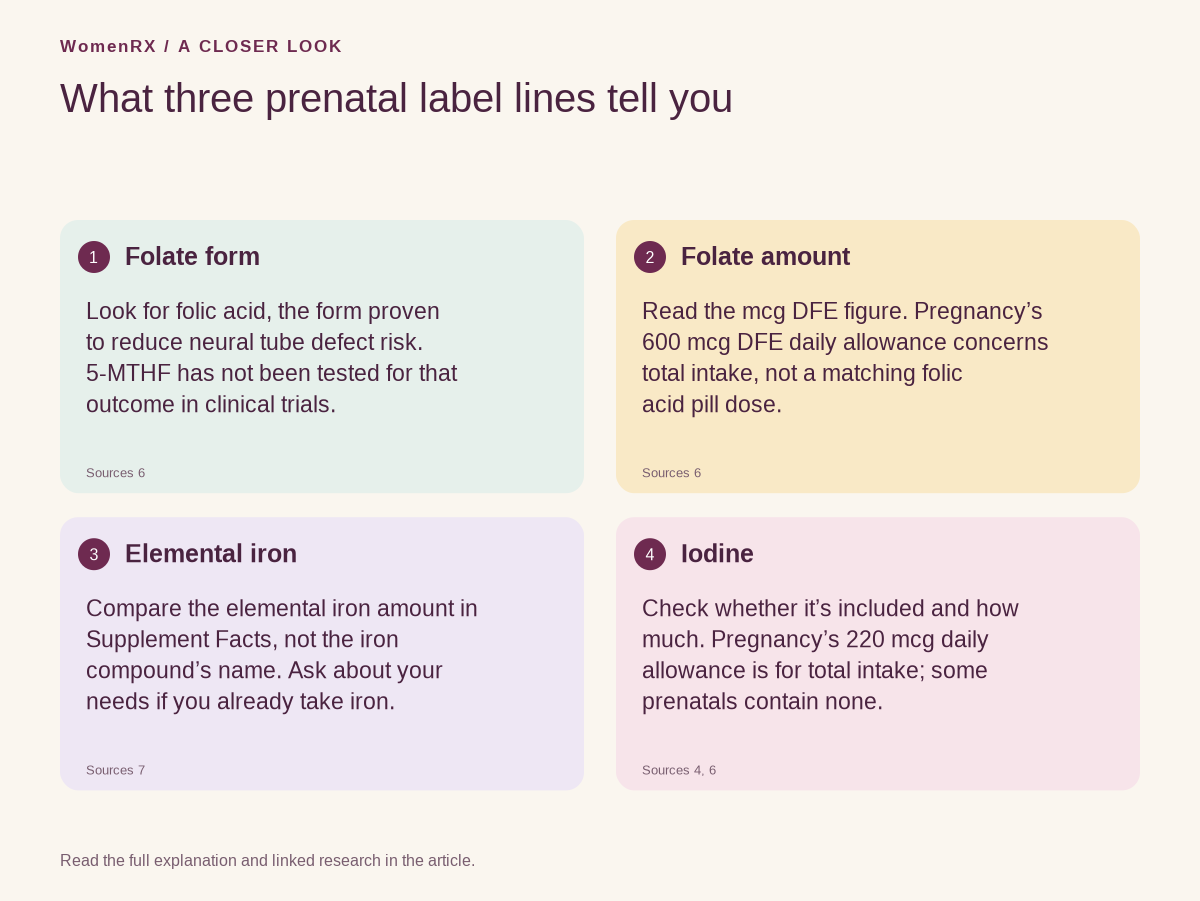
What three prenatal label lines tell you
Folate form: Look for folic acid, the form proven to reduce neural tube defect risk. 5-MTHF has not been tested for that outcome in clinical trials.6
Folate amount: Read the mcg DFE figure. Pregnancy’s 600 mcg DFE daily allowance concerns total intake, not a matching folic acid pill dose.6
Elemental iron: Compare the elemental iron amount in Supplement Facts, not the iron compound’s name. Ask about your needs if you already take iron.7
Iodine: Check whether it’s included and how much. Pregnancy’s 220 mcg daily allowance is for total intake; some prenatals contain none.46
Read the figure as text
Compare what the supplement supplies with the question you still need to answer about your total intake.- Folate form: Look for folic acid, the form proven to reduce neural tube defect risk. 5-MTHF has not been tested for that outcome in clinical trials.6
- Folate amount: Read the mcg DFE figure. Pregnancy’s 600 mcg DFE daily allowance concerns total intake, not a matching folic acid pill dose.6
- Elemental iron: Compare the elemental iron amount in Supplement Facts, not the iron compound’s name. Ask about your needs if you already take iron.7
- Iodine: Check whether it’s included and how much. Pregnancy’s 220 mcg daily allowance is for total intake; some prenatals contain none.46
Sources you can check
- Pregnancy | Pregnant | Prenatal Care | MedlinePlusAccessed 2026-09-25Return to first citation
- Vitamins: MedlinePlusAccessed 2026-09-25Return to first citation
- Folic Acid: MedlinePlusAccessed 2026-09-25Return to first citation
- Iodine - Health Professional Fact SheetAccessed 2026-09-25Return to first citation
- A Case of Neural Tube Defect in Early Pregnancy Following Sulfasalazine Exposure Without Folic Acid Supplementation.Holden F, Hughes R. · Case reports in rheumatology · 2026Return to first citation
- Dietary Supplements and Life Stages: Pregnancy - Health Professional Fact SheetAccessed 2026-09-25Return to first citation
- Iron - Health Professional Fact SheetAccessed 2026-09-25Return to first citation