Fertility Supplements: What to Check Before You Buy
Folic acid has a clear purpose before pregnancy, while a supplement sold to improve fertility needs evidence that matches your situation and the outcome you care about.
Start by separating preconception care from fertility treatment. Getting enough folic acid before and during pregnancy helps prevent major birth defects of the brain and spine; that isn't the same as proving a product helps you conceive. 5 For any fertility claim, check who was studied, whether pregnancies or live births improved, and whether the findings apply to you. 36
Two promises that sound alike but aren't
A prenatal vitamin may be a sensible part of preparing for pregnancy without being a treatment for difficulty conceiving. Folic acid is the clearest example: getting enough before and during pregnancy helps prevent major birth defects of a baby's brain or spine. That benefit concerns a pregnancy that occurs. It doesn't establish that folic acid, or a more expensive blend containing it, increases your chance of becoming pregnant. 5
So when a package says “fertility support,” translate that phrase into a question: What, exactly, did this ingredient help people do? A study showing a change in a blood marker, egg maturation or an antioxidant measure answers a different question from a study showing more pregnancies or live births.
Read the result, not just the promising headline
Consider research on astaxanthin, an antioxidant studied in women receiving assisted reproductive treatment. A 2024 systematic review found an improvement in egg maturation rate and in an antioxidant measure in follicular fluid. It did not find statistically significant changes in the other assisted-reproduction and pregnancy outcomes it examined. The authors also identified small studies, differences among studies and risk of bias as limitations. Better egg maturation is worth investigating, but it isn't proof that buying astaxanthin will help someone take home a baby. 3
The kind of study matters too. In a secondary analysis following 2,370 couples seeking fertility care, women who reported taking a multivitamin at the start were more likely to have a live birth overall than women who did not. This was an association: the researchers analyzed supplement use reported at baseline rather than randomly assigning women to take a multivitamin. The association by treatment group was observed among couples who underwent no fertility treatment, not across all treatment groups. It can't tell you that starting a multivitamin will cause a live birth, or that a particular “fertility” formula is effective. 6
Population is another filter. A review that investigates coenzyme Q10 among women with diminished ovarian reserve, for example, is asking about a defined clinical group, not everyone trying to conceive. Its discussion of possible mechanisms and earlier studies shouldn't be read as a result for a product on a shelf. 4 If you're considering myo-inositol or another named ingredient, look for human studies of that ingredient in people with your condition, at a comparable amount, reporting an outcome that matters to you. Don't let a claim about one ingredient stand in for evidence on every ingredient in a blend.
Put the bottle beside your actual plan
Before buying, read the Supplement Facts panel for the ingredients and their amounts, then compare those details with the research behind the claim. 2 Ask whether the study used the same ingredient or combination, whether participants were trying without treatment or undergoing a specific fertility procedure, and whether the measured result was a laboratory marker, pregnancy or live birth. If you already take a prenatal vitamin, also check for overlapping ingredients rather than assuming that adding another blend fills a gap.
Product quality is a separate question from effectiveness. In a US case series of weight-loss, not fertility, supplements sold on or near military bases, investigators found that many labels did not match their analyses. Those findings cannot tell us the error rate for fertility products, but they show why a printed ingredient list alone is not proof of what's in a bottle. 2 Look for clear product-specific information about independent testing of identity and contents. Even a well-verified product still needs evidence that its ingredients help with the outcome it promises.
There is also a cost in time and attention. Infertility can have causes involving either partner, and care depends on the cause, age and how long you've been trying. Evaluation may include tests for both partners. 1 If you've been trying for a year without pregnancy, or for six months at age 35 or older, it's reasonable to seek a fertility evaluation rather than give a supplement several more months to work. Seek advice sooner if you're over 40, have irregular periods, a history of pelvic inflammatory disease or previous fertility concerns. 1 If you're already in treatment, bring the exact product label to your fertility team before adding it; ask them or a pharmacist to review the amount you'd take and your medicines for possible interactions. Make the same check if you're preparing for pregnancy. A fertility claim and a Supplement Facts panel can't establish whether a particular product is safe for you during treatment or pregnancy.
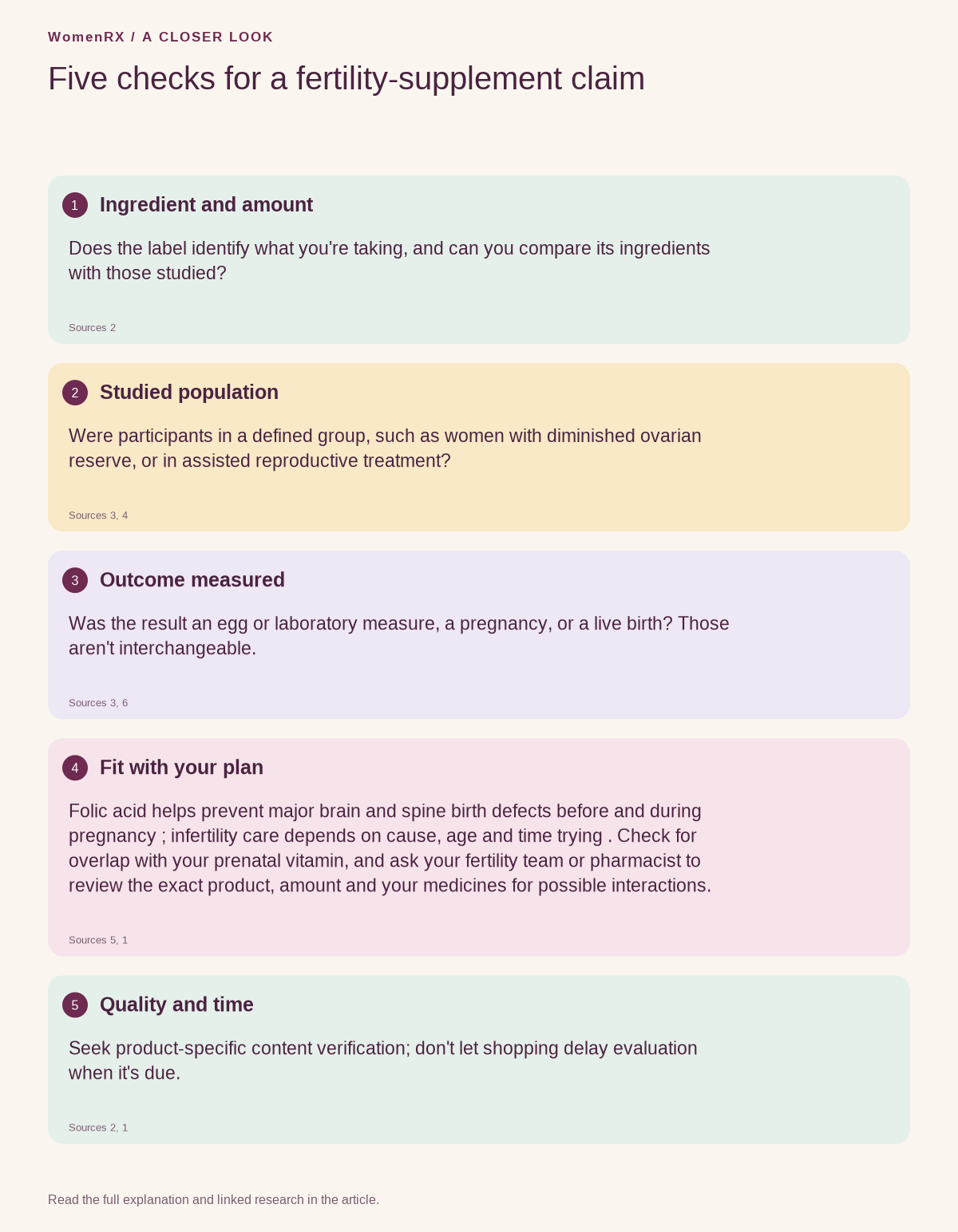
Five checks for a fertility-supplement claim
Ingredient and amount: Does the label identify what you're taking, and can you compare its ingredients with those studied?2
Studied population: Were participants in a defined group, such as women with diminished ovarian reserve, or in assisted reproductive treatment?34
Outcome measured: Was the result an egg or laboratory measure, a pregnancy, or a live birth? Those aren't interchangeable.36
Fit with your plan: Folic acid helps prevent major brain and spine birth defects before and during pregnancy ; infertility care depends on cause, age and time trying . Check for overlap with your prenatal vitamin, and ask your fertility team or pharmacist to review the exact product, amount and your medicines for possible interactions.51
Quality and time: Seek product-specific content verification; don't let shopping delay evaluation when it's due.21
Read the figure as text
Use these questions to compare a product with the research behind its promise; this is not a diagnostic score.- Ingredient and amount: Does the label identify what you're taking, and can you compare its ingredients with those studied?2
- Studied population: Were participants in a defined group, such as women with diminished ovarian reserve, or in assisted reproductive treatment?34
- Outcome measured: Was the result an egg or laboratory measure, a pregnancy, or a live birth? Those aren't interchangeable.36
- Fit with your plan: Folic acid helps prevent major brain and spine birth defects before and during pregnancy ; infertility care depends on cause, age and time trying . Check for overlap with your prenatal vitamin, and ask your fertility team or pharmacist to review the exact product, amount and your medicines for possible interactions.51
- Quality and time: Seek product-specific content verification; don't let shopping delay evaluation when it's due.21
More questions, answered
Does an improvement in egg quality mean a supplement improves pregnancy chances?
Not necessarily. In the astaxanthin review, egg maturation improved, but the other assisted-reproduction and pregnancy outcomes examined did not show statistically significant changes. A result in an intermediate measure isn't interchangeable with a live birth. 3
Should I wait to try supplements before getting a fertility evaluation?
A supplement trial shouldn't postpone an evaluation when you've been trying for a year, or six months if you're 35 or older. Irregular periods, prior pelvic inflammatory disease, previous fertility concerns or being over 40 are reasons to seek advice sooner. 1
Sources you can check
- Infertility | Infertility Treatments | MedlinePlusAccessed 2026-09-25Return to first citation
- Label Accuracy and Quality of Select Weight-Loss Dietary Supplements Sold on or near US Military Bases.Crawford C, Lindsey AT, Avula B, Katragunta K, Khan IA, Deuster PA. · Nutrients · 2024Return to first citation
- Effect of astaxanthin supplementation on female fertility and reproductive outcomes: a systematic review and meta-analysis of clinical and animal studies.Maleki-Hajiagha A, Shafie A, Maajani K, Amidi F. · Journal of ovarian research · 2024Return to first citation
- The auxiliary effect of oral nutritional supplements on fertility in women with diminished ovarian reserve: a systematic review and meta-analysis.Li X, Zhao Q, Lin G, Xu L. · Annals of medicine · 2025Return to first citation
- Folic Acid: MedlinePlusAccessed 2026-09-25Return to first citation
- Supplement use among couples seeking fertility treatment and associations with live birth and pregnancy loss.Sealy NRZ, Mumford SL, Caniglia EC, DiTosto JD, Johnstone EB, Hotaling J, Van Voorhis BJ, Ryan G, Mendola P, Schisterman EF, Hinkle SN. · Fertility and sterility · 2026Return to first citation