PCOS and Weight: What’s Connected, and What Isn’t
PCOS occurs at different body sizes, and weight alone can’t tell you which symptoms or metabolic concerns need care.
PCOS does not mean you will gain weight. Insulin resistance may play a role in PCOS, but a change on the scale cannot identify its cause. Treatment options address periods, acne, excess hair, and insulin-related concerns. If weight change is suggested as part of your care, you can ask how your symptoms would be addressed if your weight stays the same. 1 2 3
PCOS isn’t one body type
PCOS can involve irregular or absent ovulation, higher androgen levels, and ovarian follicles that stop developing. Not everyone has all these features, and some people have few noticeable symptoms. The international guideline describes PCOS as having varied reproductive, metabolic, and psychological features. That variation matters: body size alone doesn’t tell you which PCOS features someone has or what care they need. A study of young people with PCOS included participants at both normal weight and overweight. 1 3 5
How insulin, weight, and symptoms fit together
Insulin resistance is one factor that may play a role in PCOS. It means the body doesn’t use insulin as effectively as it should. MedlinePlus notes that insulin resistance can contribute to high blood glucose; it also describes insulin-sensitizing medicines as one treatment approach that may help with PCOS symptoms and androgen levels. This is a possible connection, not a pathway that applies in the same way to everyone. 1
Weight is another part of the picture, but it isn’t a measure of insulin resistance or ovarian function. It includes muscle, bone, fat, and water. Where body fat is carried can matter to metabolic health, too: MedlinePlus notes that having more fat around the abdomen is associated with higher risk of type 2 diabetes. Neither a weight reading nor that general risk relationship tells you what is happening with your PCOS symptoms or blood glucose. 1 2
So does PCOS itself cause weight gain? The relationship is not settled in a way that can explain an individual weight change. For example, a cross-sectional study of 16- to 23-year-olds included 30 normal-weight and 30 overweight participants with PCOS. It shows that PCOS can occur at different body weights, but it cannot tell whether PCOS changed anyone’s weight over time. 5
Weight and insulin-related measures can also shift together without showing which change drove the other. In a six-week randomized trial of 75 women with PCOS, two time-restricted eating groups had lower body weight, fasting insulin, and an insulin-resistance measure than a comparison group that ate without a set time window. The trial tested eating schedules, not whether PCOS causes weight gain or whether a change in weight caused the change in insulin measures. 4
It can be useful to look beyond the scale. Depending on your symptoms and health history, questions about menstrual patterns, androgen-related symptoms, glucose, or other metabolic concerns may be more useful than treating weight as a stand-in for all of them. 1 2
Make the care goal specific
PCOS care can address the concern that matters to you. MedlinePlus describes hormonal birth control as one option for making periods more regular and helping with acne or excess facial and body hair when pregnancy isn’t being pursued. It also lists medicines that block androgen effects, acne treatments, and insulin-sensitizing medicines. These options address different concerns; which belong in your plan depends on your circumstances and goals. 1
Lifestyle changes, including regular physical activity and healthy eating, are also among the approaches MedlinePlus lists for managing symptoms and related health concerns. The international guideline emphasizes individual preferences and values, partnership in care, and avoiding stigma. If weight change is part of a proposed plan, you can ask what specific health goal it is intended to support, and what options address your symptoms if your weight stays the same. 1 3
For example, you might ask whether the plan is aimed at irregular periods, acne or excess hair, an insulin-related measure, or another concern. That keeps the conversation focused on a clear goal rather than treating weight as a measure of every PCOS feature.
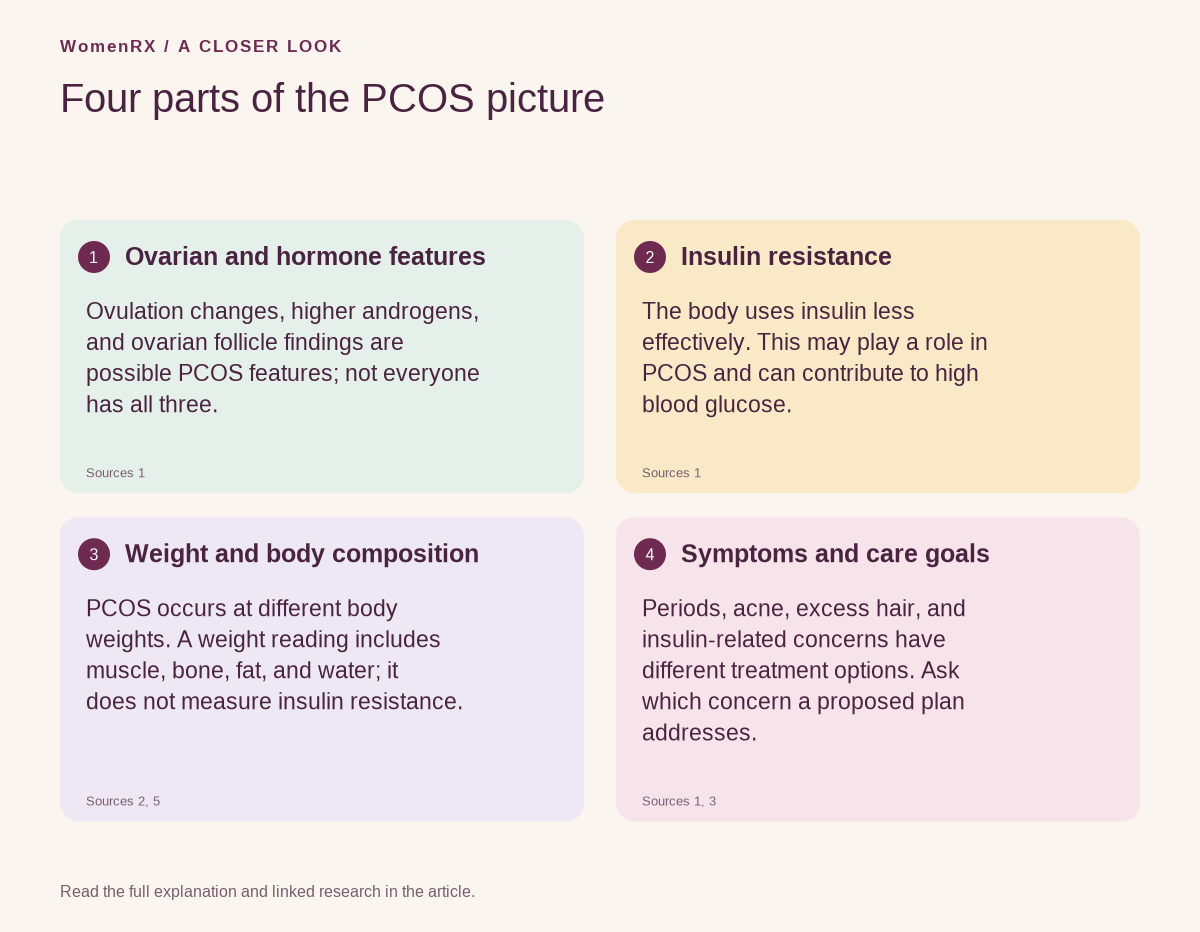
Four parts of the PCOS picture
Ovarian and hormone features: Ovulation changes, higher androgens, and ovarian follicle findings are possible PCOS features; not everyone has all three.1
Insulin resistance: The body uses insulin less effectively. This may play a role in PCOS and can contribute to high blood glucose.1
Weight and body composition: PCOS occurs at different body weights. A weight reading includes muscle, bone, fat, and water; it does not measure insulin resistance.25
Symptoms and care goals: Periods, acne, excess hair, and insulin-related concerns have different treatment options. Ask which concern a proposed plan addresses.13
Read the figure as text
These are distinct considerations in PCOS care, not steps in a sequence that everyone follows.- Ovarian and hormone features: Ovulation changes, higher androgens, and ovarian follicle findings are possible PCOS features; not everyone has all three.1
- Insulin resistance: The body uses insulin less effectively. This may play a role in PCOS and can contribute to high blood glucose.1
- Weight and body composition: PCOS occurs at different body weights. A weight reading includes muscle, bone, fat, and water; it does not measure insulin resistance.25
- Symptoms and care goals: Periods, acne, excess hair, and insulin-related concerns have different treatment options. Ask which concern a proposed plan addresses.13
More questions, answered
Can you have PCOS at a lower body weight?
Yes. A study of 16- to 23-year-olds included people with PCOS at normal weight as well as at overweight. Body weight is not a required PCOS feature, and symptoms vary. 1 5
Sources you can check
- PCOS | Polycystic Ovary Syndrome | MedlinePlusAccessed 2026-09-25Return to first citation
- Body Weight: MedlinePlusAccessed 2026-09-25Return to first citation
- Recommendations from the 2023 International Evidence-based Guideline for the Assessment and Management of Polycystic Ovary Syndrome†.Teede HJ, Tay CT, Laven J, Dokras A, Moran LJ, Piltonen TT, Costello MF, Boivin J, Redman LM, Boyle JA, Norman RJ, Mousa A, Joham AE, International PCOS Network. · Human reproduction (Oxford, England) · 2023Return to first citation
- Effect of two types of time-restricted eating on glycemic, lipid indices, and weight in women with polycystic ovary syndrome: a randomized controlled trial.Aminian M, Hajshafiha M, Heidari M, Daneghian S. · European journal of nutrition · 2026Return to first citation
- Evaluation of Serum Betatrophin Levels in Normal-Weight and Overweight Adolescents with Polycystic Ovary Syndrome.Eşkin Tanrıverdi MD, Tokmak A. · Journal of pediatric and adolescent gynecology · 2026Return to first citation