PCOS, Body Weight, and Metabolic Health: What Connects Them?
Higher body weight is common in PCOS, but it isn’t a diagnostic feature or a measure of how hard you’re trying.
Higher body weight is common among people with PCOS, but PCOS also occurs at lower weights. Weight alone can neither confirm nor rule out the condition. Insulin resistance may play a role in PCOS, and obesity may add to metabolic strain. 1 3 You can ask about reproductive symptoms and metabolic health, including the symptom-targeted treatments described by MedlinePlus. 1 2
Weight is part of the picture, not the diagnosis
PCOS is a hormonal condition associated with features such as irregular or absent ovulation, higher androgen levels, and polycystic ovarian appearance. Body weight isn’t one of those features. That means weight alone can’t confirm or exclude PCOS, and a change on the scale doesn’t show whether someone has the condition. 1 3
Higher body weight and PCOS often occur together. One review cites an estimate that 60%-70% of people with PCOS have overweight or obesity. PCOS also occurs at lower weights. The estimate describes an association, not evidence that weight causes PCOS or a way to judge any one person’s health. 3
The exact cause of PCOS is unknown. Insulin resistance, in which the body doesn’t use insulin effectively, is one factor that may play a role. Obesity may exacerbate metabolic dysfunction by intensifying insulin resistance, but that doesn’t mean weight causes PCOS. 1 3
These are related, but not interchangeable, questions: Do you have PCOS-related reproductive or hormonal features? And are there metabolic concerns worth assessing? A person’s weight cannot answer either question by itself.
Metabolic health deserves attention beyond the scale
PCOS is associated with increased risk of metabolic syndrome, a cluster of factors linked to diabetes and heart disease. The factors used to assess metabolic syndrome include waist measurement, blood pressure, fasting blood sugar, and HDL cholesterol. Weight is relevant to some of this picture, but it isn’t a substitute for checking the measures themselves. 2
Insulin resistance can affect how the body uses glucose. If you’re discussing PCOS, it’s reasonable to ask whether your metabolic health has been assessed as well as your periods, androgen-related symptoms, or fertility concerns. The specific evaluation depends on your situation; the useful distinction is that reproductive symptoms and metabolic risk are related parts of PCOS care, not the same thing. 1 2
Treatment can target the concern you have
If weight loss isn’t your immediate concern, you can ask about treatments for specific symptoms. MedlinePlus describes several: hormonal birth control can help make periods more regular and improve acne or excess hair for some people, though it isn’t an option when trying to become pregnant. Insulin-sensitizing medicines may improve insulin resistance and may lower androgen levels. These are different treatment aims, and a change in weight isn’t a guaranteed outcome or proof that symptoms have resolved. 1
A small randomized trial offers one example of why outcomes should be kept distinct. In 75 women with PCOS, two time-restricted eating schedules were compared with usual, unrestricted eating over six weeks. Both schedules reduced fasting glucose, fasting insulin, insulin-resistance measures, body weight, and waist circumference compared with the control group. The study tested eating schedules, not weight loss as an isolated treatment, and its reported outcomes don’t establish that PCOS symptoms such as irregular periods or acne improved. It also doesn’t make time-restricted eating necessary or suitable for everyone. 4
PCOS can begin at different ages
PCOS often begins around the time of a first period, but it can develop later. Whenever symptoms arise, a weight change alone can’t tell you whether reproductive features or metabolic measures have changed. 1 2
If you’re seeking care, you can start by describing the concern you want addressed, such as irregular periods, acne, unwanted hair growth, or a question about glucose or cholesterol. 1 2 You can ask how that concern will be evaluated even if your weight hasn’t changed.
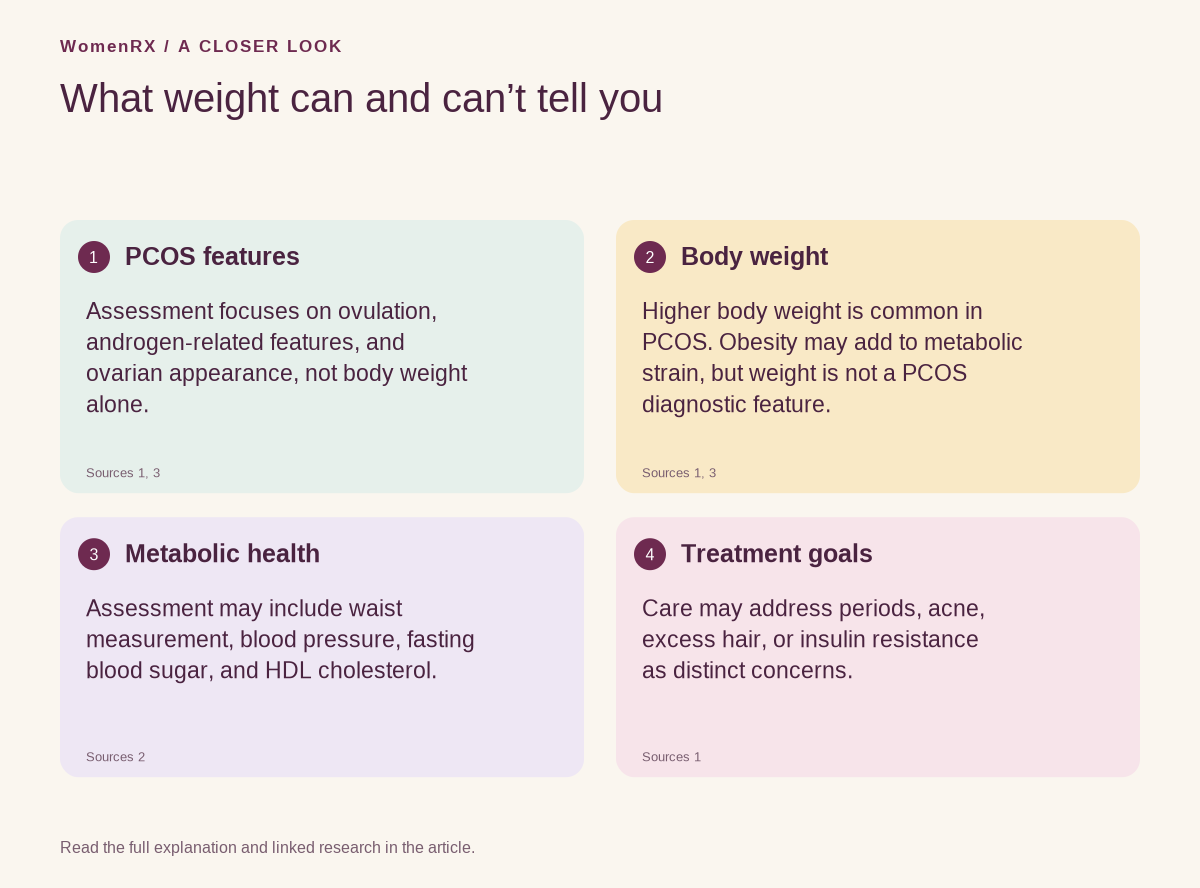
What weight can and can’t tell you
PCOS features: Assessment focuses on ovulation, androgen-related features, and ovarian appearance, not body weight alone.13
Body weight: Higher body weight is common in PCOS. Obesity may add to metabolic strain, but weight is not a PCOS diagnostic feature.13
Metabolic health: Assessment may include waist measurement, blood pressure, fasting blood sugar, and HDL cholesterol.2
Treatment goals: Care may address periods, acne, excess hair, or insulin resistance as distinct concerns.1
Read the figure as text
PCOS features, body weight, and metabolic risk overlap, but they answer different health questions.- PCOS features: Assessment focuses on ovulation, androgen-related features, and ovarian appearance, not body weight alone.13
- Body weight: Higher body weight is common in PCOS. Obesity may add to metabolic strain, but weight is not a PCOS diagnostic feature.13
- Metabolic health: Assessment may include waist measurement, blood pressure, fasting blood sugar, and HDL cholesterol.2
- Treatment goals: Care may address periods, acne, excess hair, or insulin resistance as distinct concerns.1
More questions, answered
Does improving metabolic measures mean PCOS symptoms will go away?
Not necessarily. In one six-week trial, metabolic measures and weight changed, but the reported results don’t show that periods, acne, or excess hair improved. Those symptoms may need their own assessment and treatment. 4 1
Sources you can check
- PCOS | Polycystic Ovary Syndrome | MedlinePlusAccessed 2026-09-25Return to first citation
- Metabolic Syndrome | MedlinePlusAccessed 2026-09-25Return to first citation
- Serum vitamin D levels in non-obese women with polycystic ovary syndrome: a systematic review and meta-analysis.Jiang M, Wang T, Huang L. · Frontiers in endocrinology · 2026Return to first citation
- Effect of two types of time-restricted eating on glycemic, lipid indices, and weight in women with polycystic ovary syndrome: a randomized controlled trial.Aminian M, Hajshafiha M, Heidari M, Daneghian S. · European journal of nutrition · 2026Return to first citation