Semaglutide and Metformin: What to Discuss Before Combining Them
The reason you take metformin changes what adding semaglutide can reasonably be expected to do.
Semaglutide has been studied in adults continuing metformin for type 2 diabetes. In a 24-week trial, mean HbA1c fell by 2.04 and 1.95 percentage points in two semaglutide groups. With no metformin-only group, the trial doesn’t measure the added benefit over metformin alone. If you take metformin for PCOS, those diabetes results don’t establish a cycle or fertility benefit. 5 4
Start with why you take metformin
The first question is what outcome you and your prescriber are trying to change. Metformin may be part of treatment for type 2 diabetes, or it may be used in PCOS. Those are different situations, and evidence from one doesn’t automatically answer questions about the other.
For type 2 diabetes, a phase III trial enrolled 314 adults in India whose diabetes was not adequately controlled on stable metformin and lifestyle changes. Participants continued metformin while they were assigned to one of two semaglutide formulations. At 24 weeks, mean HbA1c had fallen by 2.04 percentage points in one group and 1.95 points in the other. These are changes from each group’s starting level, not an estimate of semaglutide’s added effect compared with metformin alone: both groups received semaglutide, and there was no metformin-only comparison group. 5
A useful discussion is: What is the goal of adding semaglutide in my case, and how will we tell whether it’s helping? In diabetes, that may include reviewing glucose results and HbA1c. The trial shows improvement in HbA1c during treatment with both medicines, but it doesn’t establish which goal should guide an individual treatment decision. 1 5
If metformin is for PCOS, keep the question specific
PCOS research on semaglutide is much thinner than the diabetes evidence. A small prospective study followed 20 women with PCOS, obesity, and prediabetes who received semaglutide with metformin. It reported weight reductions and that 60% of participants became pregnant during follow-up. Because the study was small and its abstract reports no comparison group, it can’t show that the combination caused those pregnancies or establish a fertility treatment effect. 3
A 2026 review likewise describes semaglutide-specific PCOS evidence as sparse and identifies reproductive outcomes and pregnancy safety as important evidence gaps. If you take metformin for PCOS, clarify whether the intended goal is metabolic, weight-related, or reproductive. The small study reported weight and pregnancy outcomes, but it doesn’t establish a glucose-checking schedule or a predictable reproductive response. Diabetes results are not proof of a reproductive benefit in PCOS. 3 4
If pregnancy is possible or you’re planning to try to conceive, bring that up before starting treatment. A review says human reproductive effects are poorly understood, recommends avoiding semaglutide during pregnancy, and states that it should be stopped 8-10 weeks before conception. Discuss your plans and timing with your prescriber. 2 4
Side effects and monitoring depend on the goal
In the phase III diabetes trial, the most common treatment-emergent adverse events were predominantly mild-to-moderate gastrointestinal events. The trial doesn’t establish that metformin creates a specific interaction with semaglutide. If digestive effects become difficult to manage, ask what would prompt a review of treatment. 5
For diabetes, ask which glucose results matter for you and how often to check them; the appropriate method and frequency depend on your care plan. HbA1c was an outcome in the trial, but it doesn’t provide a monitoring schedule for every person taking these medicines. 1 5
For PCOS, make sure the monitoring plan matches the goal. A glucose-checking plan for diabetes doesn’t by itself answer questions about periods, ovulation, or fertility, and current semaglutide-specific PCOS evidence doesn’t establish those reproductive outcomes reliably. 3 4
A focused checklist for your discussion
- Indication: Is metformin treating diabetes, PCOS, or both? What is the specific goal of adding semaglutide?
- Evidence fit: If the goal relates to PCOS, what outcome is supported by evidence, and what remains uncertain about reproductive effects?
- Tolerability: Which gastrointestinal effects should I watch for, and what should I do if they become difficult to manage?
- Diabetes monitoring: Which glucose results matter, how often should I check, and what results should prompt a call?
- Treatment changes: What results or side effects would lead you to reconsider either medicine? Should I contact you before changing or stopping one?
- Pregnancy plans: If I might try to conceive, how does the recommendation to avoid semaglutide during pregnancy and stop it 8-10 weeks beforehand affect my treatment timing? 1 2 3 4 5
These questions separate the reason for treatment from the fact that the medicines were studied together. The appropriate plan depends on your diagnosis, goals, glucose results when relevant, and how you tolerate treatment.
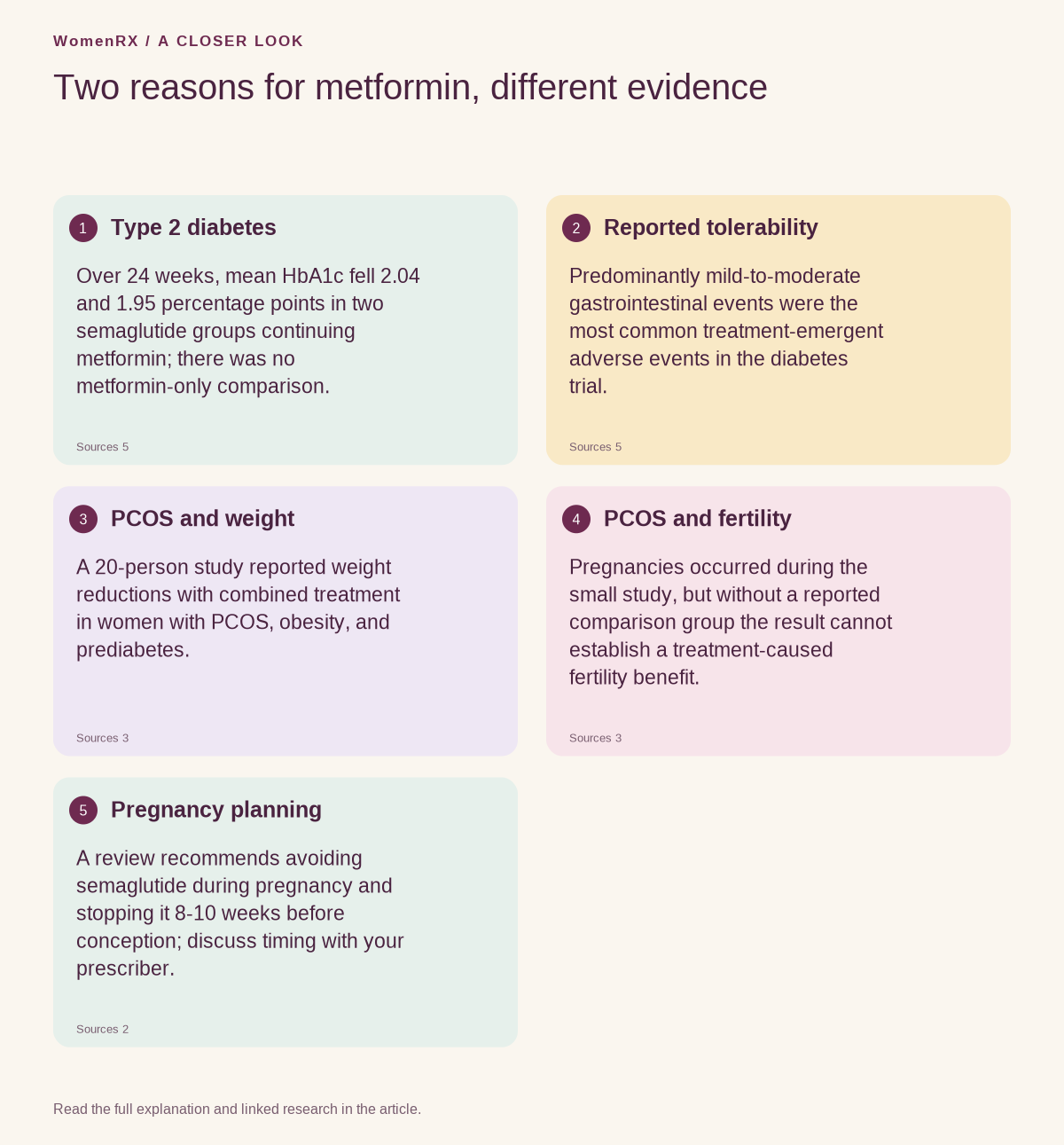
Two reasons for metformin, different evidence
Type 2 diabetes: Over 24 weeks, mean HbA1c fell 2.04 and 1.95 percentage points in two semaglutide groups continuing metformin; there was no metformin-only comparison.5
Reported tolerability: Predominantly mild-to-moderate gastrointestinal events were the most common treatment-emergent adverse events in the diabetes trial.5
PCOS and weight: A 20-person study reported weight reductions with combined treatment in women with PCOS, obesity, and prediabetes.3
PCOS and fertility: Pregnancies occurred during the small study, but without a reported comparison group the result cannot establish a treatment-caused fertility benefit.3
Pregnancy planning: A review recommends avoiding semaglutide during pregnancy and stopping it 8-10 weeks before conception; discuss timing with your prescriber.2
Read the figure as text
The clinical context changes what semaglutide research can tell you. Diabetes findings should not be treated as proof of reproductive benefit in PCOS.- Type 2 diabetes: Over 24 weeks, mean HbA1c fell 2.04 and 1.95 percentage points in two semaglutide groups continuing metformin; there was no metformin-only comparison.5
- Reported tolerability: Predominantly mild-to-moderate gastrointestinal events were the most common treatment-emergent adverse events in the diabetes trial.5
- PCOS and weight: A 20-person study reported weight reductions with combined treatment in women with PCOS, obesity, and prediabetes.3
- PCOS and fertility: Pregnancies occurred during the small study, but without a reported comparison group the result cannot establish a treatment-caused fertility benefit.3
- Pregnancy planning: A review recommends avoiding semaglutide during pregnancy and stopping it 8-10 weeks before conception; discuss timing with your prescriber.2
More questions, answered
Does taking metformin with semaglutide prove there’s a drug interaction?
No. The cited diabetes trial studied semaglutide in participants continuing metformin, but it doesn’t establish a specific interaction. Gastrointestinal disorders were among the most common adverse events, but that finding alone doesn’t show that the medicines interact. 5
Does the diabetes evidence show semaglutide helps PCOS-related fertility?
No. Diabetes results don’t establish reproductive benefits. A small study in women with PCOS reported pregnancies during combined treatment, but its abstract describes no comparison group, so it can’t show the treatment caused that outcome. 3 4 5
Sources you can check
- Diabetes | Type 1 Diabetes | Type 2 Diabetes | MedlinePlusAccessed 2026-09-25Return to first citation
- GLP-1 Receptor Agonists and Fertility: What Is Known So Far?Becker AS, Castilhos JP, Shugair SAS, Colombo T, Hentschke M-. · JBRA assisted reproduction · 2026Return to first citation
- Effect of semaglutide with metformin for weight loss and fertility in polycystic ovary syndrome (PCOS) patients with obesity: A pilot prospective study.Bolek T, Turňová P, Janošova S, Péč MJ, Ságová I, Nagy N, Jurica J, Mokáň M, Samoš M. · Clinical nutrition ESPEN · 2026Return to first citation
- Incretin-Based Anti-obesity Medications in Polycystic Ovary Syndrome: The Evidence Map.Jensterle M, Janez A. · Drugs · 2026Return to first citation
- Semaglutide Injection in Indian Patients With Type 2 Diabetes Mellitus: A Randomised, Phase III, Active-Controlled Study.Ambika Gopalakrishnan U, Joshi AS, Giri R, Shah SJ, Shukla J, Maheshwari S, M Chowdaiah R, Singh MK, Bari AS, Pathak NP, Shah AN, Bhandari S, Gowda A, Chandrappa A, Supe PD, Das B,... · Diabetes, obesity & metabolism · 2026Return to first citation