Can Semaglutide or Weight Loss Change Your Period?
A cycle change during semaglutide treatment doesn’t show what caused it, but pregnancy and your usual cycle pattern are useful places to start.
A period change while taking semaglutide may have more than one explanation. In one trial of women with PCOS, adding semaglutide to metformin was linked with greater weight loss and more menstrual-cycle recovery than metformin alone. That doesn’t establish whether the cycle change came directly from semaglutide or through weight change, or what happens for users without PCOS. 3
A late, lighter, heavier, or missing period can be unsettling when it happens around the time you start a medication or lose weight. The timing is worth noticing, but it can’t tell you by itself what caused the change. Your usual cycle pattern, PCOS if you have it, and the possibility of pregnancy are useful context.
What the PCOS trial can tell us
A randomized trial enrolled 100 women with PCOS and overweight or obesity. One group took metformin; the other added semaglutide to metformin. Eighty participants completed the 16-week treatment. The researchers reported greater weight loss and more menstrual-cycle recovery in the group taking both medicines. 3
Because the groups were randomized and both received metformin, the comparison can show the difference associated with adding semaglutide in this study population. It does not show semaglutide’s effect on its own, or tell us whether the cycle result followed directly from the medicine or indirectly from changes such as weight loss. The study also involved women with PCOS, so it doesn’t establish what to expect if you don’t have PCOS. 3
A more regular cycle during treatment isn’t proof that PCOS has resolved. PCOS can involve menstrual irregularity, and one change in your cycle can’t establish what’s happening with the underlying condition. 3
Your starting pattern matters
If your periods were irregular before treatment, a change may be harder to interpret than a shift from a previously predictable pattern. Note whether you have PCOS or a history of irregular cycles, and when the change began in relation to treatment and weight change. Those details can help you describe the pattern without treating timing as proof of cause.
The PCOS trial does not establish that semaglutide directly changes periods for people generally, or that weight loss will reliably make cycles more regular. It offers a specific finding in women taking semaglutide alongside metformin, not a prediction for every person using semaglutide. 3
Keep pregnancy in view
If pregnancy is possible and your period is late, take a pregnancy test rather than assuming the medication or weight change explains it. Pregnancy matters for semaglutide use: US Wegovy prescribing information says weight loss offers no benefit during pregnancy and may cause fetal harm, and advises discontinuing Wegovy when pregnancy is recognized if it’s being used for weight reduction. The oral semaglutide labeling for Ozempic and Rybelsus describes a different risk-benefit consideration during pregnancy. If you get a positive test, contact your prescriber promptly to review your specific medication and reason for taking it. 12
A short record can make the change clearer
For your own notes, record your usual cycle pattern, what changed, when the change began, when semaglutide started or changed, and whether your weight changed. If pregnancy is possible, include that too. This isn’t a diagnostic checklist; it’s a simple way to keep the timing and context straight.
If a cycle change repeats or continues to concern you, bring that pattern to the clinician who prescribes your medication or your gynecologist. A cycle change alone doesn’t show whether semaglutide, weight change, PCOS, pregnancy, or something else is responsible.
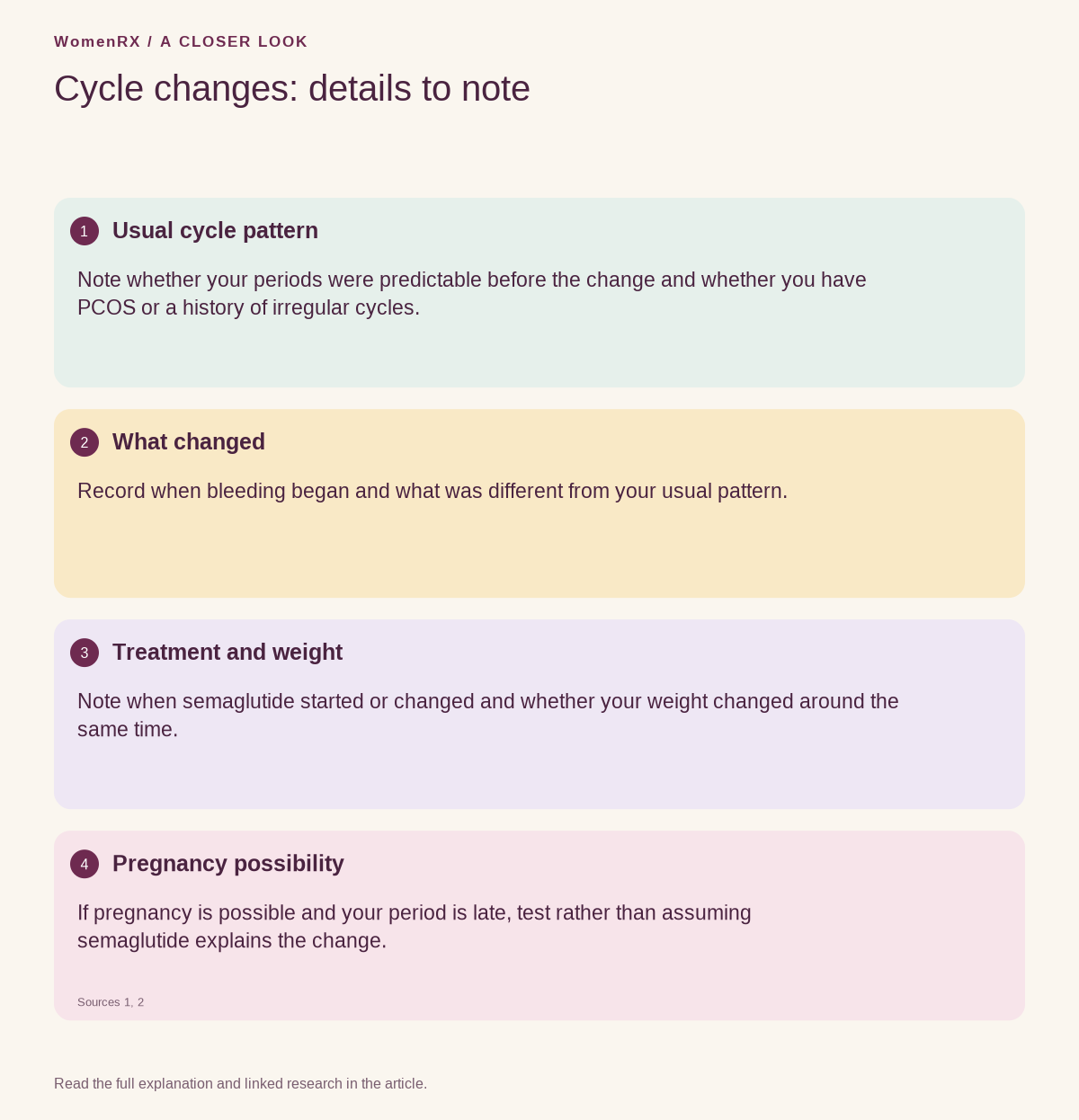
Cycle changes: details to note
Usual cycle pattern: Note whether your periods were predictable before the change and whether you have PCOS or a history of irregular cycles.
What changed: Record when bleeding began and what was different from your usual pattern.
Treatment and weight: Note when semaglutide started or changed and whether your weight changed around the same time.
Pregnancy possibility: If pregnancy is possible and your period is late, test rather than assuming semaglutide explains the change.12
Read the figure as text
These prompts can help you describe what changed and when; they are not a diagnostic test.- Usual cycle pattern: Note whether your periods were predictable before the change and whether you have PCOS or a history of irregular cycles.
- What changed: Record when bleeding began and what was different from your usual pattern.
- Treatment and weight: Note when semaglutide started or changed and whether your weight changed around the same time.
- Pregnancy possibility: If pregnancy is possible and your period is late, test rather than assuming semaglutide explains the change.12
More questions, answered
Does a more regular period mean my PCOS is better?
Not by itself. A trial found more menstrual-cycle recovery when semaglutide was added to metformin in women with PCOS, but it doesn’t show that one person’s cycle change means PCOS has resolved. 3
What if a pregnancy test is positive?
Contact your prescriber promptly to review your medication and why you take it. Wegovy’s pregnancy instructions for weight reduction differ from the risk-benefit language in oral semaglutide labeling. 12
Sources you can check
- WEGOVY (SEMAGLUTIDE) INJECTION, SOLUTION WEGOVY (SEMAGLUTIDE) TABLET [NOVO NORDISK PHARMACEUTICAL INDUSTRIES, LP] | US prescribing information and patient instructionsAccessed 2026-09-25Return to first citation
- OZEMPIC (ORAL SEMAGLUTIDE) TABLET RYBELSUS (ORAL SEMAGLUTIDE) TABLET [NOVO NORDISK PHARMACEUTICAL INDUSTRIES, LP] | US prescribing information and patient instructionsAccessed 2026-09-25Return to first citation
- Effects of combined metformin and semaglutide therapy on body weight, metabolic parameters, and reproductive outcomes in overweight/obese women with polycystic ovary syndrome: a prospective, randomized, controlled, open-label clinical trial.Chen H, Lei X, Yang Z, Xu Y, Liu D, Wang C, Du H. · Reproductive biology and endocrinology : RB&E · 2025Return to first citation