Menopause Hormone Therapy and GLP-1 Medicines: Is Combining Them Better for Weight Loss?
A reported link between hormone therapy and greater semaglutide weight loss is intriguing, but it doesn’t show that adding hormone therapy causes extra weight loss.
There’s a menopause-specific report of an association between using hormone therapy and greater weight loss with semaglutide, but experts describe it as hypothesis-generating, not proof that combining the treatments works better. Keep the decisions separate: consider an incretin-based medicine for weight and metabolic health. If menopause symptoms are prompting a hormone-therapy discussion, weigh the relief you hope for against your individual risks, not a hoped-for weight-loss boost. The position statement calls for individualized hormone-therapy decisions and says not to start it solely to augment weight loss. 1
What the combination evidence actually says
The most relevant menopause-specific summary is a 2026 position statement from the Spanish Menopause Society. It says an association between concomitant menopause hormone therapy and greater semaglutide-related weight loss has been reported. But it calls that finding hypothesis-generating. Semaglutide has the most direct menopause-specific evidence among incretin-based therapies, though that evidence remains limited and largely observational. Tirzepatide still needs menopause-specific evaluation. 1
That distinction matters. An association can point to a question worth studying, but it can’t tell us whether hormone therapy caused more weight loss. It doesn’t establish that starting hormone therapy would add to the weight loss achieved with semaglutide. 1
In other words, the finding isn’t evidence to start hormone therapy to boost weight loss.
Each treatment has a different job
A useful way to think about the decision is to ask what problem you’re trying to address. Incretin-based medicines are considered in care for weight and cardiometabolic health. The menopause position statement recommends viewing that care alongside body composition and physical function, rather than focusing on the number on the scale alone. 1
Hormone therapy is a separate menopause-care decision. If menopause symptoms are prompting the discussion, consider the relief you hope for alongside your individual health risks. The position statement calls for individualized hormone-therapy decisions and specifically cautions against starting it solely to augment weight loss. 1 If you’re discussing both treatments, ask what each is intended to help with and how you’ll judge whether it’s helping.
Why menopause-specific research matters
Body-fat distribution can change across the menopause transition. A review describes increasing central adiposity during perimenopause and a greater tendency toward visceral fat after menopause. That background helps explain why weight and metabolic health may be part of menopause care, but it doesn’t show that hormone therapy reverses those changes or adds to a GLP-1 medicine’s effects. 2
The same caution applies to studies of either treatment on its own: they cannot answer whether using both together produces an added weight benefit. For that, evidence would need to compare the combination with the medicine alone and report the menopause stage, hormone-therapy route and formulation, and weight outcomes. The reported association does not answer that comparative question. 1
A practical way to separate the decisions
If you’re considering both, start with two distinct questions:
- For the weight or metabolic concern: What is the goal of the incretin-based treatment, and how will progress be assessed beyond weight alone? The menopause position statement includes body composition, cardiometabolic health, and physical function in its framework. 1
- For menopause care: Which menopause symptoms are you hoping to relieve, and how do your individual health risks affect the decision? A possible weight-loss association is not a reason to start hormone therapy solely to boost weight loss. 1
- For using both: If a patch, pill, or particular formulation is under discussion, ask how it fits your individual menopause-care decision rather than choosing it in hopes of amplifying weight loss. The reported weight-loss association doesn’t establish an advantage for a particular route or formulation. 1
A possible association has been described, but a combination advantage hasn’t been established. Make each treatment decision for its own purpose, rather than treating hormone therapy as a weight-loss partner.
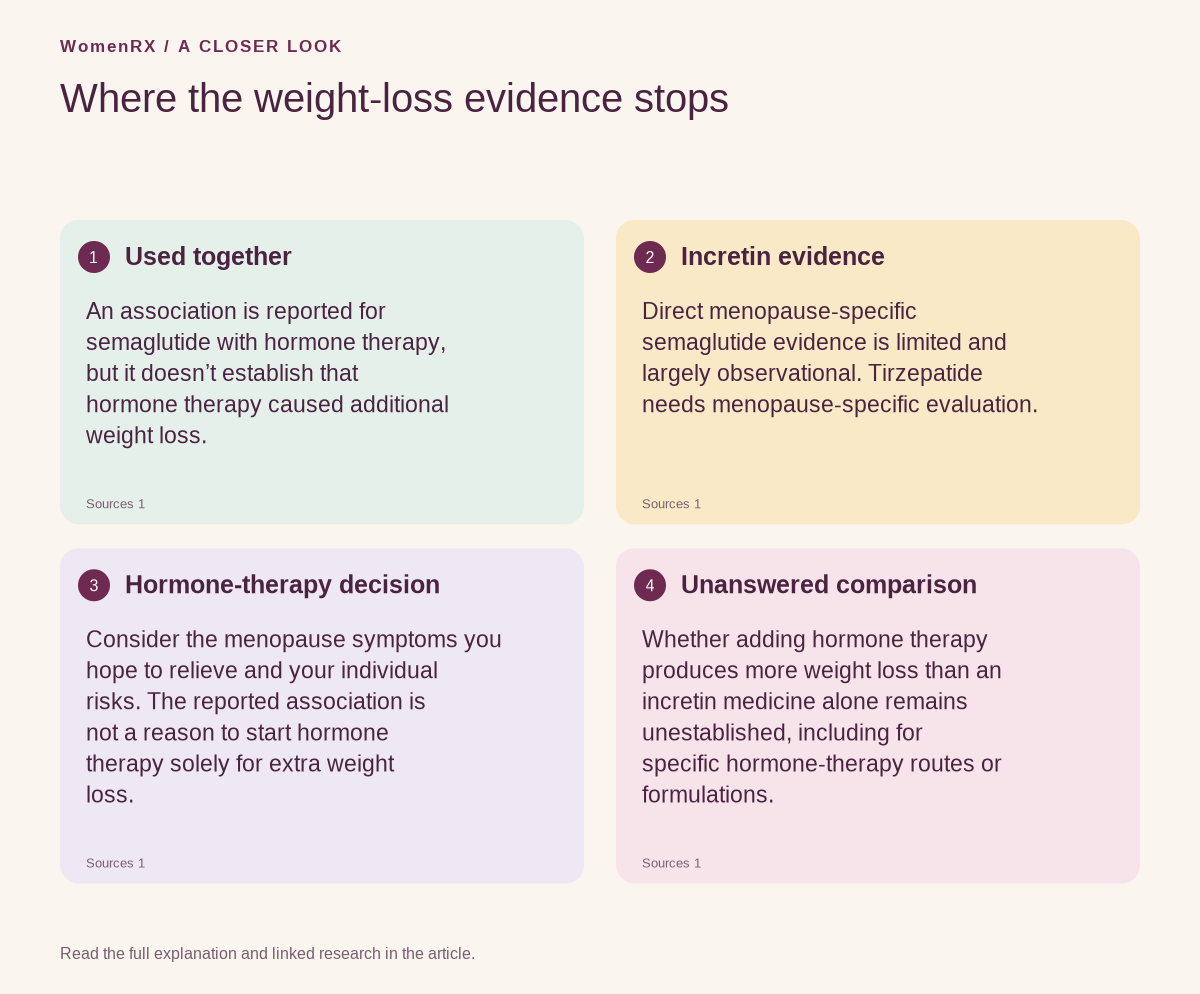
Where the weight-loss evidence stops
Used together: An association is reported for semaglutide with hormone therapy, but it doesn’t establish that hormone therapy caused additional weight loss.1
Incretin evidence: Direct menopause-specific semaglutide evidence is limited and largely observational. Tirzepatide needs menopause-specific evaluation.1
Hormone-therapy decision: Consider the menopause symptoms you hope to relieve and your individual risks. The reported association is not a reason to start hormone therapy solely for extra weight loss.1
Unanswered comparison: Whether adding hormone therapy produces more weight loss than an incretin medicine alone remains unestablished, including for specific hormone-therapy routes or formulations.1
Read the figure as text
The reported combination finding, evidence about each treatment, and the unanswered comparison are different pieces of the picture.- Used together: An association is reported for semaglutide with hormone therapy, but it doesn’t establish that hormone therapy caused additional weight loss.1
- Incretin evidence: Direct menopause-specific semaglutide evidence is limited and largely observational. Tirzepatide needs menopause-specific evaluation.1
- Hormone-therapy decision: Consider the menopause symptoms you hope to relieve and your individual risks. The reported association is not a reason to start hormone therapy solely for extra weight loss.1
- Unanswered comparison: Whether adding hormone therapy produces more weight loss than an incretin medicine alone remains unestablished, including for specific hormone-therapy routes or formulations.1
More questions, answered
Does the reported association mean hormone therapy makes semaglutide work better?
No. The menopause-specific position statement calls the association hypothesis-generating. It doesn’t establish that hormone therapy causes greater weight loss. 1
Does the semaglutide finding apply to tirzepatide?
The reported hormone-therapy association concerns semaglutide. The menopause position statement says tirzepatide still needs menopause-specific evaluation, so the semaglutide finding shouldn’t be treated as evidence of a combination advantage with tirzepatide. 1
Sources you can check
- Incretin-based therapies in peri- and postmenopausal women with obesity: an expert position statement from the Spanish Menopause Society.Sánchez-Prieto M, Romero-Domínguez M, Orozco R, Lilue M, Lubián-López DM, González SP, Nieto A, Coronado P, Sánchez-Borrego R, Cano A, Castelo-Branco C, Palacios S, Young Investiga... · Maturitas · 2026Return to first citation
- The menopause-obesity axis in MASH progression: from estrogen decline to liver fibrosis.Ntikoudi A, Vlachou E. · Frontiers in gastroenterology (Lausanne, Switzerland) · 2026Return to first citation