Metformin for PCOS: What to Discuss Before Prescribing
Metformin may be considered for some PCOS treatment goals, but a prescription should follow a discussion of what you want to treat and whether the medicine is safe for you.
Metformin is an insulin-sensitizing medicine that may help some people with PCOS, particularly when metabolic health is a treatment goal; it isn’t automatically the right choice for irregular periods or fertility treatment. 145 If you seek care online, expect a review of your goals, health history, medicines, kidney function, and how you’ll handle side effects and follow-up. 257 Raise pregnancy plans because they change which treatment goal matters most. 14
Start with the problem you want to treat
PCOS can affect ovulation, periods, and metabolic health, but it doesn’t affect everyone in the same way. That’s why “Can I get metformin?” is more useful when paired with “What am I hoping it will help?” 1
Metformin belongs to a group of medicines that improve the body’s response to insulin. Insulin-sensitizing medicines may help some PCOS symptoms, but metformin isn’t approved by the US Food and Drug Administration specifically to treat PCOS. That doesn’t rule out a prescription; it makes a clear treatment goal and follow-up plan especially useful. 15
Consider three different conversations:
- Metabolic health: If blood sugar or other metabolic concerns are driving your question, ask what the clinician wants to assess and how you’ll know whether the plan is helping. PCOS can come with metabolic risks, but having PCOS alone doesn’t tell a prescriber what your blood sugar is or whether metformin fits. 16
- Irregular periods: Metformin may help menstrual regularity for some people, but its response varies. If predictable bleeding is your main goal and you’re not trying to become pregnant, hormonal birth control is another option used to make periods more regular. The better conversation is about which problem matters most to you, not which medicine has “PCOS” in a search result. 15
- Trying to conceive: Treatment aimed at improving metabolic health isn’t the same as treatment aimed at helping you ovulate and become pregnant. A systematic review of PCOS pregnancy management identifies letrozole as an ovulation-induction treatment and describes metformin’s benefits as metabolic. Tell the clinician if pregnancy is a current goal so the discussion starts in the right place. 4
The evidence also calls for realistic expectations. A 2026 analysis combined 16 randomized trials in non-menopausal women with PCOS to compare several medicines and supplements on weight and metabolic measures. Its authors reported no statistically significant effect on their insulin-resistance measure for the interventions studied, and the analysis did not evaluate reproductive or patient-centered outcomes. It cannot tell you whether metformin will fix your cycles or help you conceive. 3
What an online visit should accomplish
An online visit can be a way to discuss treatment, not a way around assessment. You should be able to explain your main goal, your period pattern, whether you’re trying to become pregnant, and any previous experience with metformin. A prescriber can then consider those answers alongside your health history and other medicines. For example, a person seeking help with irregular periods while avoiding pregnancy is asking a different question from someone seeking fertility treatment. 14
Kidney function needs a real check. Metformin leaves the body through the kidneys. US prescribing information for metformin calls for regular kidney-function testing; labeling for a product that combines metformin with glipizide specifically calls for an estimated glomerular filtration rate, or eGFR, before starting that product. Its numerical prescribing rules apply to that combination product and shouldn’t be treated as personalized instructions for metformin alone. If you don’t have a recent kidney result, ask how the clinician will obtain one and when it should be checked again. 27
Side effects deserve a plan, too. Nausea, diarrhea, and stomach discomfort can make metformin hard to continue. Ask what to do if those effects interfere with eating or daily life, and how you’ll reach the prescriber for a change in plan rather than simply stopping follow-up. 57
Finally, mention your other medicines and any upcoming imaging or procedures. Metformin prescribing information flags certain drug interactions and notes that some procedures may require a temporary change, depending on the circumstances. The useful next step is to have the prescriber review your specific situation, not to adjust a medicine on your own based on a general rule. 7
If the visit ends with a prescription, make sure you know what it’s intended to improve and when you’ll revisit that goal. If it ends with a different treatment plan, that can also be a useful answer: PCOS care should fit the concern you brought in, whether that’s metabolic health, cycles, or pregnancy. 14
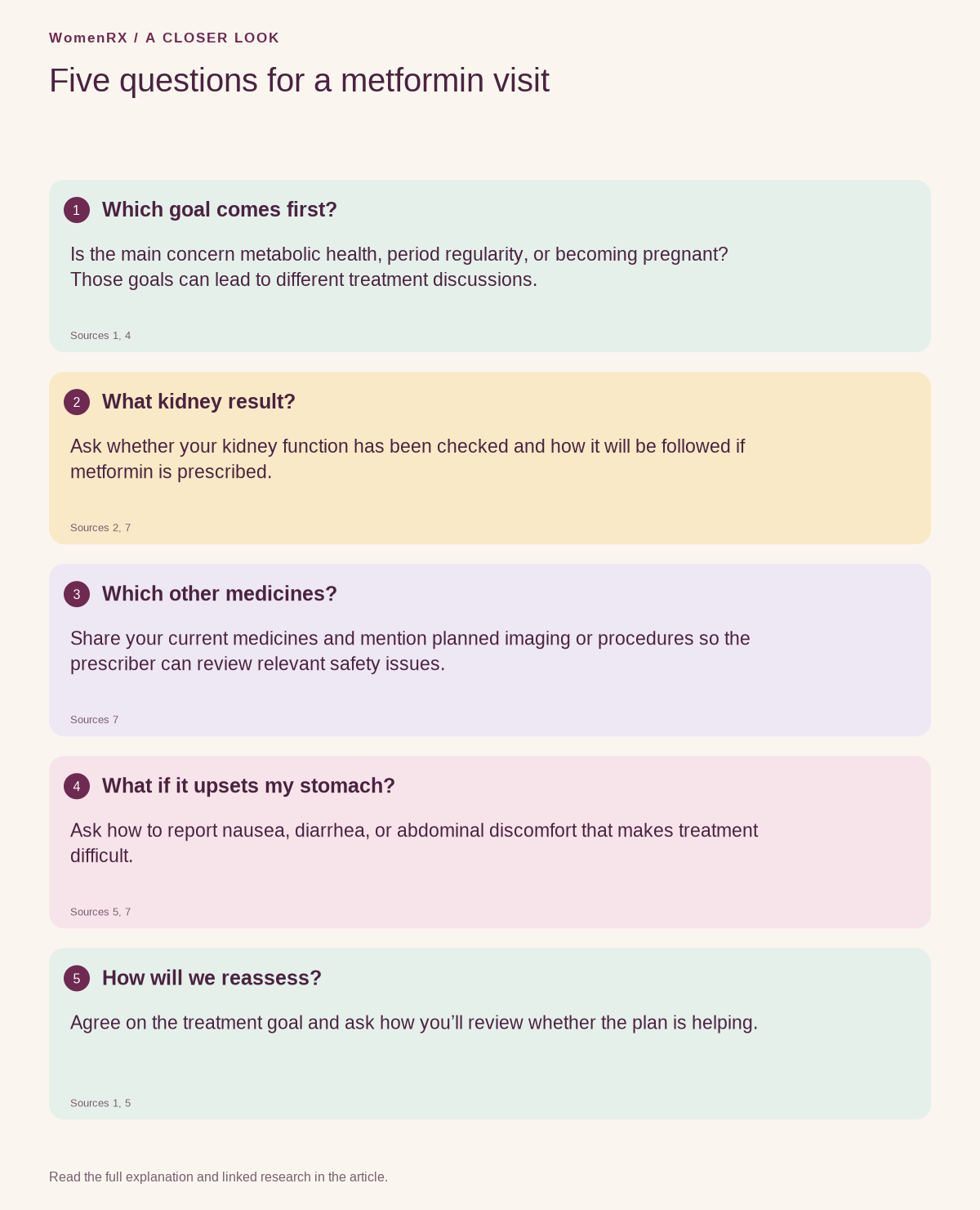
Five questions for a metformin visit
Which goal comes first?: Is the main concern metabolic health, period regularity, or becoming pregnant? Those goals can lead to different treatment discussions.14
What kidney result?: Ask whether your kidney function has been checked and how it will be followed if metformin is prescribed.27
Which other medicines?: Share your current medicines and mention planned imaging or procedures so the prescriber can review relevant safety issues.7
What if it upsets my stomach?: Ask how to report nausea, diarrhea, or abdominal discomfort that makes treatment difficult.57
How will we reassess?: Agree on the treatment goal and ask how you’ll review whether the plan is helping.15
Read the figure as text
Use these prompts to make an online treatment discussion specific to your goals and safety needs.- Which goal comes first?: Is the main concern metabolic health, period regularity, or becoming pregnant? Those goals can lead to different treatment discussions.14
- What kidney result?: Ask whether your kidney function has been checked and how it will be followed if metformin is prescribed.27
- Which other medicines?: Share your current medicines and mention planned imaging or procedures so the prescriber can review relevant safety issues.7
- What if it upsets my stomach?: Ask how to report nausea, diarrhea, or abdominal discomfort that makes treatment difficult.57
- How will we reassess?: Agree on the treatment goal and ask how you’ll review whether the plan is helping.15
More questions, answered
Does having insulin resistance mean I need metformin?
Not necessarily. PCOS treatment depends on your symptoms and goals, and responses to metformin vary. Ask what finding the clinician is treating and what change would count as a useful response for you. 15
Can metformin replace fertility treatment for PCOS?
Don’t assume so. Metabolic treatment and ovulation induction have different aims. A systematic review describes letrozole as an ovulation-induction treatment and metformin in terms of metabolic benefits; if you’re trying to conceive, say so at the start of the visit. 4
Sources you can check
- PCOS | Polycystic Ovary Syndrome | MedlinePlusAccessed 2026-09-25Return to first citation
- GLIPIZIDE AND METFORMIN HYDROCHLORIDE TABLET, FILM COATED [REMEDYREPACK INC.] | US prescribing information and patient instructionsAccessed 2026-09-25Return to first citation
- Comparative analysis of glucagon-like peptide-1 receptor agonists, metformin, and inositol in improving anthropometric and metabolic outcomes in women with polycystic ovary syndrome: a network meta-analysis.Omarion A, Ayasa Y, Omarion Z, Jayouse B, Ayesh H. · Frontiers in endocrinology · 2026Return to first citation
- A systematic review of pregnancy outcomes and management in polycystic ovary syndrome.Odunvbun WO, Ukoba O, Isogun JK, Ekoh A. · African journal of reproductive health · 2026Return to first citation
- Effects of GLP-1 Receptor Agonists vs Metformin in Polycystic Ovary Syndrome: A Systematic Review and Meta-Analysis.Almubaddil K, Alotaibi M, Bin Mutreb L, Alanazi F, Altulihee M. · Cureus · 2026Return to first citation
- Recommendations from the 2023 International Evidence-based Guideline for the Assessment and Management of Polycystic Ovary Syndrome†.Teede HJ, Tay CT, Laven J, Dokras A, Moran LJ, Piltonen TT, Costello MF, Boivin J, Redman LM, Boyle JA, Norman RJ, Mousa A, Joham AE, International PCOS Network. · Human reproduction (Oxford, England) · 2023Return to first citation
- METFORMIN HYDROCHLORIDE TABLET, EXTENDED RELEASE [REMEDYREPACK INC.] | US prescribing information and patient instructionsAccessed 2026-09-25Return to first citation