Combined or Progestin-Only Pill: Which Fits Your Routine and Health History?
Both pill types prevent pregnancy through daily use; estrogen exposure and bleeding preferences help distinguish them.
Start with two questions: Would a daily pill fit your routine, and do you want an option with or without estrogen? Combined pills contain estrogen and progestin; progestin-only pills contain no estrogen. Both prevent pregnancy, but don’t assume one type is more effective than the other. Bleeding preferences and estrogen-related health concerns can help shape the choice. Neither pill protects against sexually transmitted infections (STIs). 1247
First, picture the daily routine
A pill can be appealing if you want a method you control without a procedure. Combined and progestin-only pills are both used to prevent pregnancy, and both need to be taken every day. Think about an ordinary week, not an ideal one: Would you remember it through early shifts, travel, or a disrupted morning? If a daily task is likely to be difficult, an IUD or implant is worth comparing because neither depends on remembering a pill each day. 1
Don’t assume one pill type prevents pregnancy more effectively than the other. The practical question is whether you can keep up with daily use. Missed combined pills have specific guidance about what to do next, so before choosing a pill, ask for missed-pill instructions for the exact formulation you’re considering rather than assuming every pill follows the same rule. 13
What changes when a pill contains estrogen?
Combined pills contain estrogen and progestin. If a more predictable bleeding pattern matters to you, that’s a reason to discuss them: clinical research on combined pills describes more regular bleeding as one of their advantages. It isn’t a promise that you’ll never have spotting. Bleeding changes can still be bothersome enough that some people stop a hormonal method. 47
Progestin-only pills leave out estrogen. That distinction may matter when reviewing health risks, but it doesn’t mean every progestin-only pill feels or works the same. Unscheduled bleeding is one consideration. A review of bleeding management notes that changing from a norethindrone progestin-only pill to a drospirenone progestin-only pill may help some people with bleeding; research comparing progestin-only formulations has also found differences in unscheduled bleeding. Those findings are reasons to ask about the particular pill, not to expect one bleeding pattern from the entire category. 57
If your periods are already heavy or difficult to manage, say so at the outset. A review of treatments for heavy menstrual bleeding found that both combined and progestin-only pills may reduce blood loss, but the studies varied and did not establish one pill type as the clear winner for everyone. Pregnancy prevention and bleeding control can be two separate goals in the same decision. 5
Put your health history into the comparison
Estrogen is a meaningful part of the decision, not just a label on the package. A review of combined pills reports a higher risk of venous blood clots with commonly used ethinylestradiol-containing pills than with nonuse. Research on a newer estrogen has measured potentially favorable clotting markers, but those markers do not establish its long-term safety for an individual woman. 4
A personal history of blood clots is therefore worth raising when discussing an estrogen-containing pill. High blood pressure and smoking also belong in that conversation; whether a particular pill is suitable depends on an individual health review. For context, a short trial comparing a combined pill with a progestin-only pill enrolled women with polycystic ovary syndrome (PCOS) and excluded those with prior clots, hypertension, or active smoking. It measured clotting markers, not whether participants developed blood clots, and cannot settle eligibility for women with those histories. 6 A useful question is: “Does anything in my history change whether a pill containing estrogen makes sense for me?”
Your life stage changes what to bring up
If you’ve recently given birth or are breastfeeding, mention both when you discuss contraception rather than assuming breastfeeding covers pregnancy prevention. Breastfeeding works as temporary contraception under the lactational amenorrhea method only when all three conditions apply: you’ve had no menstrual period since birth, you’re fully or nearly fully breastfeeding, and you’re under six months postpartum. Once any condition no longer applies, another method is needed. Those criteria describe breastfeeding as a method; they do not determine which pill is right for you. 2
If you’re in perimenopause, tell the prescriber what you want the pill to do. For example, you may care most about pregnancy prevention, or bleeding changes may be just as pressing. Unexpected bleeding while using hormonal contraception can have causes other than the method itself, so it’s worth describing what has changed rather than assuming a different pill will resolve it. 7
The most useful comparison is personal and concrete: Can you sustain daily use and get clear instructions for missed pills? How much does bleeding predictability matter? And does your health history affect the choice of an estrogen-containing pill? Whichever pill you consider, it won’t protect against STIs; external latex condoms can help with that separate need. 1234
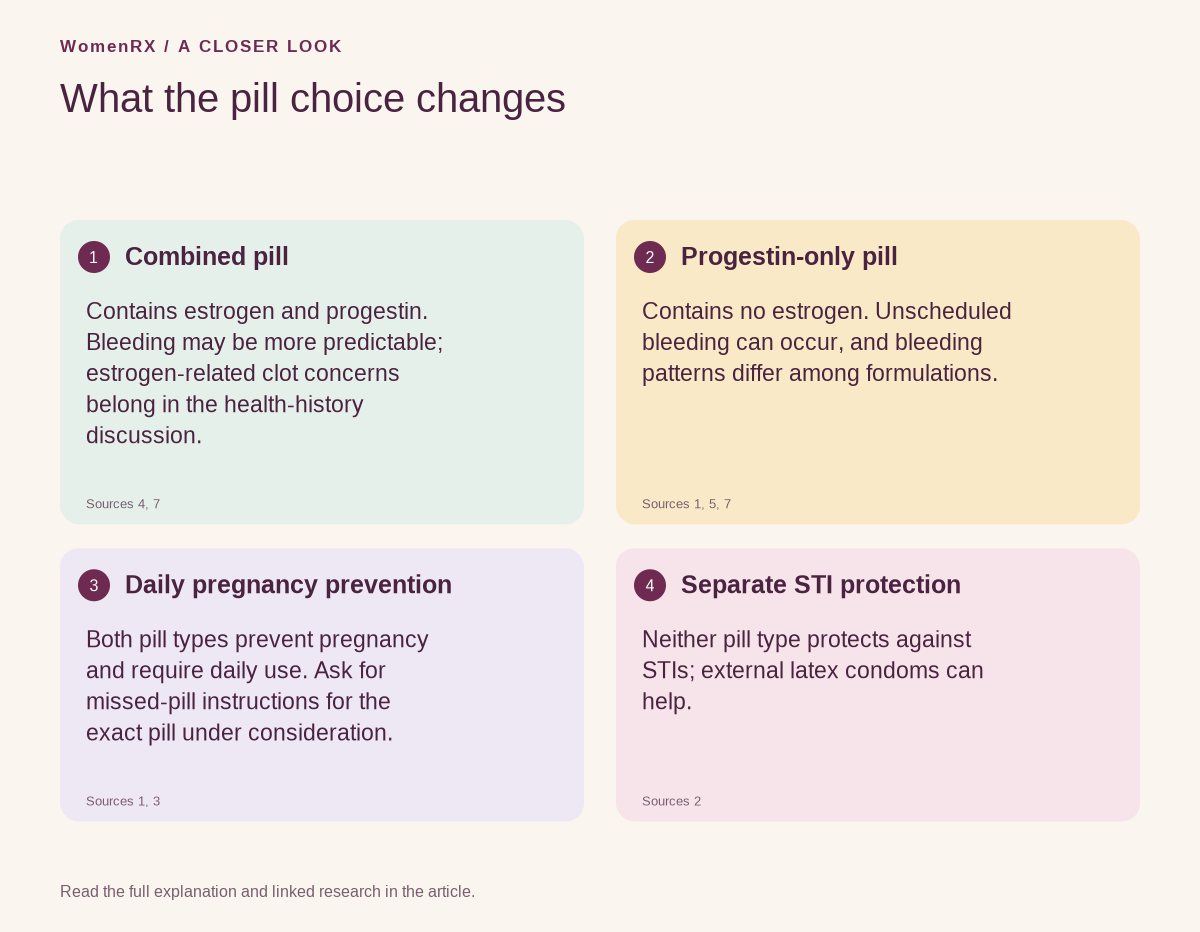
What the pill choice changes
Combined pill: Contains estrogen and progestin. Bleeding may be more predictable; estrogen-related clot concerns belong in the health-history discussion.47
Progestin-only pill: Contains no estrogen. Unscheduled bleeding can occur, and bleeding patterns differ among formulations.157
Daily pregnancy prevention: Both pill types prevent pregnancy and require daily use. Ask for missed-pill instructions for the exact pill under consideration.13
Separate STI protection: Neither pill type protects against STIs; external latex condoms can help.2
Read the figure as text
Both options require daily use. Compare their hormones and possible bleeding patterns, then get instructions for the specific pill you choose.- Combined pill: Contains estrogen and progestin. Bleeding may be more predictable; estrogen-related clot concerns belong in the health-history discussion.47
- Progestin-only pill: Contains no estrogen. Unscheduled bleeding can occur, and bleeding patterns differ among formulations.157
- Daily pregnancy prevention: Both pill types prevent pregnancy and require daily use. Ask for missed-pill instructions for the exact pill under consideration.13
- Separate STI protection: Neither pill type protects against STIs; external latex condoms can help.2
Sources you can check
- Birth Control | Contraception | Contraceptives | MedlinePlusAccessed 2026-09-25Return to first citation
- CDC: Birth control methods, barrier methods, fertility awareness and breastfeedingAccessed 2026-09-25Return to first citation
- Faculty statement from the CEU on a new publication: WHO Selected Practice Recommendations for Contraceptive Use Update. Missed pills: new recommendations.Faculty of Family Planning and Reproductive Health Care Clinical Effectiveness Unit. · The journal of family planning and reproductive health care · 2005Return to first citation
- Estetrol-based combined oral contraceptives: A systematic review of clinical outcomes.Råberg M, Vad IR, Axelsdóttir KH, Løkkegaard ECL. · Acta obstetricia et gynecologica Scandinavica · 2026Return to first citation
- Combined Oral Contraceptive Pills Versus Progestin-Only Pills for Heavy Menstrual Bleeding: A Systematic Review.Mohamed GS, Abdalla EM, Karamalla S, Osman TI, Hamid Musa HM, Mohamed H, Ahmed OK, Elshaikh SI, Shafiq MM. · Cureus · 2026Return to first citation
- Effects of estetrol/drospirenone vs drospirenone-only on thrombin generation in women with polycystic ovary syndrome: a randomized, double-blind, controlled trial.Chantrapanichkul P, Wiwatboworn P, Rattanachaiyanont M, Tanmahasamut P, Wongwananuruk T, Surasang W, Ruchutrakool T, Chinthammitr Y, Suwanawiboon B, Rungjirajittranon T. · Research and practice in thrombosis and haemostasis · 2026Return to first citation
- Abnormal Uterine Bleeding Associated With Hormonal Contraception.Schrager S, Fox K, Lee R. · American family physician · 2024Return to first citation