Can Hormonal Birth Control Change Sexual Desire?
Desire can change after starting birth control, but a direct comparison found that reported decreases were uncommon and varied by method.
Hormonal contraception may affect desire for some women, but it doesn’t reliably raise or lower it for everyone. In a randomized comparison, reported decreases in desire were uncommon and differed among women assigned to the DMPA-IM shot, a levonorgestrel implant, and a copper IUD. Desire is also different from arousal or pain, so those figures can’t explain every sexual change. 2
A change in desire after starting or switching birth control is worth taking seriously, but it doesn’t automatically mean the method caused it. Sexual desire can shift for more than one reason, and contraceptive methods may affect desire and sexual activity differently. 1 2
What a direct method comparison found
A secondary analysis of the randomized ECHO trial followed 7,829 women seeking contraception at sites in Eswatini, Kenya, South Africa, and Zambia. Participants were assigned to one of three methods: the injectable shot DMPA-IM, a levonorgestrel implant, or a nonhormonal copper IUD. The women were HIV-uninfected, and follow-up lasted 12 to 18 months. 2
The proportion reporting a decrease in sexual desire was 1.6% among women assigned to DMPA-IM, 1.1% with the levonorgestrel implant, and 0.5% with the copper IUD. These are reported proportions, not proof that the method caused a change for any individual. The analysis also found small differences in some measures of sexual activity between groups. 2
Because participants were randomly assigned, this comparison offers useful evidence about differences between these three methods in this study population. But it doesn’t answer whether a pill, patch, vaginal ring, or hormonal IUD will change your desire. Nor should results from women in this trial be treated as a personalized prediction for you. 2 The reported results don’t specify whether postpartum status, breastfeeding, relationship context, or baseline sexual function were accounted for, or provide separate estimates for women in those circumstances.
Desire, arousal, and pain aren’t interchangeable
The ECHO comparison measured reported decreases in desire and several sexual behaviors, such as whether participants had sex. Desire isn’t a stand-in for arousal, lubrication, or pain. If one of those experiences has changed for you, describe it separately rather than using the desire figures to explain it. 2
It also helps to remember that a method can affect sexual experience without necessarily changing desire. Contraception may reduce worry about an unintended pregnancy, while hormonal effects and changes in bleeding may also be part of the picture. These influences can point in different directions for different people. 2
Timing can help you make sense of a change
Notice what changed and when. For example, did you feel less interested in sex after starting the method, after a switch, or only during certain parts of your cycle? Is the main difference desire, physical arousal, lubrication, or pain? A timeline may help you describe the change without settling its cause in advance.
Desire can also vary across the menstrual cycle. In an online survey of 585 women ages 18 to 40, reports of increased desire and lubrication were somewhat more common around ovulation, but women varied widely in whether they noticed a change and when it occurred. 3
Other parts of your life may be relevant too. Medications, chronic health conditions, and worry about pregnancy can affect sexual health. 1 If you’re postpartum or breastfeeding, include that context rather than treating the trial’s group results as a personal prediction.
A focused conversation about the change
If you decide to bring it up with a clinician, a few details can make the conversation more useful:
- Method and timing: Which method are you using, and when did you start or switch?
- What changed: Is it desire, arousal, lubrication, pain, or how often you want sex?
- Pattern: Is the change steady, or does it vary with your cycle or bleeding?
- What else shifted: Did a medication, health condition, relationship circumstance, or pregnancy concern change around the same time? 1 3
- What matters most to you: Are you looking to understand the change, consider another method, or talk through both?
A clear timeline can help separate a possible method-related change from other influences, without assuming the answer in advance. If you’re considering a different method, make the conversation about both your sexual experience and the pregnancy prevention you want.
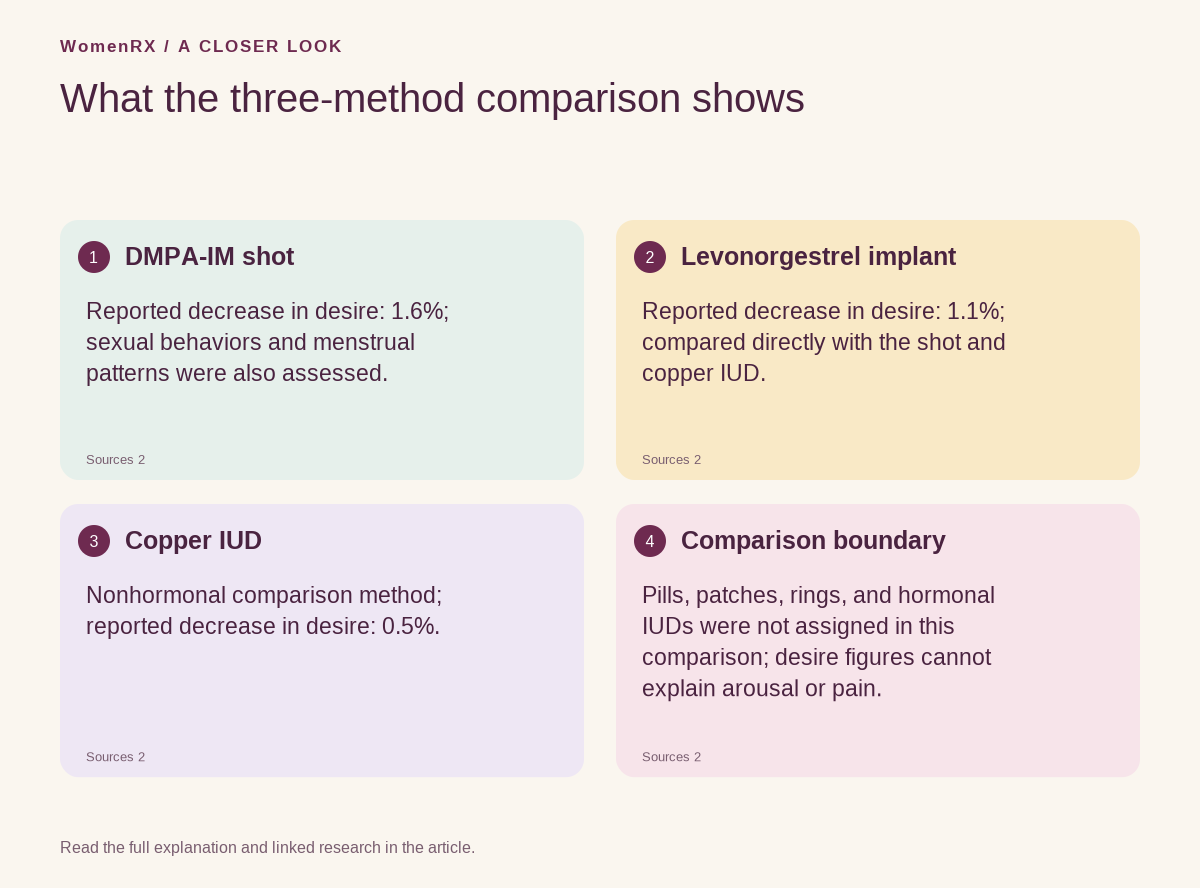
What the three-method comparison shows
DMPA-IM shot: Reported decrease in desire: 1.6%; sexual behaviors and menstrual patterns were also assessed.2
Levonorgestrel implant: Reported decrease in desire: 1.1%; compared directly with the shot and copper IUD.2
Copper IUD: Nonhormonal comparison method; reported decrease in desire: 0.5%.2
Comparison boundary: Pills, patches, rings, and hormonal IUDs were not assigned in this comparison; desire figures cannot explain arousal or pain.2
Read the figure as text
This evidence map shows reported decreases in desire for the methods directly compared, alongside the boundary of that comparison.- DMPA-IM shot: Reported decrease in desire: 1.6%; sexual behaviors and menstrual patterns were also assessed.2
- Levonorgestrel implant: Reported decrease in desire: 1.1%; compared directly with the shot and copper IUD.2
- Copper IUD: Nonhormonal comparison method; reported decrease in desire: 0.5%.2
- Comparison boundary: Pills, patches, rings, and hormonal IUDs were not assigned in this comparison; desire figures cannot explain arousal or pain.2
More questions, answered
Does birth control lower desire for everyone?
No. In the ECHO comparison, reported decreases in desire were uncommon and differed across the three assigned methods. Those results can’t predict an individual’s experience or cover every type of birth control. 2
What if sex hurts or arousal feels different?
Name the specific change rather than grouping it all under libido. A result about reported decreases in desire can’t tell you why sex hurts or arousal feels different. 2
Sources you can check
- Sexual Health | MedlinePlusAccessed 2026-09-25Return to first citation
- Sexual behaviour among women using intramuscular depot medroxyprogesterone acetate, a copper intrauterine device, or a levonorgestrel implant for contraception: Data from the ECHO randomized trial.Hofmeyr GJ, Singata-Madliki M, Batting J, Steyn P, Thomas KK, Issema R, Beesham I, Mbatsane E, Morrison C, Deese J, Smit J, Philip N, Palanee-Phillips T, Reddy K, Onono M, Mastro T... · PloS one · 2024Return to first citation
- Female Sexual Desire, Response, and Activity Across the Menstrual Cycle.Kiesner J, Bittoni C, Pastore M. · Journal of sex & marital therapy · 2025Return to first citation