Does Birth Control Cause Weight Gain? Compare the Methods
A weight change after starting birth control is worth taking seriously, but the best comparison depends on the method and the time since you started it.
Birth control methods don’t all have the same weight evidence. In a randomized trial, women assigned to the contraceptive shot gained more weight on average over 12 to 18 months than women assigned to a copper IUD; the levonorgestrel implant group fell between them. Those averages can help you compare options, but they can’t tell you what caused your own weight change. 4
Start with the method, not the category
“Birth control” can mean a pill, patch, ring, injection, implant or IUD. Even implants and IUDs come in different types. A weight result for one method shouldn’t be treated as a result for all hormonal contraception. 14
The clearest direct comparison here comes from a randomized trial of women ages 16 to 35 at sites in Eswatini, Kenya, South Africa and Zambia. Participants were assigned to an intramuscular depot medroxyprogesterone acetate shot (DMPA), a levonorgestrel implant or a nonhormonal copper IUD. Researchers measured weight when women entered the study and again at their final visit, 12 to 18 months later. 4
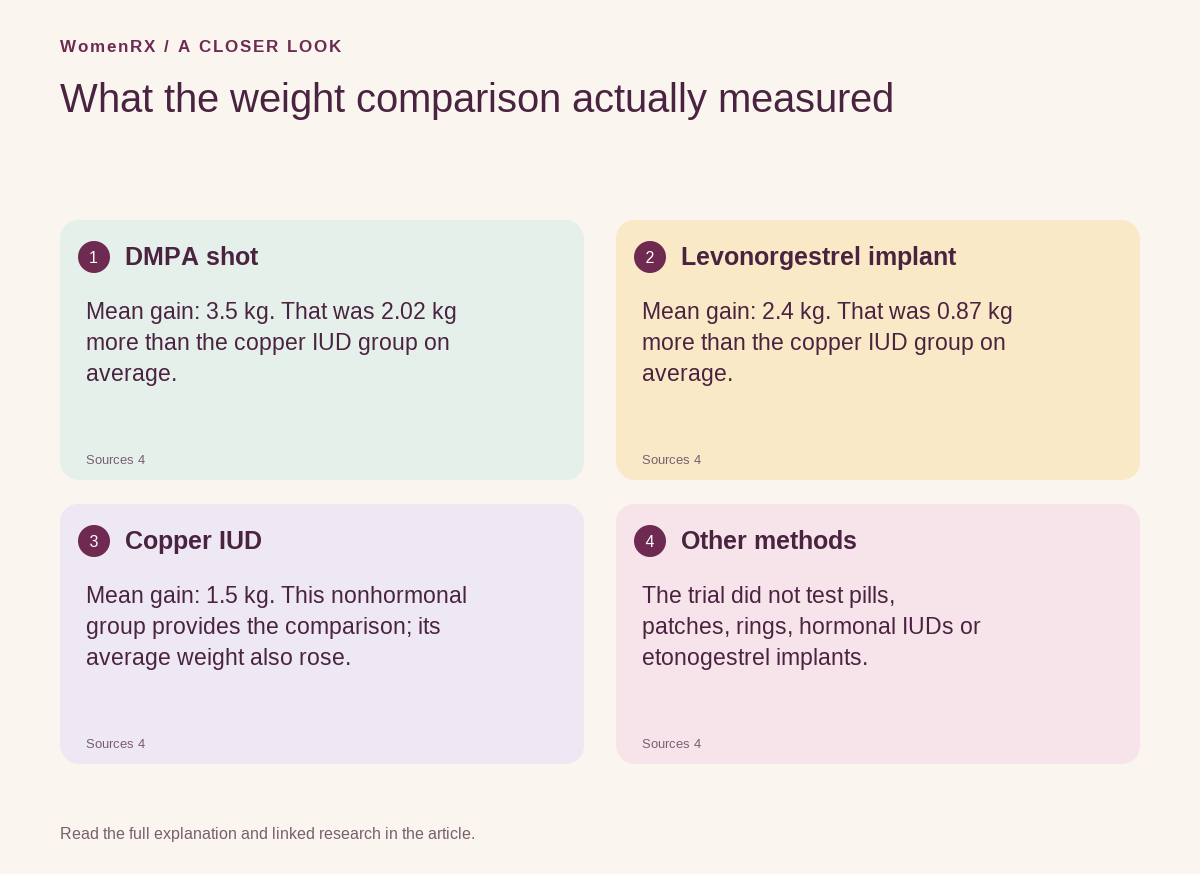
Mean weight rose in all three groups: 3.5 kg with the shot, 2.4 kg with the levonorgestrel implant and 1.5 kg with the copper IUD. The average difference between the shot and copper IUD groups was 2.02 kg; between the implant and copper IUD groups, it was 0.87 kg. These are differences between groups, not the total weight each group gained. 4
That copper IUD group matters. Its average weight also increased, so seeing the scale move after starting a method doesn’t, by itself, show that the method caused the change. At the same time, the larger average gains in the two hormonal-method groups are a real finding to consider when choosing between these specific options. 4
What an average cannot tell you about your change
The trial compared weight at two visits. That makes it useful for comparing average changes over roughly a year or more, but not for explaining a change you noticed in the first few weeks. It also measured weight, not how much of a change was body fat, fluid or something else. And a group average cannot predict whether one person will gain, lose or stay at the same weight. 4
The findings don’t cover every method. The trial did not assign participants to a combined pill, patch, vaginal ring, hormonal IUD or etonogestrel implant. In particular, its levonorgestrel implant result cannot stand in for a levonorgestrel IUD: they’re different methods. 14
How to make your timeline useful
If your weight changed, first name the exact method and when you began it. Then compare your observation with research that measured that method, against a meaningful alternative, over a similar span of time. For example, a change soon after starting a pill cannot be explained by a trial that compared a shot, a levonorgestrel implant and a copper IUD at 12 to 18 months. 4
Context matters, too. If you started contraception after a pregnancy, weight may still be changing during the postpartum year. A small prospective pregnancy study measured weight change through one year postpartum, but it did not test whether contraception caused those changes. That’s a reason to keep the timing of pregnancy and contraception separate in your own account, not a reason to dismiss what you’ve noticed. 2
If weight is affecting how you feel about your method, you don’t need to prove causation before bringing it up. You can say what changed, when it changed and whether you’d rather keep the method or consider another one. The Society of Family Planning recommends discussing potential weight change as a legitimate part of contraceptive choice while offering the full range of methods without weight-based bias. 3
What the weight comparison actually measured
DMPA shot: Mean gain: 3.5 kg. That was 2.02 kg more than the copper IUD group on average.4
Levonorgestrel implant: Mean gain: 2.4 kg. That was 0.87 kg more than the copper IUD group on average.4
Copper IUD: Mean gain: 1.5 kg. This nonhormonal group provides the comparison; its average weight also rose.4
Other methods: The trial did not test pills, patches, rings, hormonal IUDs or etonogestrel implants.4
Read the figure as text
Three assigned contraceptive methods, each with weight measured from study entry to a final visit at 12-18 months.- DMPA shot: Mean gain: 3.5 kg. That was 2.02 kg more than the copper IUD group on average.4
- Levonorgestrel implant: Mean gain: 2.4 kg. That was 0.87 kg more than the copper IUD group on average.4
- Copper IUD: Mean gain: 1.5 kg. This nonhormonal group provides the comparison; its average weight also rose.4
- Other methods: The trial did not test pills, patches, rings, hormonal IUDs or etonogestrel implants.4
More questions, answered
Does the copper IUD guarantee my weight won’t change?
No. In the randomized comparison, the copper IUD group gained an average of 1.5 kg over 12 to 18 months. A nonhormonal method provides a useful comparison, not a promise that your weight will stay fixed. 4
Can I use the levonorgestrel implant result to judge a hormonal IUD?
No. The trial tested a levonorgestrel implant, not a levonorgestrel-releasing IUD. Its measured weight difference should not be assigned to a method it did not study. 4
Sources you can check
- Birth Control | Contraception | Contraceptives | MedlinePlusAccessed 2026-09-25Return to first citation
- Eating in the absence of hunger is not associated with weight, self-reported eating behaviors, or well-being in pregnant adults: Prospective cohort study.Lipsky LM, Burger KS, Faith MS, Shearrer GE, Nansel TR. · PloS one · 2025Return to first citation
- Society of Family Planning Committee Statement: Contraception and body weight.Zwayne N, Lyman E, Ebersole A, Morse J, with the assistance of Elise Boos and Antoinette Nguyen on behalf of the Clinical Affairs Committee, and Monica Skoko Rodríguez. · Contraception · 2025Return to first citation
- Weight change among women using intramuscular depot medroxyprogesterone acetate, a copper intrauterine device, or a levonorgestrel implant for contraception: Findings from a randomised, multicentre, open-label trial.Beksinska M, Issema R, Beesham I, Lalbahadur T, Thomas K, Morrison C, Hofmeyr GJ, Steyn PS, Mugo N, Palanee-Phillips T, Ahmed K, Nair G, Baeten JM, Smit J. · EClinicalMedicine · 2021Return to first citation