Getting Pregnant After Birth Control: Selected Methods
Pregnancy may be possible as soon as Mirena is removed, while the birth control shot can take longer to wear off.
Pregnancy may be possible as soon as Mirena is removed. A trial described fertility returning rapidly after etonogestrel implant removal, while ovulation can take several months after the depot medroxyprogesterone acetate shot.1457 If you miss a period and pregnancy is possible, take a pregnancy test rather than waiting for more missed periods. If your cycle is unpredictable, test at least 21 days after sex without contraception.10
Stopping birth control starts two different clocks: when the method stops preventing pregnancy, and how long it takes to conceive. They aren’t the same. A method can be reversible without pregnancy happening in the first cycle. The clearest exception to a quick return is the depot medroxyprogesterone acetate shot, whose effect can persist after the last injection.14
Return to fertility after selected methods
Hormonal IUD: Pregnancy is possible as soon as Mirena is removed, even if you haven’t had a period yet. In two Mirena studies, the estimated probability of conceiving within 12 months of removal was about 80% among 229 women who wanted pregnancy and provided follow-up information. For Kyleena, about 71% of 163 women who wanted pregnancy and provided follow-up information conceived within 12 months. Those figures describe different study groups, not a head-to-head comparison of the devices or a promise about your own chances.56
Implant: In a US clinical trial, 330 sexually active women with apparently normal menstrual cycles used an etonogestrel implant. The researchers described the return of normal menstrual cycles and fertility after removal as rapid. The reported findings don’t give a dependable number of days until ovulation or pregnancy, so there’s no useful countdown to put on your calendar.7
Combined pill: Pregnancy does occur after stopping combined oral contraceptives. One US claims-based study compared people stopping a 91-day levonorgestrel-containing combined pill with people stopping a 28-day version. Recorded pregnancy rates differed, but the authors cautioned that differences in days’ supply and unmeasured factors could help explain the result. It cannot tell you precisely when you will ovulate after your last pill.8
Depot medroxyprogesterone acetate shot: This is the method most worth planning ahead for if timing matters to you. A systematic review found wide variation in return to ovulation after the last shot; in most of the studies it reviewed, ovulation was reported between 15 and 49 weeks afterward. In a US study described in the Depo-Provera prescribing information, the median time from the last injection to conception was 10 months among those who conceived. Follow-up information was unavailable for 39% of those who stopped to become pregnant, so that median is not a prediction for everyone.14
A missed period doesn’t answer the whole question
Bleeding on contraception may not resemble your cycle without it. Mirena, for example, can make bleeding lighter or stop it; its patient information says menstrual periods should return after removal.5 After stopping contraception, pregnancy is one possible reason for a missed period; a late period doesn’t, by itself, show that your cycle is still settling.9
If pregnancy is possible, check for it first. A home pregnancy test is most reliable from the first day of a missed period. If bleeding was absent or irregular on contraception and you don’t know when a period is due, test at least 21 days after you last had sex without contraception. If the result is negative but you still think you might be pregnant, repeat it a few days later. If a second test is negative and your period still hasn’t arrived, ask for medical advice.10
If you miss three periods in a row, arrange an assessment. Seek advice sooner if a missed period comes with symptoms such as weight change, tiredness, new facial hair or changes in your skin, or if your periods have become irregular. This is guidance for assessing missed periods, not a reason to put off a pregnancy test or a fixed waiting period for every contraceptive method.910
Absent or infrequent periods can mean ovulation isn’t happening regularly, but stopping contraception isn’t the only possible explanation. The American Society for Reproductive Medicine (ASRM) includes absent, infrequent and irregular periods in its fertility assessment guidance and says a clearly abnormal menstrual history calls for investigation of the cause. Depending on the situation, an assessment may consider thyroid function, signs of excess androgens, or other causes. Stress, weight loss and excessive exercise can also be associated with a form of chronic anovulation called functional hypothalamic amenorrhea.23
There’s a distinction here if you’ve recently had the shot: a delayed cycle can fit its known effect, but that doesn’t mean every missing period should automatically be attributed to it. If your cycles were irregular before birth control, tell your clinician; prior menstrual patterns are useful in a fertility assessment.34
When trying warrants a fertility evaluation
If you have regular cycles and no known condition associated with infertility, ASRM recommends starting an evaluation after 12 months of trying if you’re under 35, or 6 months if you’re 35 or older. If you’re over 40, a more immediate evaluation may be warranted. A known medical history associated with infertility calls for immediate evaluation. If periods are clearly abnormal, ask about investigating the cause.3
An evaluation looks beyond the contraception you used. ASRM recommends assessing ovulation, the reproductive tract and, when applicable, the sperm-producing partner in parallel. That matters because a delay in pregnancy after stopping birth control does not, by itself, identify the cause.3
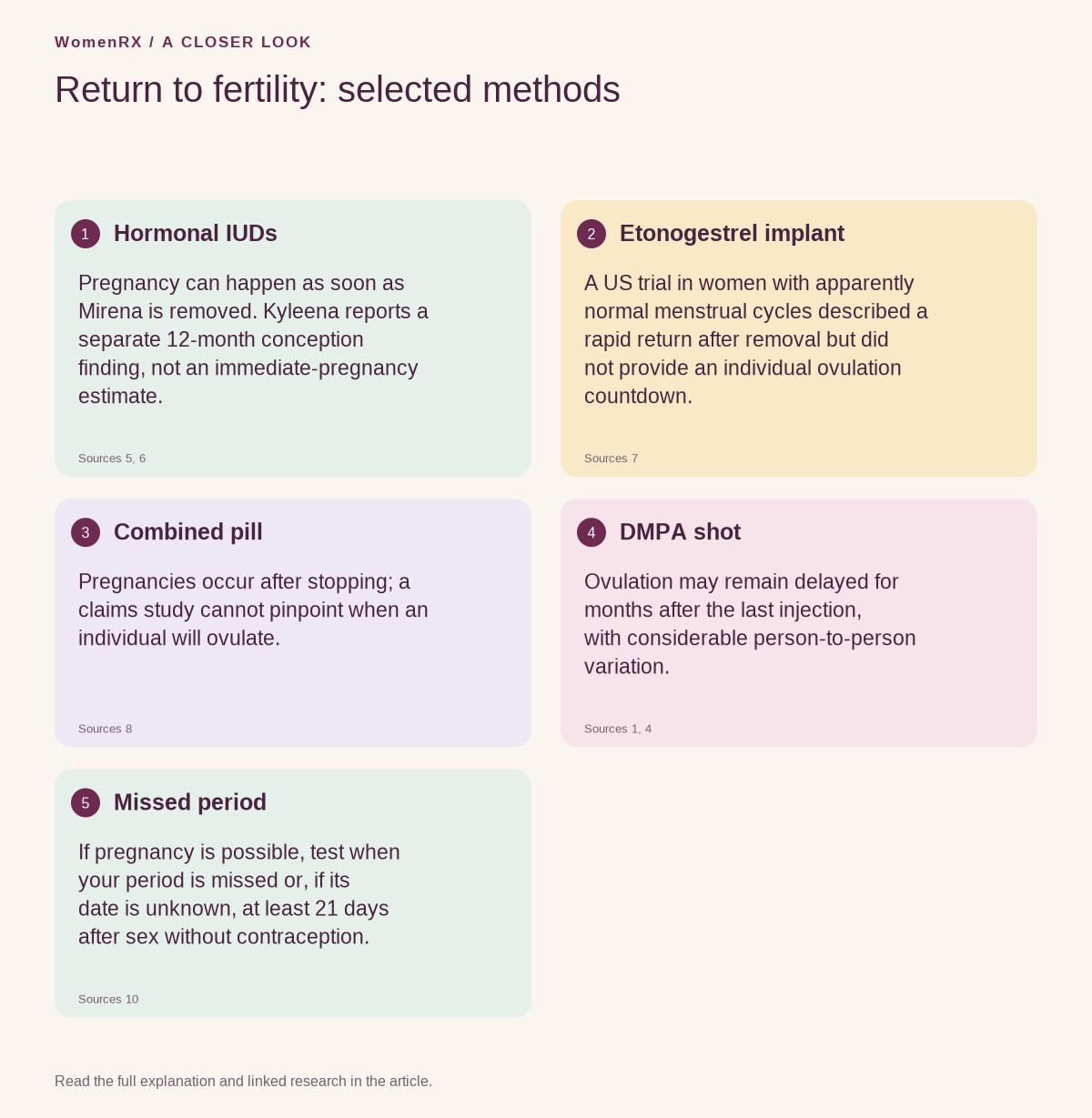
Return to fertility: selected methods
Hormonal IUDs: Pregnancy can happen as soon as Mirena is removed. Kyleena reports a separate 12-month conception finding, not an immediate-pregnancy estimate.56
Etonogestrel implant: A US trial in women with apparently normal menstrual cycles described a rapid return after removal but did not provide an individual ovulation countdown.7
Combined pill: Pregnancies occur after stopping; a claims study cannot pinpoint when an individual will ovulate.8
DMPA shot: Ovulation may remain delayed for months after the last injection, with considerable person-to-person variation.14
Missed period: If pregnancy is possible, test when your period is missed or, if its date is unknown, at least 21 days after sex without contraception.10
Read the figure as text
The useful comparison is whether pregnancy can happen soon after stopping, whether a method’s effect may linger, and what to do about a missed period.- Hormonal IUDs: Pregnancy can happen as soon as Mirena is removed. Kyleena reports a separate 12-month conception finding, not an immediate-pregnancy estimate.56
- Etonogestrel implant: A US trial in women with apparently normal menstrual cycles described a rapid return after removal but did not provide an individual ovulation countdown.7
- Combined pill: Pregnancies occur after stopping; a claims study cannot pinpoint when an individual will ovulate.8
- DMPA shot: Ovulation may remain delayed for months after the last injection, with considerable person-to-person variation.14
- Missed period: If pregnancy is possible, test when your period is missed or, if its date is unknown, at least 21 days after sex without contraception.10
More questions, answered
Do I need a test to confirm ovulation if my periods are regular?
Not routinely. ASRM says a history of regular 21- to 35-day cycles is generally enough to establish an ovulatory pattern, unless there are other signs such as excess facial or body hair. Clearly irregular or absent cycles call for evaluation of the cause, not just repeated ovulation testing.3
Sources you can check
- When can a woman have repeat progestogen-only injectables--depot medroxyprogesterone acetate or norethisterone enantate?Paulen ME, Curtis KM. · Contraception · 2009Return to first citation
- Functional Hypothalamic Amenorrhea: An Endocrine Society Clinical Practice Guideline.Gordon CM, Ackerman KE, Berga SL, Kaplan JR, Mastorakos G, Misra M, Murad MH, Santoro NF, Warren MP. · The Journal of clinical endocrinology and metabolism · 2017Return to first citation
- Fertility evaluation of infertile women: a committee opinion (2021) | American Society for Reproductive Medicine | ASRMAccessed 2026-09-25Return to first citation
- DEPO-PROVERA (MEDROXYPROGESTERONE ACETATE) INJECTION, SUSPENSION [PHARMACIA & UPJOHN COMPANY LLC] | US prescribing information and patient instructionsAccessed 2026-09-25Return to first citation
- MIRENA (LEVONORGESTREL) INTRAUTERINE DEVICE [BAYER HEALTHCARE PHARMACEUTICALS INC.] | US prescribing information and patient instructionsAccessed 2026-09-25Return to first citation
- KYLEENA (LEVONORGESTREL) INTRAUTERINE DEVICE [BAYER HEALTHCARE PHARMACEUTICALS INC.] | US prescribing information and patient instructionsAccessed 2026-09-25Return to first citation
- Safety and efficacy of Implanon, a single-rod implantable contraceptive containing etonogestrel.Funk S, Miller MM, Mishell DR, Archer DF, Poindexter A, Schmidt J, Zampaglione E, Implanon US Study Group. · Contraception · 2005Return to first citation
- Delayed pregnancy detection and return to fertility with extended levonorgestrel-containing oral contraceptives: A real world setting cohort study.Kaplan S, Bertoia ML, Lass A, Wang FT, Evans A, Dhanda S, Roy D, Seeger JD. · Pharmacoepidemiology and drug safety · 2023Return to first citation
- Missed or late periods - NHSAccessed 2026-09-26Return to first citation
- Doing a pregnancy test - NHSAccessed 2026-09-26Return to first citation