Hormonal Birth Control and Weight: What to Expect
Weight findings differ by method: evidence doesn’t show a large effect for combined pills or patches, while the signal for the Depo shot is less certain but worth weighing in your choice.
Hormonal contraception isn’t one single exposure. Reviews of combined birth control pills and patches found no evidence of a large weight effect, though they couldn’t rule out smaller changes. Evidence for progestin-only methods is weaker overall; some studies suggest greater gain with the Depo shot, but they don’t establish what will happen to you. Your own experience still matters. 2 3
The answer depends on the method
It’s understandable to wonder whether a change on the scale is related to contraception. But a change that happens while you’re using a method doesn’t, by itself, prove the method caused it. Weight can reflect water, muscle, bone, and fat, and everyday factors can affect it too. 1
Research also doesn’t support treating all hormonal contraception as if it has the same effect. The evidence differs for combined pills and patches, progestin-only methods, and especially the Depo shot.
Combined pills and patches: no large effect is evident
A Cochrane review included 49 trials and 85 comparisons of combination contraceptives. In the four trials with a placebo or no-treatment comparison, researchers found no evidence that combined pills or a combined skin patch caused weight change. Most comparisons between different combination contraceptives also found no substantial difference. The authors said the evidence was insufficient to determine the effect on weight, but no large effect was evident. 2
That’s reassuring, but it isn’t a promise that your weight won’t change. The review couldn’t rule out smaller effects, and weight can change over time for reasons unrelated to contraception. It also doesn’t answer every question about every formulation.
Progestin-only methods: thinner evidence, with a concern about the shot
A review of progestin-only contraception included 22 studies of 11,450 women. It covered the injection, hormonal IUDs, implants, and progestin-only pills. The overall evidence was rated low quality; many studies were observational or had substantial follow-up limitations. Most studies didn’t find a significant difference between comparison groups. 3
The clearest concern in that review was depot medroxyprogesterone acetate (DMPA), the Depo shot. One retrospective study found that average weight gain was 2.28 kg greater for DMPA users than for copper IUD users at one year. Because that result came from an observational comparison, it can’t show that the shot caused the difference or predict what will happen to you. 3
For hormonal IUDs, implants, and progestin-only pills, the review found limited and mixed evidence rather than a dependable weight forecast for an individual method. That’s a genuine evidence gap, not proof that no one experiences a change. 3
How to compare methods around your priorities
If weight is a major concern, ask specifically about the method you’re considering rather than asking only whether “birth control” causes weight gain. The evidence gives more reassurance about large weight effects for combined pills and patches than it does for progestin-only methods overall, and it raises a more specific, though uncertain, concern about DMPA. 2 3
You can also decide what kind of follow-up would feel useful. For example, you might note your weight before a change and check the trend again later under similar conditions, rather than reading too much into one measurement. There’s no evidence here establishing a particular monitoring schedule. If you notice a change that matters to you, you can bring it up even if studies don’t prove the method caused it. Weight is one measure, not the whole picture. 1
A focused conversation could include: “What does the weight evidence say about this specific method?” “How uncertain is that evidence?” and “If I notice a change I don’t want, what other options would fit my priorities?” You don’t have to dismiss your experience, and you don’t have to assume it’s a predictable effect for everyone.
What these reviews can’t settle
The combined-method review searched for studies through 2013, and the progestin-only review searched through August 2016. They offer useful comparisons, but they don’t settle what newer research may show. The progestin-only review also had low-quality evidence overall, so its findings are not a precise forecast for one person. 2 3
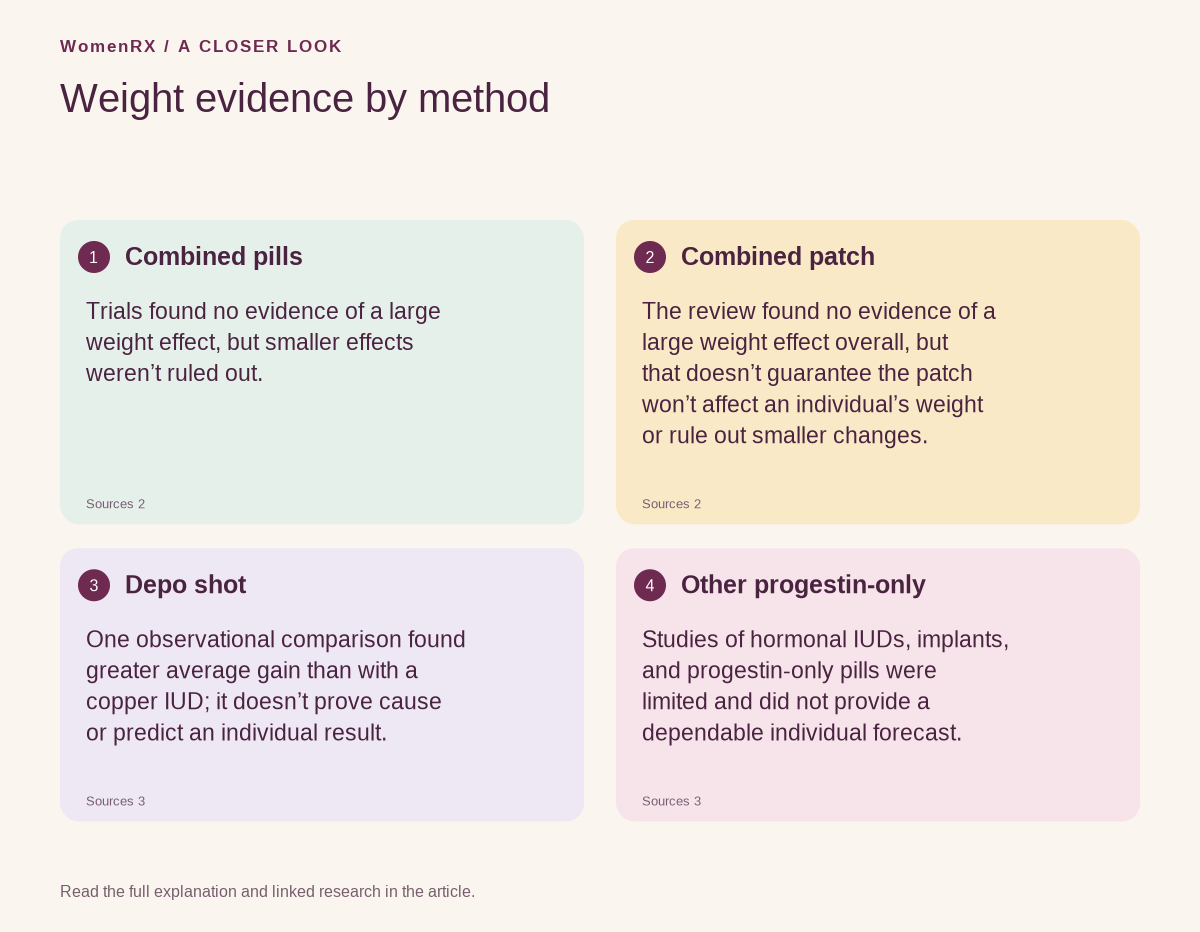
Weight evidence by method
Combined pills: Trials found no evidence of a large weight effect, but smaller effects weren’t ruled out.2
Combined patch: The review found no evidence of a large weight effect overall, but that doesn’t guarantee the patch won’t affect an individual’s weight or rule out smaller changes.2
Depo shot: One observational comparison found greater average gain than with a copper IUD; it doesn’t prove cause or predict an individual result.3
Other progestin-only: Studies of hormonal IUDs, implants, and progestin-only pills were limited and did not provide a dependable individual forecast.3
Read the figure as text
The studies don’t support one weight forecast for every hormonal method. These comparisons show where findings are more reassuring and where uncertainty remains.- Combined pills: Trials found no evidence of a large weight effect, but smaller effects weren’t ruled out.2
- Combined patch: The review found no evidence of a large weight effect overall, but that doesn’t guarantee the patch won’t affect an individual’s weight or rule out smaller changes.2
- Depo shot: One observational comparison found greater average gain than with a copper IUD; it doesn’t prove cause or predict an individual result.3
- Other progestin-only: Studies of hormonal IUDs, implants, and progestin-only pills were limited and did not provide a dependable individual forecast.3
More questions, answered
If I gain weight after starting contraception, does that mean it caused the change?
Not necessarily. The timing is worth noticing, but it doesn’t establish cause. Reviews of contraceptive studies found insufficient evidence to determine a weight effect for combined methods, and the evidence for progestin-only methods was limited overall. Weight includes water, muscle, bone, and fat, and other everyday factors can affect it. If the change matters to you, that’s still a reasonable reason to revisit whether the method fits. 1 2 3
Does the evidence mean I should avoid the Depo shot?
The review raises a possible weight concern for DMPA, but its overall evidence was low quality and the reported comparison was observational. It doesn’t establish that you’ll gain weight. Consider that uncertainty alongside the priorities that matter to you when choosing a method. 3
Sources you can check
- Body Weight: MedlinePlusAccessed 2026-09-25Return to first citation
- Combination contraceptives: effects on weight.Gallo MF, Lopez LM, Grimes DA, Carayon F, Schulz KF, Helmerhorst FM. · The Cochrane database of systematic reviews · 2014Return to first citation
- Progestin-only contraceptives: effects on weight.Lopez LM, Ramesh S, Chen M, Edelman A, Otterness C, Trussell J, Helmerhorst FM. · The Cochrane database of systematic reviews · 2016Return to first citation