Stopping Birth Control Without a Protection Gap
Pregnancy may become possible soon after some methods end, while the injection can take longer to wear off, so the next step depends on what you use now.
If you’re stopping birth control but don’t want to get pregnant, arrange the next method before your current protection ends. You could become pregnant as soon as Mirena is removed. Pregnancy may also become possible after stopping pills or removing an implant or copper IUD, while fertility return after the Depo-Provera injection is often delayed. 458 Neither pattern tells you exactly when you’ll conceive or how long an overdue shot protects you. Switching instructions depend on both methods. 36

Start with the method you’re leaving
Stopping birth control isn’t one uniform process. You can stop taking pills, while removing Mirena requires a healthcare provider. Implants and copper IUDs are other reversible devices, but Mirena’s removal timetable does not tell you how to switch from either one. The injection is given about every three months rather than removed. If you need continued pregnancy protection, the handoff depends on the method you use and the method you want next. 136
If pregnancy is your goal, a systematic review followed pregnancy outcomes among 14,884 women who stopped contraception intending to conceive, including women who stopped pills or had an implant or IUD removed. Pregnancy within a year was documented after each of those methods, but the outcomes cannot tell any one person when she’ll ovulate. A separate review describes conception without a lingering contraceptive effect after stopping progestin-only pills or removing an implant. Time to pregnancy also depends on factors beyond the method stopped. 45
Switching? Match the handoff to your method
The practical question is whether the new method needs to be working before the old one ends. These are specific examples from US product instructions, not a universal switching schedule:
- From one combination pill to another: Instructions for Lo Loestrin Fe say to start it on the day you would have taken the next pill from your previous combination-pill pack, without skipping days between packs. Other products may have different instructions, so check the plan for the pill you’re starting. 7
- From a pill, patch or ring to Mirena: Mirena’s instructions allow insertion while you’re still using the previous method. If it’s inserted during active use, the instructions call for continuing that method for seven days after insertion or until the end of the current treatment cycle. This is an example of overlap rather than stopping first and arranging insertion later. 6
- Removing Mirena to use something else: If you have regular cycles, its instructions describe two ways to maintain continuous contraception: remove it during the first seven days of the menstrual cycle and start the new method immediately, or start the new method at least seven days before removal when removal is planned for another time in the cycle. If your cycles are irregular or you have no periods, start the new method at least seven days before removal. 6
- From a pill to the Depo-Provera injection: Depo-Provera’s instructions say to give the first injection the day after the last active pill, or, at the latest, the day following the final inactive pill. Those are instructions for switching to Depo-Provera, not for switching away from it. 3
Two more device handoffs have different instructions:
- From an implant or another intrauterine system to Mirena: Mirena’s instructions say to insert it on the same day the implant or previous intrauterine system is removed. That is a Mirena starting instruction, not a timetable for every implant or IUD switch. 6
- From an injection to Mirena: Mirena’s instructions call for seven days of nonhormonal backup if insertion occurs more than 13 weeks after the last injection. 6
If you’re stopping injections without starting Mirena, plan another method before relying on it for protection. Depo-Provera is given about every three months, but its reported median of 10 months from the last injection to conception among women who did conceive concerns fertility return, not how long an overdue shot protects against pregnancy. Neither figure supplies a switching schedule for every replacement method. 3
If you use a copper IUD, it does not release hormones, so there is no contraceptive hormone to wear off after removal. Pregnancy is possible after removal; you can’t count on predicting an individual ovulation date to plan your next method. The Mirena removal instructions above do not establish when to start another method after copper IUD use. Arrange the handoff for the replacement you choose rather than borrowing Mirena’s seven-day removal rule. The same applies to an implant switch other than the implant-to-Mirena example. 1468
If sex has already happened during a possible protection gap, ask promptly about emergency contraception rather than waiting to see what happens. The CDC lists the copper IUD as an emergency-contraception option that can be placed within five days of unprotected sex. 8
What bleeding may tell you, and what it can’t
What changes after stopping depends partly on how the method affected your bleeding while you used it. For example, Mirena can make periods lighter or stop them; its instructions say menstrual periods should return after removal. Depo-Provera can cause irregular bleeding or no bleeding during use, and its instructions say periods will usually return to their normal cycle in time after stopping. Neither instruction gives you an exact date for your first period. 36
If a combined pill reduced your menstrual bleeding, that change may not persist after you stop taking it. Implant use can involve absent, infrequent or unpredictable bleeding, while a copper IUD does not release hormones. After stopping pills or removing an implant or copper IUD, track bleeding, but don’t treat the timing of your first period as a test of when pregnancy becomes possible. 58910
Bleeding alone doesn’t establish when ovulation has returned. Researchers assess fertility return through pregnancy outcomes or measures of ovulation, and time to pregnancy reflects more than the contraceptive method. With Depo-Provera, fertility return is likely to be delayed: among women who became pregnant in a US follow-up study cited in its instructions, the median time to conception was 10 months from the last injection. The study lacked follow-up information for 39% of those who stopped to become pregnant, and the median isn’t a deadline or a prediction for you. 35
A method may also have been treating something, not just preventing pregnancy. Mirena is used to reduce heavy menstrual bleeding, while combined hormonal contraception can reduce heavy bleeding and menstrual pain. If you had those symptoms before starting, they may return when the treatment ends, but improvement during treatment can’t tell you whether they will or how severe they’ll be. Notice whether bleeding, pain or other familiar symptoms are coming back so you can choose a replacement that addresses both your pregnancy plans and your periods. Unusually heavy bleeding or severe lower abdominal pain warrants medical attention. The Mirena and Depo-Provera instructions flag these as concerning symptoms during use, not as predictable effects of stopping. 3610
If you’ve recently had a baby
Breastfeeding changes the contraception conversation, but breastfeeding alone isn’t a blanket substitute for a method. The CDC’s temporary lactational amenorrhea method applies only while all three conditions hold: you’ve had no menstrual periods since birth, you’re fully or nearly fully breastfeeding, and you’re under six months postpartum. Plan another method when any one condition no longer applies. 8
If you’re breastfeeding and considering a new combined hormonal method, the choice also involves milk supply. US instructions for a combined pill state that these contraceptives can reduce milk production and suggest considering other methods while breastfeeding. Lo Loestrin Fe’s postpartum start instructions address women who are not breastfeeding, so do not apply that timing while breastfeeding. Settle the next-method plan before stopping the one you have, rather than borrowing a switching schedule meant for someone who hasn’t recently given birth. 7
If you’re stopping contraception to try to conceive, preconception care can help you address existing health concerns, such as diabetes or high blood pressure, before pregnancy. If you’re stopping but still want to avoid pregnancy, remember that most contraceptive methods don’t protect against sexually transmitted infections; external latex condoms can help with that separate concern. 28
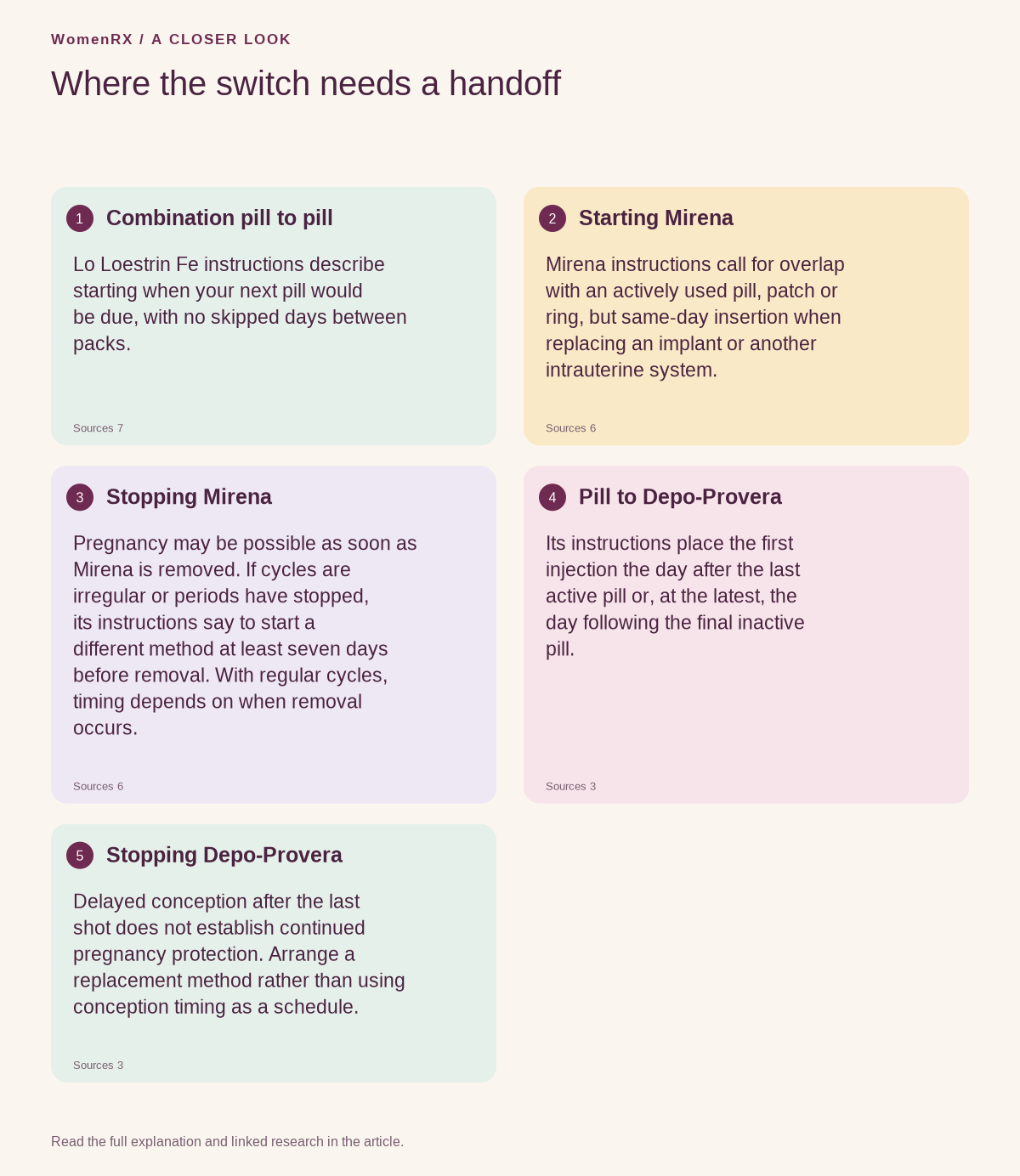
Where the switch needs a handoff
Combination pill to pill: Lo Loestrin Fe instructions describe starting when your next pill would be due, with no skipped days between packs.7
Starting Mirena: Mirena instructions call for overlap with an actively used pill, patch or ring, but same-day insertion when replacing an implant or another intrauterine system.6
Stopping Mirena: Pregnancy may be possible as soon as Mirena is removed. If cycles are irregular or periods have stopped, its instructions say to start a different method at least seven days before removal. With regular cycles, timing depends on when removal occurs.6
Pill to Depo-Provera: Its instructions place the first injection the day after the last active pill or, at the latest, the day following the final inactive pill.3
Stopping Depo-Provera: Delayed conception after the last shot does not establish continued pregnancy protection. Arrange a replacement method rather than using conception timing as a schedule.3
Read the figure as text
These examples distinguish pill, device and injection handoffs. The timing given for Mirena does not apply to every IUD or implant switch.- Combination pill to pill: Lo Loestrin Fe instructions describe starting when your next pill would be due, with no skipped days between packs.7
- Starting Mirena: Mirena instructions call for overlap with an actively used pill, patch or ring, but same-day insertion when replacing an implant or another intrauterine system.6
- Stopping Mirena: Pregnancy may be possible as soon as Mirena is removed. If cycles are irregular or periods have stopped, its instructions say to start a different method at least seven days before removal. With regular cycles, timing depends on when removal occurs.6
- Pill to Depo-Provera: Its instructions place the first injection the day after the last active pill or, at the latest, the day following the final inactive pill.3
- Stopping Depo-Provera: Delayed conception after the last shot does not establish continued pregnancy protection. Arrange a replacement method rather than using conception timing as a schedule.3
More questions, answered
Will years on the pill make it harder to get pregnant later?
A systematic review found no significant association between duration of contraceptive use and return of fertility overall, but findings about longer pill use varied. The review cannot predict how quickly you’ll conceive. 4
Sources you can check
- Birth Control | Contraception | Contraceptives | MedlinePlusAccessed 2026-09-25Return to first citation
- Preconception Care: MedlinePlusAccessed 2026-09-25Return to first citation
- DEPO-PROVERA (MEDROXYPROGESTERONE ACETATE) INJECTION, SUSPENSION [PHARMACIA & UPJOHN COMPANY LLC] | US prescribing information and patient instructionsAccessed 2026-09-25Return to first citation
- Return of fertility after discontinuation of contraception: a systematic review and meta-analysis.Girum T, Wasie A. · Contraception and reproductive medicine · 2018Return to first citation
- Potential biomarkers to predict return to fertility after discontinuation of female contraceptives-looking to the future.Cordova-Gomez A, Wong AP, Sims LB, Doncel GF, Dorflinger LJ. · Frontiers in reproductive health · 2023Return to first citation
- MIRENA (LEVONORGESTREL) INTRAUTERINE DEVICE [BAYER HEALTHCARE PHARMACEUTICALS INC.] | US prescribing information and patient instructionsAccessed 2026-09-25Return to first citation
- LO LOESTRIN FE (NORETHINDRONE ACETATE AND ETHINYL ESTRADIOL, ETHINYL ESTRADIOL AND FERROUS FUMARATE) KIT [ALLERGAN, INC.] | US prescribing information and patient instructionsAccessed 2026-09-25Return to first citation
- CDC: Birth control methods, barrier methods, fertility awareness and breastfeedingAccessed 2026-09-25Return to first citation
- The effects of Implanon on menstrual bleeding patterns.Mansour D, Korver T, Marintcheva-Petrova M, Fraser IS. · The European journal of contraception & reproductive health care : the official journal of the European Society of Contraception · 2008Return to first citation
- [Additional non-contraceptive effects of contraception: CNGOF Contraception Guidelines].Amat L, Bulach A, Leclercq M, Mesrine S, Scheffler F, Sperandeo D, Scheffler M. · Gynecologie, obstetrique, fertilite & senologie · 2018Return to first citation