Choosing Birth Control During Perimenopause
Pregnancy prevention, bleeding control, and hot-flash relief are three different jobs, and one method may not do them all.
You can still become pregnant during perimenopause, even when periods are irregular or far apart. If pregnancy isn’t wanted, keep contraception in the picture while you weigh two other needs: what’s happening with your bleeding, and whether symptoms such as hot flashes need treatment. Combined hormonal contraception may help with cycle irregularity, but your medical history affects whether it’s suitable. Menopause hormone therapy treats symptoms; it doesn’t replace a contraception plan. 452
Start with the job you need done
Perimenopause can bring unpredictable cycles and a decline in fertility, but pregnancy remains possible. That’s why a skipped period isn’t, by itself, a reason to stop birth control. A review of contraception in perimenopause recommends continuing contraception until menopause is confirmed. 4
Then separate the other goals. You might want more predictable bleeding, relief from hot flashes, or both. A method that prevents pregnancy won’t necessarily address either symptom. Conversely, a treatment chosen for hot flashes doesn’t settle the question of pregnancy prevention. Thinking in these three lanes makes the tradeoffs easier to see. 52
When cycle control is part of the goal
Combined hormonal contraception, which contains estrogen and a progestin, can prevent pregnancy and may also control menstrual irregularity during perimenopause. That makes it worth considering if changing cycles are the main frustration. Its symptom benefits shouldn’t be taken to mean it’s the right choice for every woman with hot flashes. 5
Medical history matters more than your birthday alone. The CDC’s contraceptive eligibility guidance does not rule out combined hormonal contraception solely because you’re in your 40s. But it classifies the method differently when other risks are present. Migraine with aura or markedly high blood pressure makes combined hormonal contraception an unsuitable choice under that guidance. Smoking at age 35 or older, even with fewer than 15 cigarettes a day, generally weighs against it; the classification is more restrictive with heavier smoking. A history of a blood clot also requires a closer look, with the classification depending on the circumstances. Blood pressure should be measured before starting a combined hormonal method. 67
For example, if you’ve begun having irregular periods and also have migraine with aura, the cycle-control appeal of a combined pill doesn’t erase the migraine-related restriction. A different contraceptive approach and, if needed, separate symptom treatment may fit better. 63
When pregnancy prevention and symptom treatment need separate plans
Progestin-only methods include the levonorgestrel IUD, implant, pill, and medroxyprogesterone injection. Nonhormonal contraception, including the copper IUD, is another path. These options let you address pregnancy prevention without assuming you need an estrogen-containing contraceptive. Which one fits depends partly on your bleeding priorities and medical history. 65
Bleeding can be especially hard to interpret with the medroxyprogesterone injection. Its prescribing information describes irregular, prolonged, or heavy bleeding, as well as periods stopping altogether. In its clinical studies, 55% of users reported no menstrual bleeding by month 12. No bleeding while using the injection therefore isn’t a reliable way to tell whether menopause has arrived. Persistent or severe abnormal bleeding deserves evaluation rather than being automatically attributed to the method or to perimenopause. 14
If hot flashes are the problem that most affects your day, it may make more sense to discuss them as a treatment goal in their own right. Menopause hormone therapy is the most effective treatment for vasomotor symptoms, according to the North American Menopause Society’s 2022 position statement, but its benefits and risks vary with the regimen and the woman using it. A perimenopausal contraception review describes progestin-only contraception used alongside estrogen therapy as one possible way to address both needs. There are also evidence-supported nonhormonal options for hot flashes, including cognitive-behavioral therapy and certain prescription medicines. The key distinction is that treating hot flashes doesn’t remove the need to decide how to prevent pregnancy. 2534
Let bleeding patterns influence the comparison, not make the diagnosis
A method may change whether you bleed, how often you bleed, or how predictable bleeding feels. That change can be useful, frustrating, or both. It can also obscure a menstrual pattern you might otherwise have used to recognize the transition toward menopause. The absence of periods on a hormonal contraceptive shouldn’t be treated as proof that contraception is no longer needed. 14
New heavy or otherwise unexplained bleeding also shouldn’t simply be written off as perimenopause. The CDC treats unexplained bleeding that could signal a serious condition differently from an established irregular pattern when assessing whether to start some methods, particularly an IUD. If that’s what’s happening, finding the cause belongs ahead of choosing a method mainly for bleeding control. 6
A useful way to narrow the choice is to decide which benefit you need most: dependable pregnancy prevention alone, pregnancy prevention with better cycle control, or pregnancy prevention plus separate treatment for hot flashes. From there, factors such as blood pressure, smoking, migraine aura, and clot history can change which routes remain reasonable. There’s no single perimenopause method that has to carry all three jobs. 4562
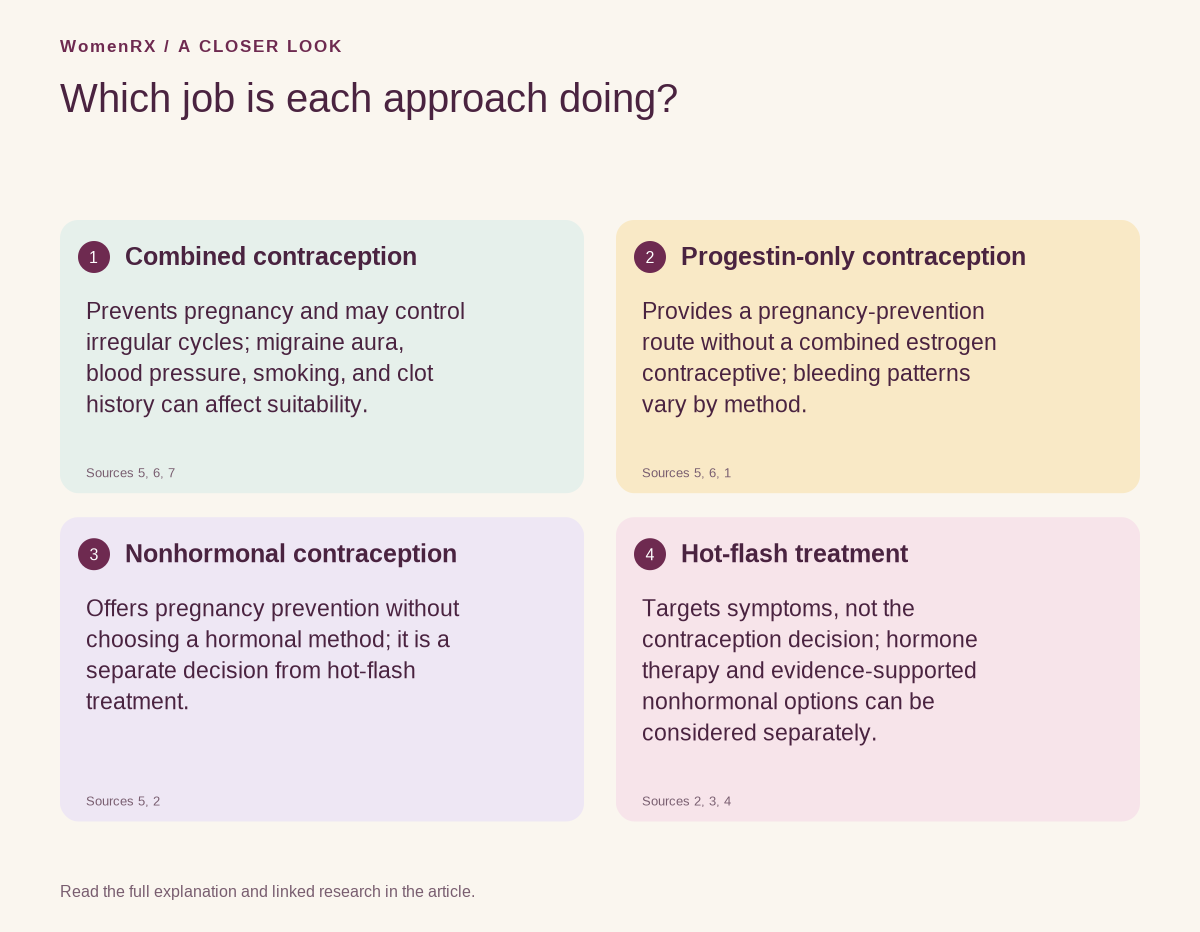
Which job is each approach doing?
Combined contraception: Prevents pregnancy and may control irregular cycles; migraine aura, blood pressure, smoking, and clot history can affect suitability.567
Progestin-only contraception: Provides a pregnancy-prevention route without a combined estrogen contraceptive; bleeding patterns vary by method.561
Nonhormonal contraception: Offers pregnancy prevention without choosing a hormonal method; it is a separate decision from hot-flash treatment.52
Hot-flash treatment: Targets symptoms, not the contraception decision; hormone therapy and evidence-supported nonhormonal options can be considered separately.234
Read the figure as text
Compare the primary role of four approaches before weighing bleeding preferences and medical history.- Combined contraception: Prevents pregnancy and may control irregular cycles; migraine aura, blood pressure, smoking, and clot history can affect suitability.567
- Progestin-only contraception: Provides a pregnancy-prevention route without a combined estrogen contraceptive; bleeding patterns vary by method.561
- Nonhormonal contraception: Offers pregnancy prevention without choosing a hormonal method; it is a separate decision from hot-flash treatment.52
- Hot-flash treatment: Targets symptoms, not the contraception decision; hormone therapy and evidence-supported nonhormonal options can be considered separately.234
More questions, answered
Does turning 40 mean I have to stop taking a combined pill?
No. Age alone does not rule out combined hormonal contraception during perimenopause. The decision changes when factors such as smoking, high blood pressure, migraine with aura, or a clot history enter the picture. 56
If my periods stop on birth control, can I stop using it?
Not on that basis alone. Hormonal contraception can change or stop bleeding, so a missing period while using it doesn’t establish that menopause has occurred. Pregnancy prevention still needs its own plan until menopause is confirmed. 14
Sources you can check
- DEPO-PROVERA (MEDROXYPROGESTERONE ACETATE) INJECTION, SUSPENSION [PHARMACIA & UPJOHN COMPANY LLC] | US prescribing information and patient instructionsAccessed 2026-09-25Return to first citation
- The 2022 hormone therapy position statement of The North American Menopause Society.“The 2022 Hormone Therapy Position Statement of The North American Menopause Society” Advisory Panel. · Menopause (New York, N.Y.) · 2022Return to first citation
- The 2023 nonhormone therapy position statement of The North American Menopause Society.Menopause (New York, N.Y.) · 2023Return to first citation
- Contraception in perimenopause.Soltes BA. · Menopause (New York, N.Y.) · 2025Return to first citation
- Perimenopausal contraception.Voedisch AJ, Ariel D. · Current opinion in obstetrics & gynecology · 2020Return to first citation
- Appendix A: Summary of Classifications for U.S. Medical Eligibility Criteria for Contraceptive Use, 2024 | Contraception | CDCAccessed 2026-09-25Return to first citation
- Combined Hormonal Contraceptives | Contraception | CDCAccessed 2026-09-25Return to first citation