Getting Birth Control Online: What Telehealth Can Do
Online care may help with some prescription contraception, but procedures such as IUD placement still happen in person.
An online service may let you discuss contraception and request a prescription for some hormonal methods, but a prescription isn’t guaranteed. Check which methods the service offers. Ask what methods it provides, what health screening it uses, whether it can arrange in-person care, and how refills work. IUDs and implants require a provider to place them; injections also require an office visit. 1 4 5
First, match the service to the step you need
Telehealth can be a useful way to discuss contraception and seek a prescription. A US study of one online platform analyzed 38,439 requests for prescription hormonal birth control from 2015 to 2017; methods were dispensed for 63% of requests. That older, single-platform result doesn’t predict what a service will offer today, but it’s a reminder that submitting an intake form doesn’t guarantee a prescription. 5
Before you start, check which methods the service actually offers where you live. Ask whether it can assess you for a new prescription, whether it handles refills, and what it does if your preferred method needs an exam or procedure. Those are questions to ask, not services every online provider necessarily offers. One review notes that state-to-state differences in minor consent, pharmacist prescribing, and telehealth laws can affect young people's access to newer options. 4
What can be handled remotely, and what cannot
A consultation or prescription request: Some web-based platforms provide access to prescription hormonal contraception. The specific methods available depend on the service. A remote visit may be enough for a clinician to assess a request, but the service may decide that another step is needed. 4 5
A refill: Ask directly whether the service handles refills and what information it needs. The online-platform study supports the availability of prescription requests, not a promise that every service offers refills. 5
An IUD or implant: These devices must be placed by a provider. MedlinePlus describes IUD insertion and implant placement as provider procedures, and the Office on Women’s Health says IUD insertion is performed in an office or clinic. An online visit may help you discuss options, but it doesn’t place the device. 1 3
An injection: The contraceptive injection is given in a provider’s office, so it also requires an in-person step. 1
This distinction can help you avoid choosing a service that can discuss a method but can’t complete the care you want. If you’re interested in a device or injection, ask whether the service can connect you with an in-person provider or whether you’ll need to arrange that separately.
What a useful screening process should clarify
Ask the service what health information it uses to assess the method you’re requesting. In a study of one online platform, researchers estimated that 12.0% of patients who reported their blood pressure had a contraindication to combined hormonal methods. That figure comes from people using that platform in 2015-2017, not from all women seeking contraception. It does show why it’s worth asking how the service considers blood pressure and health history when assessing a method. 5
A practical service check:
- Who reviews your information? Ask who evaluates the intake and how to reach that person with a question.
- What does screening include? Ask which health details or measurements matter for the method you want, and what happens if something needs follow-up.
- What’s available where you live? Confirm the specific method and next steps before paying or submitting a full intake. State laws can affect young people's access to some newer options. 4
- Can the service complete the care? For an IUD, implant, or injection, ask how the in-person portion is arranged. 1 3
- How do refills work? Ask about the service’s refill process rather than assuming it’s included.
If you’re postpartum or breastfeeding
Mention that you’ve recently given birth or are breastfeeding when you ask about contraception. Those details are part of choosing a method, and the right prescription option depends on your circumstances.
Breastfeeding only counts as the temporary lactational amenorrhea method when all three conditions apply: you haven’t had a period since giving birth, you’re fully or nearly fully breastfeeding, and you’re less than six months postpartum. If any one of those conditions stops being true, the CDC says another method is needed. 2
The useful bottom line
Online care can be a starting point for discussing and requesting some prescription contraception; it isn’t a universal route to every method or every step. Before choosing a service, confirm what it can provide where you live, how it screens your request, whether refills are available, and how any needed in-person care will happen. If you want an IUD, implant, or injection, plan for that in-person step. 1 4 5
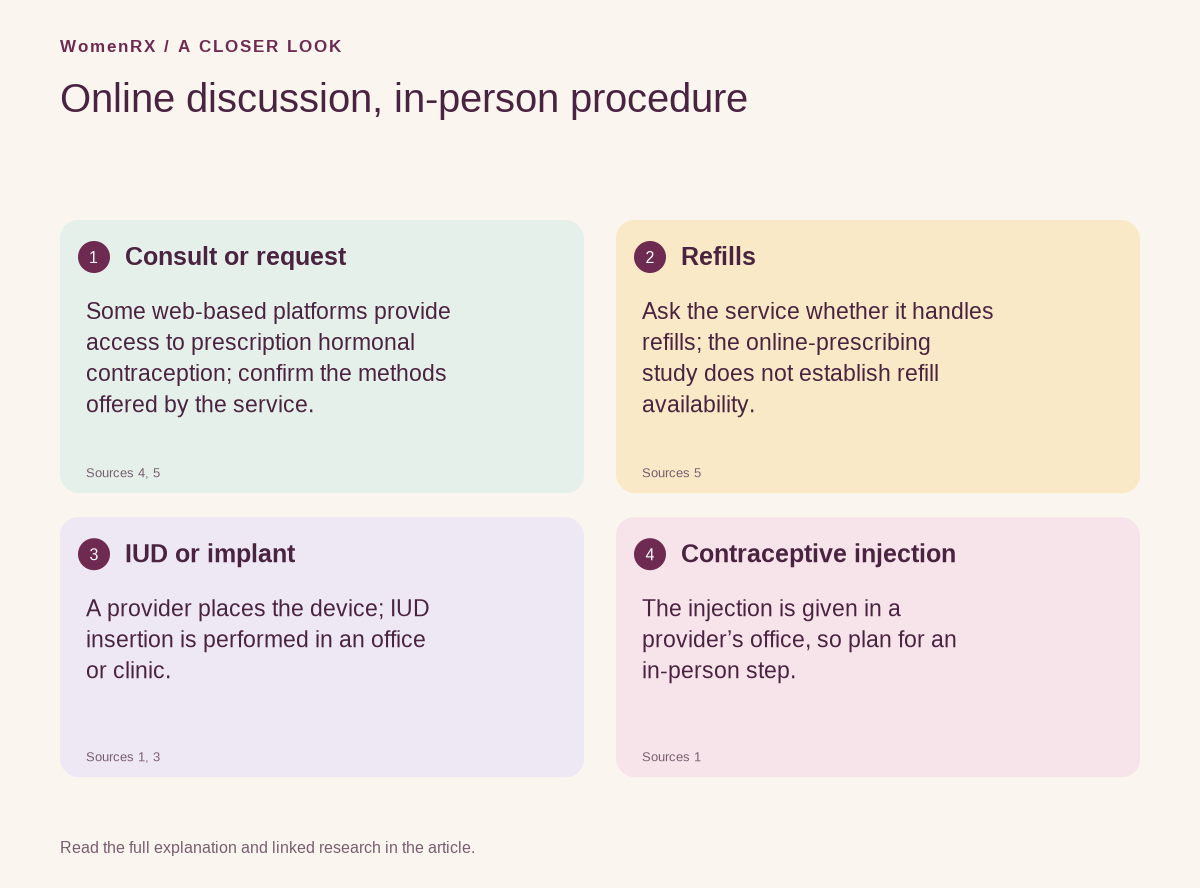
Online discussion, in-person procedure
Consult or request: Some web-based platforms provide access to prescription hormonal contraception; confirm the methods offered by the service.45
Refills: Ask the service whether it handles refills; the online-prescribing study does not establish refill availability.5
IUD or implant: A provider places the device; IUD insertion is performed in an office or clinic.13
Contraceptive injection: The injection is given in a provider’s office, so plan for an in-person step.1
Read the figure as text
A quick comparison of what may begin remotely and which contraceptive steps require a provider in person.- Consult or request: Some web-based platforms provide access to prescription hormonal contraception; confirm the methods offered by the service.45
- Refills: Ask the service whether it handles refills; the online-prescribing study does not establish refill availability.5
- IUD or implant: A provider places the device; IUD insertion is performed in an office or clinic.13
- Contraceptive injection: The injection is given in a provider’s office, so plan for an in-person step.1
More questions, answered
Does an online request mean I’ll get a prescription?
No. In a study of one US online platform, methods were dispensed for 63% of prescription hormonal birth control requests submitted from July 2015 through September 2017. That finding describes that platform and period, not every service today. 5
Can breastfeeding alone prevent pregnancy?
Only under the CDC’s three conditions for lactational amenorrhea: no period since birth, fully or nearly fully breastfeeding, and less than six months postpartum. If any condition changes, another method is needed. 2
Sources you can check
- Birth Control | Contraception | Contraceptives | MedlinePlusAccessed 2026-09-25Return to first citation
- CDC: Birth control methods, barrier methods, fertility awareness and breastfeedingAccessed 2026-09-25Return to first citation
- Office on Women's Health: Barrier contraception side effectsAccessed 2026-09-25Return to first citation
- Expanding adolescent access to hormonal contraception: an update on over-the-counter, pharmacist prescribing, and web-based telehealth approaches.Williams RL, Meredith AH, Ott MA. · Current opinion in obstetrics & gynecology · 2018Return to first citation
- Who Accesses Birth Control Online? An Analysis of Requests for Contraception Submitted to an Online Prescribing Platform in the United States.Wollum A, Zuniga C, Grindlay K, Grossman D. · Women's health issues : official publication of the Jacobs Institute of Women's Health · 2023Return to first citation