Getting Birth Control Pills Online: What to Check
An online prescription should come with a pill choice that fits your health history and a clear plan for questions after you start.
To get the pill online, expect questions about your health history, smoking, medicines, and whether you’ve recently given birth or are breastfeeding. Those answers help a prescriber assess whether a combined pill or a progestin-only pill is appropriate. Before you choose a service, check that it provides instructions for your exact pill and a way to get help if you miss pills or develop concerns. 35
Why the type of pill matters
“The pill” can mean a pill containing both estrogen and progestin, or one containing progestin only. The choice isn’t just a preference between two hormone combinations. Your health history can change which methods are appropriate, and CDC guidance calls for that assessment to be individualized. 15
For example, smoking is especially relevant when considering a combined pill. CDC guidance says combined oral contraceptives usually aren’t recommended for people 35 or older who smoke fewer than 15 cigarettes a day, and shouldn’t be used by those 35 or older who smoke 15 or more. A history of blood clots or a newly diagnosed condition also deserves review rather than an automatic refill. 5
If you’ve recently given birth, say how long it’s been and whether you’re breastfeeding. The timing matters: CDC classifies combined hormonal contraception as an unacceptable health risk during the first 21 days postpartum for people who are breastfeeding, while its classification for progestin-only pills differs. After that, your circumstances still matter, so a service shouldn’t make the choice from breastfeeding status alone. 5
Breastfeeding concerns can also be part of the conversation, without treating one study as a prediction for you. In a U.S. observational cohort of 1,349 women who intended to breastfeed for at least four months, those reporting progestin-only pill use at three months had higher adjusted odds of breastfeeding at four months than those using nonhormonal contraception. Those reporting combined hormonal contraception had lower adjusted odds than the nonhormonal group. These associations cannot establish that the contraceptives caused the differences. 4
What a useful online screening should cover
Look for a service that gives you room to report your medical conditions, medicines, and changes in health, rather than offering a pill based only on your age and shipping address. CDC eligibility guidance addresses conditions including blood clots, chronic kidney disease, sickle cell disease, and the postpartum period, as well as interactions involving certain medicines used to prevent or treat HIV. You don’t need to work out the eligibility categories yourself. The useful question is whether a prescriber will review the details that apply to you and explain the choice. 5
A short set of questions can help you judge the service before paying or submitting a request:
- Who reviews my answers, and can I ask why this pill was chosen? Your medical history may make one category of pill a better fit than another. 5
- Will I receive instructions for the exact pill prescribed? Missed-pill directions can depend on which pills in a pack were missed. The patient instructions for one combined pill, Lo Loestrin Fe, distinguish between different pills and weeks of its pack, so its directions shouldn’t be treated as instructions for every pill. 3
- How do I reach the prescriber if I miss pills, have side effects, or my health changes? CDC eligibility guidance applies to continued use as well as starting a method, including when a condition develops or worsens. 5
Follow-up is more than a refill reminder
Before you start, know where to find your pill’s missed-dose instructions and how to get a timely answer if you’re unsure whether you need backup contraception. Don’t substitute directions you find for another brand: even within the Lo Loestrin Fe pack, its patient instructions give different directions for different missed pills. 3
You should also be able to raise side effects that affect your day-to-day life. Mood is one example worth mentioning if it changes after you start. A meta-analysis found an association between oral contraceptive use and depression diagnoses in studies of women without pre-existing psychological or gynecological conditions; observational associations don’t show that the pill caused depression in any individual woman. That’s a reason to make room for a conversation about how you’re feeling, not to assume what’s causing it. 6
An online service can be convenient, but convenience shouldn’t leave you guessing. The strongest sign of useful follow-up is straightforward: you know which pill you’ve been prescribed, why it fits your reported history, where its instructions are, and how to reach someone when a missed pill, side effect, or health change makes the next step unclear. 35
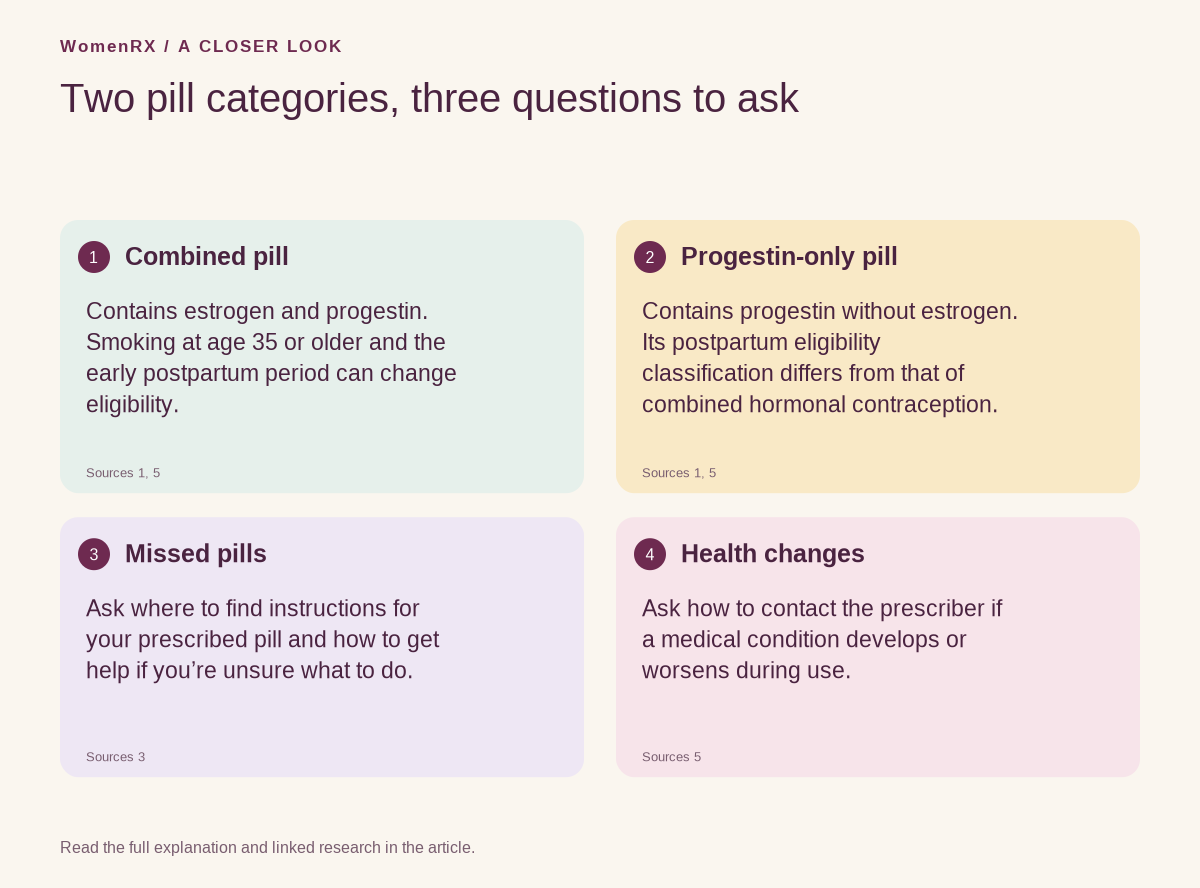
Two pill categories, three questions to ask
Combined pill: Contains estrogen and progestin. Smoking at age 35 or older and the early postpartum period can change eligibility.15
Progestin-only pill: Contains progestin without estrogen. Its postpartum eligibility classification differs from that of combined hormonal contraception.15
Missed pills: Ask where to find instructions for your prescribed pill and how to get help if you’re unsure what to do.3
Health changes: Ask how to contact the prescriber if a medical condition develops or worsens during use.5
Read the figure as text
First ask: Who reviews my health information and explains why this pill fits? Then use the two follow-up prompts below to ask about support after it’s prescribed. 5- Combined pill: Contains estrogen and progestin. Smoking at age 35 or older and the early postpartum period can change eligibility.15
- Progestin-only pill: Contains progestin without estrogen. Its postpartum eligibility classification differs from that of combined hormonal contraception.15
- Missed pills: Ask where to find instructions for your prescribed pill and how to get help if you’re unsure what to do.3
- Health changes: Ask how to contact the prescriber if a medical condition develops or worsens during use.5
More questions, answered
Will birth control pills protect me from sexually transmitted infections?
No. Birth control pills do not protect against HIV or other sexually transmitted infections. External latex condoms can help protect against HIV and other STIs. 32
Does breastfeeding on its own prevent pregnancy?
Not necessarily. CDC describes breastfeeding as temporary contraception only when all three conditions apply: you have had no menstrual periods since birth, you are fully or nearly fully breastfeeding, and you are under six months postpartum. Another method is needed once any condition no longer applies. 2
Sources you can check
- Birth Control | Contraception | Contraceptives | MedlinePlusAccessed 2026-09-25Return to first citation
- CDC: Birth control methods, barrier methods, fertility awareness and breastfeedingAccessed 2026-09-25Return to first citation
- LO LOESTRIN FE (NORETHINDRONE ACETATE AND ETHINYL ESTRADIOL, ETHINYL ESTRADIOL AND FERROUS FUMARATE) KIT [ALLERGAN, INC.] | US prescribing information and patient instructionsAccessed 2026-09-25Return to first citation
- Contraception and Breastfeeding at 4 Months Postpartum Among Women Intending to Breastfeed.Goulding AN, Wouk K, Stuebe AM. · Breastfeeding medicine : the official journal of the Academy of Breastfeeding Medicine · 2018Return to first citation
- U.S. Medical Eligibility Criteria for Contraceptive Use, 2024.Nguyen AT, Curtis KM, Tepper NK, Kortsmit K, Brittain AW, Snyder EM, Cohen MA, Zapata LB, Whiteman MK, Contributors. · MMWR. Recommendations and reports : Morbidity and mortality weekly report. Recommendations and reports · 2024Return to first citation
- Association of oral contraceptives with depression symptoms, diagnosis, and treatment in healthy women: A meta-analysis.Kellock MD, Potts HWW, Pinho G, Chilanga F, Farič N. · European journal of obstetrics, gynecology, and reproductive biology · 2026Return to first citation