Sprintec and weight: what the evidence can tell you
Weight changes after starting a pill can have several explanations, and studies of other contraceptives can’t establish what Sprintec did for you.
The cited research doesn’t report a Sprintec-specific weight finding, so it can’t show whether this pill caused your weight change. A review comparing a vaginal ring with combined pills found no change in average weight in either group; two trials comparing other pills found a difference between groups. Your scale also reflects water and other body tissues, not just body fat. 1 2 3
What the pill studies actually measured
The most useful short answer is that the cited trial results don’t establish a Sprintec-specific effect on weight. Studies of other combined contraceptives can offer context, but they can’t confirm what caused a change for one person.
A review of 12 randomized trials comparing the contraceptive vaginal ring with combined oral contraceptive pills reported that average body weight didn’t change in either group. That’s a finding about those study groups and comparisons, not proof that no individual gained weight or that every pill has the same effect. 3
In the combined results of two randomized trials, two other combined pills were compared over six cycles. The group taking one pill had less weight gain than the group taking the other. The result shows that one pill comparison can differ from another; it doesn’t tell us how Sprintec compares. 2
A scale change isn’t the same as body-fat gain
Body weight includes water, muscle, bone, and fat. A scale can show a change without revealing which of these accounts for it. 1 Feeling bloated and seeing a higher number are also different observations: note each separately rather than treating either one as proof of fat gain or proof that the pill is responsible.
Other changes happening around the same time can make the cause hard to pin down. For example, changes in routine, diet, activity, or health may coincide with starting contraception. Age and postpartum changes are worth noting too, if relevant to you, without assuming they explain the weight change. A change that begins after starting a pill is worth noticing, but timing alone doesn’t identify its cause.
Track the pattern without turning it into a verdict
If you want a clearer picture, make a brief, neutral record:
- Note when you started Sprintec and when you first noticed a change.
- If you weigh yourself, use the same scale and similar conditions each time, and pay attention to the pattern rather than a single reading.
- Record bloating or other symptoms separately from the number on the scale.
- Jot down major changes in routine or health that might help explain the timing.
This isn’t a test that can diagnose the cause. It’s a way to bring specific observations into a conversation instead of relying on a vague impression of “weight gain.”
What to discuss if the change bothers you
Tell your prescriber what changed, when it began, and whether you mean a scale change, bloating, or both. Ask whether other factors could explain the pattern and whether a different contraceptive approach makes sense for your needs. The studies above don’t support promising that Sprintec will cause weight gain, prevent it, or match the average outcome seen with another pill.
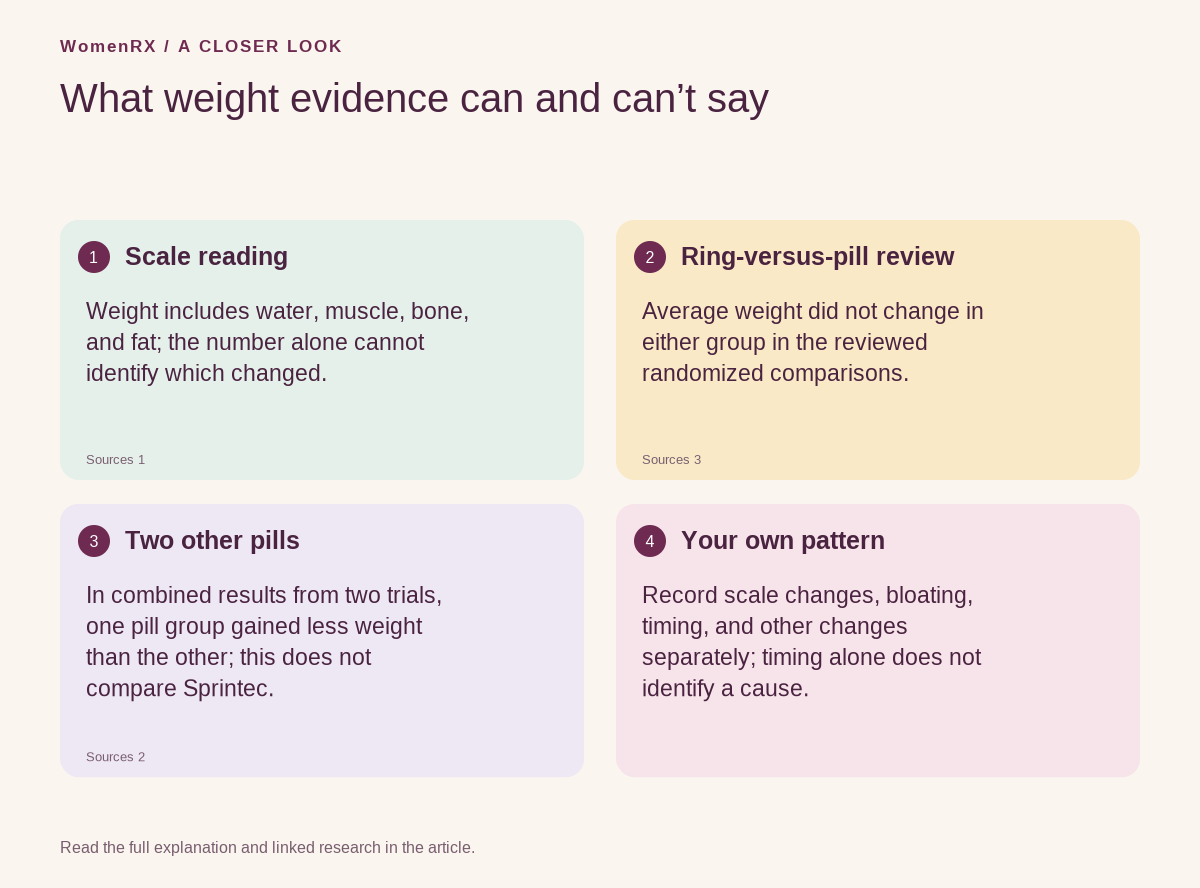
What weight evidence can and can’t say
Scale reading: Weight includes water, muscle, bone, and fat; the number alone cannot identify which changed.1
Ring-versus-pill review: Average weight did not change in either group in the reviewed randomized comparisons.3
Two other pills: In combined results from two trials, one pill group gained less weight than the other; this does not compare Sprintec.2
Your own pattern: Record scale changes, bloating, timing, and other changes separately; timing alone does not identify a cause.
Read the figure as text
Separate group-average findings from what a scale reading or an individual experience can establish.- Scale reading: Weight includes water, muscle, bone, and fat; the number alone cannot identify which changed.1
- Ring-versus-pill review: Average weight did not change in either group in the reviewed randomized comparisons.3
- Two other pills: In combined results from two trials, one pill group gained less weight than the other; this does not compare Sprintec.2
- Your own pattern: Record scale changes, bloating, timing, and other changes separately; timing alone does not identify a cause.
More questions, answered
Does a stable scale rule out feeling bloated?
A scale measures total body weight, including water, muscle, bone, and fat, but it can’t tell you which component changed. 1 Bloating is a separate observation; if useful, record it apart from the scale reading.
Can a study of another pill predict my experience with Sprintec?
Not reliably. The cited trials comparing two pills studied different products, and the ring-versus-pill review reported group averages. Neither establishes what caused a change for an individual taking Sprintec. 2 3
Sources you can check
- Body Weight: MedlinePlusAccessed 2026-09-25Return to first citation
- Efficacy, cycle control, and safety of two triphasic oral contraceptives: Cyclessa (desogestrel/ethinyl estradiol) and ortho-Novum 7/7/7 (norethindrone/ethinyl estradiol): a randomized clinical trial.Kaunitz AM. · Contraception · 2000Return to first citation
- The contraceptive vaginal ring compared with the combined oral contraceptive pill: a comprehensive review of randomized controlled trials.Roumen FJ. · Contraception · 2007Return to first citation