Hormonal Birth Control and Blood Clots: What Changes Your Risk
Estrogen-containing pills, patches, and rings deserve a different clot-risk conversation from most progestin-only methods.
Combined birth control pills, patches, and vaginal rings contain estrogen and increase the risk of a clot in a vein; most progestin-only methods have not shown the same increase. Your method, clot history, smoking, migraine symptoms, and whether you’ve recently given birth all matter. New swelling or pain in a limb needs prompt evaluation; breathing trouble or chest pain needs immediate medical help.489
Start with the kind of clot and the kind of birth control
A blood clot in a deep vein, often in a leg, is called deep vein thrombosis (DVT). If part of a clot travels to the lungs, it can cause a pulmonary embolism (PE). Together, they’re called venous thromboembolism, or VTE. This is the clot risk being compared here. Heart attack and stroke involve different blood vessels, though they also matter when choosing contraception.9
The first question to ask about a method is whether it contains estrogen. Combined pills contain estrogen and a progestin; combined patches and vaginal rings also deliver estrogen. A ring or patch isn’t exempt from clot risk because it doesn’t go through your stomach. Progestin-only pills, the implant, and hormonal IUDs are different choices. A copper IUD contains no hormones.134
What the numbers can, and can’t, tell you
In a Danish registry study of nonpregnant women ages 15 to 49 with no prior thrombotic disease, researchers observed 3.7 VTE events per 10,000 woman-years among women not using hormonal contraception. The crude rates were 7.5 per 10,000 woman-years among users of a combined pill containing levonorgestrel and 30-40 micrograms of ethinyl estradiol, and 9.3 among users of a combined pill containing drospirenone and 30-40 micrograms of ethinyl estradiol. A woman-year means one woman followed for one year, or an equivalent amount of follow-up across women. These are population rates, not the chance that any particular person will have a clot.7
The same study found that, after accounting for length of use, confirmed VTE occurred at about twice the rate among users of combined pills with drospirenone as among users of combined pills with levonorgestrel. That relative comparison is worth knowing, but it doesn’t mean a clot is likely for either user. Nor can those older Danish rates predict your risk if you have other health factors or use a different formulation. The study could not account for body mass index or family predisposition in its comparisons.7
Route matters less than the presence of estrogen when making an initial shortlist. In studies described in U.S. prescribing information, users of one ethinyl estradiol-containing vaginal ring had VTE rates similar to users of combined oral contraceptives; that’s not evidence that every ring and pill formulation has identical risk. A Finnish registry study also found an association with an estrogen-containing patch, but its patch estimate was imprecise. Neither finding makes a patch or ring a proven lower-clot-risk workaround for an estrogen-containing pill.68
Studies of progestin-only pills and hormone-releasing IUDs did not find an increased VTE risk compared with nonuse, and a more recent Finnish study similarly found no association for progestin-only contraception overall. Don’t automatically extend that finding to every injection: guidance treats depot medroxyprogesterone acetate separately in some higher-risk circumstances. If avoiding estrogen is your priority, you can compare the progestin-only pill, implant, hormonal IUD, injection, and copper IUD on their other practical tradeoffs rather than treating them as interchangeable.4578
When your own history changes the comparison
A previous DVT or PE, or a known clotting disorder, changes the discussion before you choose a combined method. U.S. contraceptive guidance evaluates prior clots in detail, including whether someone is receiving anticoagulant treatment. Tell the prescriber about a close family member’s clot, too, especially if you know they have an inherited clotting disorder. Family history is a risk factor, but it isn’t the same thing as having had a clot yourself.469
Smoking and age together are another clear dividing line: combined hormonal contraception should not be used by someone who smokes cigarettes and is over 35. As you get older, including in the years approaching menopause, a fresh review makes sense if other clot-risk factors have changed. That doesn’t mean age alone gives every person the same answer.46
Migraine with aura also needs to be named, not filed away as “headaches.” An estrogen-containing ring’s U.S. prescribing information lists migraine with aura among reasons not to use it. This concern includes stroke risk; migraine with aura isn’t simply a way to estimate your chance of a DVT. Say whether you’ve had an aura when discussing a combined pill, patch, or ring.6
The weeks after birth have their own rules. U.S. guidance classifies combined hormonal contraception as an unacceptable health risk during the first 21 days postpartum, whether or not you’re breastfeeding. After that, the assessment depends in part on timing, breastfeeding, and additional VTE risks, such as a previous clot, smoking, or reduced mobility. Progestin-only and IUD options are assessed separately, so a plan for contraception after birth needn’t wait for estrogen to become an option.4
If you’re comparing methods, a focused set of questions is: Does this specific product contain estrogen? Have I had a clot, or has a close relative? Do I smoke, have migraine with aura, or expect a period of limited movement? If I’ve recently given birth, how does the timing affect my options? Then ask which suitable method best fits what you want from birth control, including convenience and side effects. The answers are more useful than a single risk number divorced from your circumstances.249
Symptoms that shouldn’t wait for a contraception visit
A DVT may cause swelling, pain or tenderness, warmth, or redness or other discoloration in the affected leg or arm. Seek medical evaluation as soon as possible if these appear. A PE can happen without noticeable leg symptoms. Trouble breathing, chest pain that worsens with a breath or cough, coughing up blood, a fast or irregular heartbeat, lightheadedness, or fainting calls for immediate medical help. These symptoms matter regardless of which birth control method you use.9
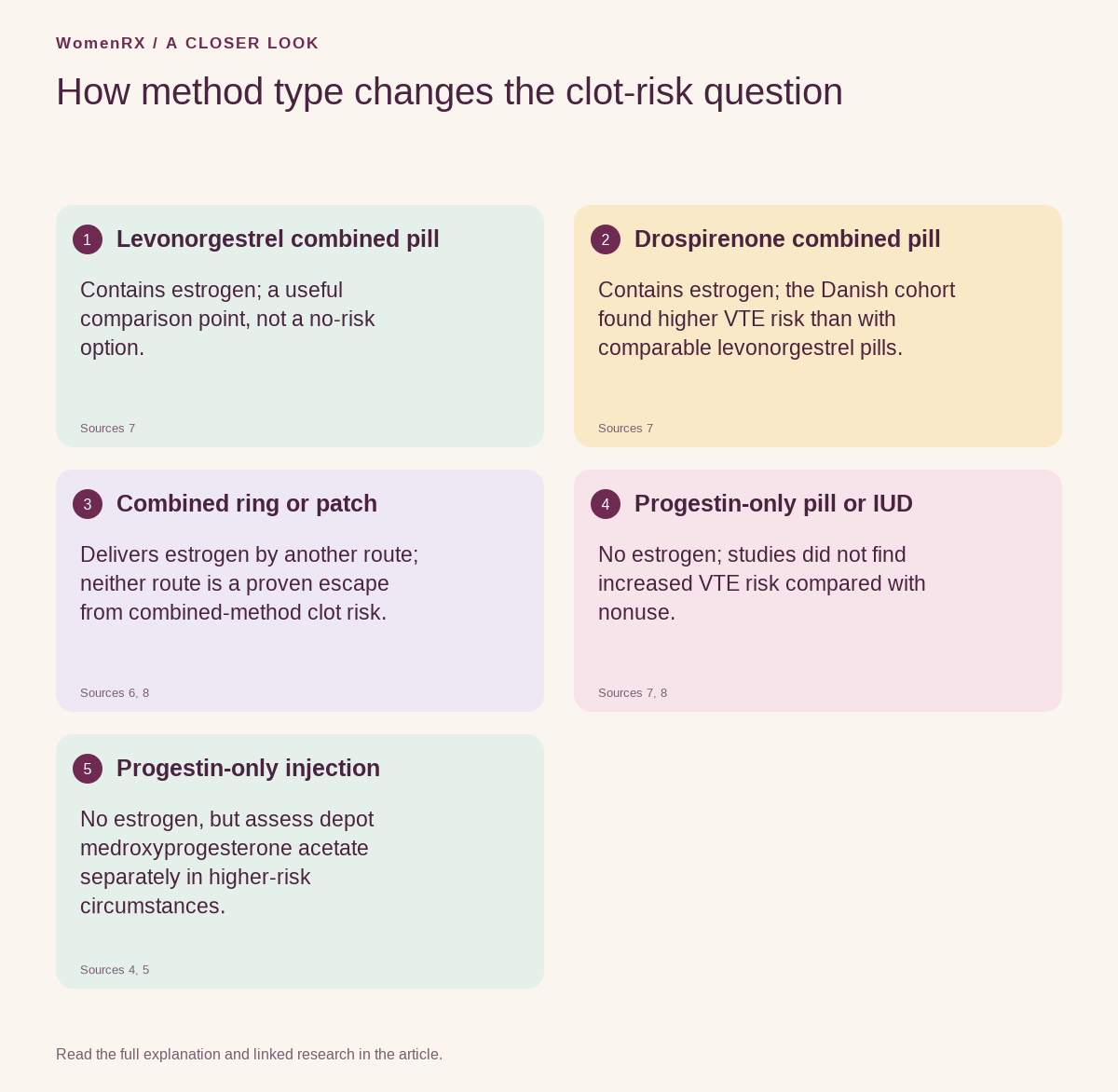
How method type changes the clot-risk question
Levonorgestrel combined pill: Contains estrogen; a useful comparison point, not a no-risk option.7
Drospirenone combined pill: Contains estrogen; the Danish cohort found higher VTE risk than with comparable levonorgestrel pills.7
Combined ring or patch: Delivers estrogen by another route; neither route is a proven escape from combined-method clot risk.68
Progestin-only pill or IUD: No estrogen; studies did not find increased VTE risk compared with nonuse.78
Progestin-only injection: No estrogen, but assess depot medroxyprogesterone acetate separately in higher-risk circumstances.45
Read the figure as text
Check whether a method contains estrogen first, then consider its formulation and your own risk factors.- Levonorgestrel combined pill: Contains estrogen; a useful comparison point, not a no-risk option.7
- Drospirenone combined pill: Contains estrogen; the Danish cohort found higher VTE risk than with comparable levonorgestrel pills.7
- Combined ring or patch: Delivers estrogen by another route; neither route is a proven escape from combined-method clot risk.68
- Progestin-only pill or IUD: No estrogen; studies did not find increased VTE risk compared with nonuse.78
- Progestin-only injection: No estrogen, but assess depot medroxyprogesterone acetate separately in higher-risk circumstances.45
Sources you can check
- Birth Control | Contraception | Contraceptives | MedlinePlusAccessed 2026-09-25Return to first citation
- CDC: Birth control methods, barrier methods, fertility awareness and breastfeedingAccessed 2026-09-25Return to first citation
- Contraception-related venous thromboembolism in adolescents.O'Brien SH. · Seminars in thrombosis and hemostasis · 2014Return to first citation
- U.S. Medical Eligibility Criteria for Contraceptive Use, 2024.Nguyen AT, Curtis KM, Tepper NK, Kortsmit K, Brittain AW, Snyder EM, Cohen MA, Zapata LB, Whiteman MK, Contributors. · MMWR. Recommendations and reports : Morbidity and mortality weekly report. Recommendations and reports · 2024Return to first citation
- Venous thromboembolic disease associated with hormonal contraceptives. Venous Thromboembolism Group of the Spanish Society of Internal Medicine and the Catalan Society of Contraception.Franco Moreno A, Perelló Capó J, Madridano Cobo O, Muñoz Rivas N, Martín Asenjo M, Blanco Molina Á. · Revista clinica espanola · 2026Return to first citation
- NUVARING (ETONOGESTREL AND ETHINYL ESTRADIOL) INSERT, EXTENDED RELEASE [ORGANON LLC] | US prescribing information and patient instructionsAccessed 2026-09-25Return to first citation
- Risk of venous thromboembolism from use of oral contraceptives containing different progestogens and oestrogen doses: Danish cohort study, 2001-9.Lidegaard Ø, Nielsen LH, Skovlund CW, Skjeldestad FE, Løkkegaard E. · BMJ (Clinical research ed.) · 2011Return to first citation
- Systemic hormonal contraception and risk of venous thromboembolism.Heikinheimo O, Toffol E, Partonen T, But A, Latvala A, Haukka J. · Acta obstetricia et gynecologica Scandinavica · 2022Return to first citation
- About Venous Thromboembolism (Blood Clots) | Venous Thromboembolism (Blood Clots) | CDCAccessed 2026-09-25Return to first citation