Symptoms That May Prompt Thyroid Testing and What the Tests Show
Tiredness or weight changes can raise a thyroid question, but blood tests separate an underactive thyroid from clues about its cause.
Hashimoto’s may come to light when symptoms such as tiredness or weight gain raise a question about an underactive thyroid, but those symptoms have many possible causes.6 A TSH blood test is usually the starting point for checking thyroid function; thyroid hormone tests add context, while antibody tests can help identify an autoimmune cause. Symptoms or antibodies alone don’t show how well your thyroid is working.51
What you might notice first
You may notice that you’re unusually tired, gaining weight, or simply not feeling like yourself. Those changes can raise a thyroid question, but they aren’t a Hashimoto’s symptom pattern you can recognize with certainty. Hypothyroidism, meaning too little thyroid hormone for your body’s needs, can be mild and hard to notice. Its symptoms also overlap with other conditions, so a diagnosis can’t rest on how you feel alone.65
Hashimoto’s is an autoimmune condition in which the immune system attacks the thyroid. It’s a common cause of hypothyroidism, but the two terms answer different questions: hypothyroidism describes thyroid function; Hashimoto’s describes a possible cause.5 Studies of children and adolescents include people diagnosed with Hashimoto’s whose thyroid function is still normal.3
A systematic review of studies in children and adolescents already diagnosed with Hashimoto’s found more constipation and weight gain in those in the hypothyroid phase than in those whose thyroid function remained normal. That comparison does not show how symptoms change over time for an individual. It does not establish a symptom-based test for adults.3
Function first, cause second
If you and your clinician are looking into a possible thyroid problem, TSH is usually the first blood test. TSH stands for thyroid-stimulating hormone. Tests for thyroid hormones, including T4, help assess how much hormone is in your blood. These results address whether the thyroid is working as it should; they do not, by themselves, establish that Hashimoto’s is the cause of a problem.1
Thyroid antibody tests ask a different question. They look for markers that may help identify an autoimmune thyroid disorder. Thyroid peroxidase antibodies, often shortened to TPO antibodies, and thyroglobulin antibodies are used when evaluating Hashimoto’s. An antibody result is a clue to consider alongside thyroid-function results and the rest of the clinical picture, not a measure of how much thyroid hormone your body has available.14
This distinction is especially useful if you feel unwell but your thyroid-function tests are normal. An antibody finding may help explain autoimmune activity, yet it does not mean your symptoms must be caused by low thyroid hormone. Likewise, an underactive thyroid needs an assessment of its cause rather than an assumption that every case is Hashimoto’s.15
If you’re planning pregnancy or have recently given birth
If you already have an underactive thyroid and are planning pregnancy, bring it up with the clinician managing your thyroid care. Pregnancy can change thyroid hormone needs. If you take levothyroxine and find out you’re pregnant, contact that clinician promptly. Thyroid blood tests help guide treatment during pregnancy.65
For people with pre-existing primary hypothyroidism whose TSH is above the normal range for the trimester, US prescribing information for levothyroxine describes monitoring TSH 4 to 8 weeks after delivery. That treatment-monitoring instruction is not a recommendation for every postpartum woman to have antibody testing or thyroid screening.2
The practical question is not, “Do these symptoms prove I have Hashimoto’s?” It’s, “Is my thyroid function normal, and if it isn’t, what might be causing the change?” TSH and thyroid hormone tests address the first part. Antibody tests may help with the second.1
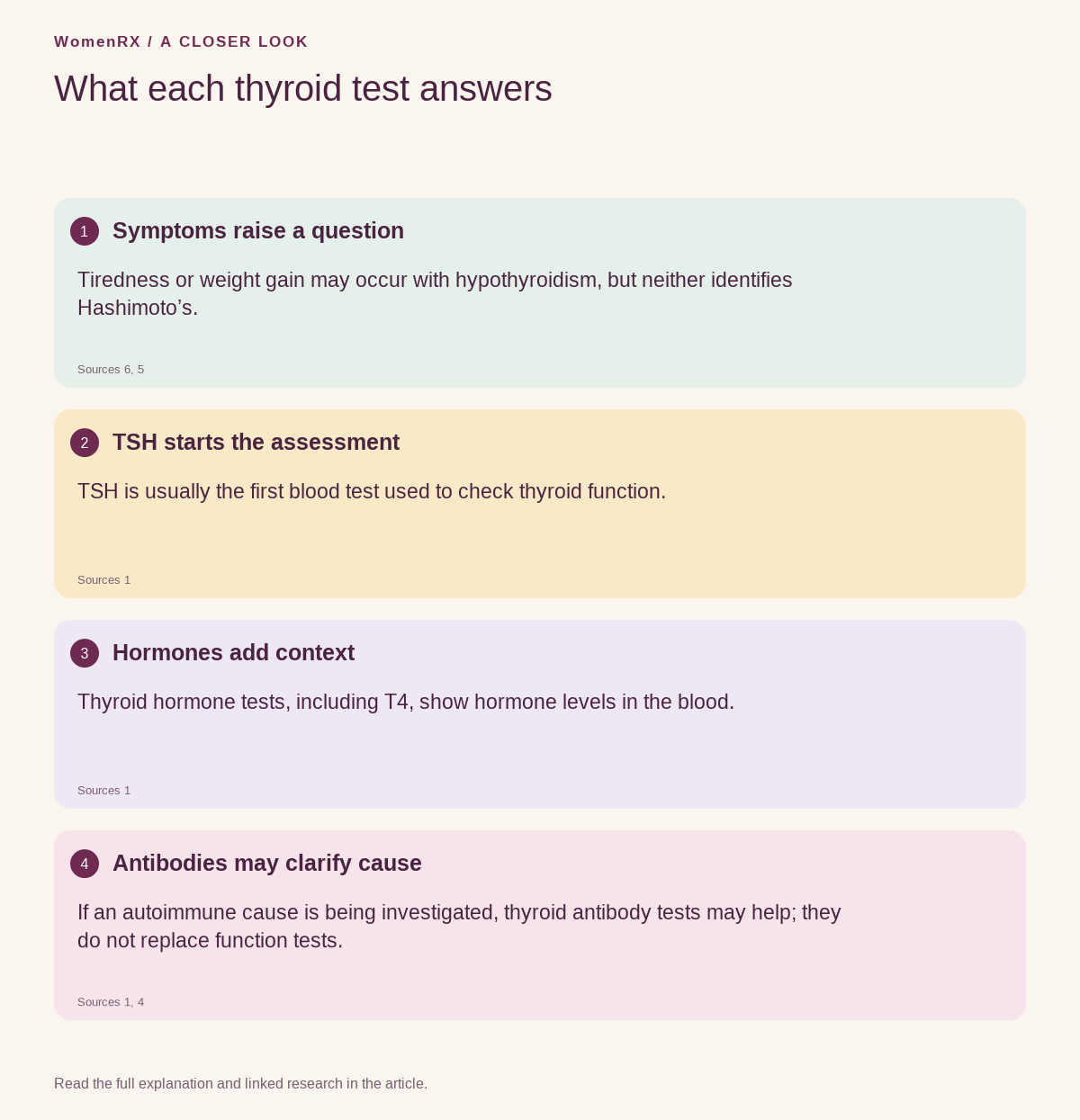
What each thyroid test answers
Symptoms raise a question: Tiredness or weight gain may occur with hypothyroidism, but neither identifies Hashimoto’s.65
TSH starts the assessment: TSH is usually the first blood test used to check thyroid function.1
Hormones add context: Thyroid hormone tests, including T4, show hormone levels in the blood.1
Antibodies may clarify cause: If an autoimmune cause is being investigated, thyroid antibody tests may help; they do not replace function tests.14
Read the figure as text
Symptoms can start a thyroid conversation. TSH and hormone tests assess function; antibody tests may be used separately to investigate cause.- Symptoms raise a question: Tiredness or weight gain may occur with hypothyroidism, but neither identifies Hashimoto’s.65
- TSH starts the assessment: TSH is usually the first blood test used to check thyroid function.1
- Hormones add context: Thyroid hormone tests, including T4, show hormone levels in the blood.1
- Antibodies may clarify cause: If an autoimmune cause is being investigated, thyroid antibody tests may help; they do not replace function tests.14
More questions, answered
Does a positive thyroid antibody test mean I need levothyroxine?
Not by itself. Antibody tests help investigate an autoimmune cause; thyroid-function tests assess whether your thyroid is making enough hormone. Levothyroxine replaces thyroid hormone when hypothyroidism needs treatment, so an antibody result alone doesn’t answer the treatment question.15
Can Hashimoto’s be diagnosed when thyroid function is normal?
In studies of children and adolescents, yes. A review included those diagnosed with Hashimoto’s whose thyroid function was normal, as well as those in a hypothyroid phase. It does not tell an individual adult when or whether their thyroid function will change.3
Sources you can check
- Thyroid Tests: MedlinePlusAccessed 2026-09-25Return to first citation
- LEVOTHYROXINE SODIUM TABLET [CARDINAL HEALTH 107, LLC] | US prescribing information and patient instructionsAccessed 2026-09-25Return to first citation
- Evaluation of Characteristics in Children and Adolescents with Hashimoto Thyroiditis in Euthyroid and Hypothyroid Phases: A Systematic Review and Meta-analysis.Oktaviana M, Chandra K, Widjanarko ND. · Turkish archives of pediatrics · 2025Return to first citation
- Thyroid function, autoimmunity, thyroid volume, and metabolic profile in people with Hashimoto thyroiditis.Couto B, Neves C, Neves JS, Delgado L. · BMC endocrine disorders · 2024Return to first citation
- Hypothyroidism (Underactive Thyroid) - NIDDKAccessed 2026-09-25Return to first citation
- Underactive thyroid (hypothyroidism) - NHSAccessed 2026-09-25Return to first citation