Fertility Evaluation Looks at Both Partners, Not Just One
Conception depends on several steps, so a useful fertility evaluation looks at the people and reproductive factors involved together.
Fertility evaluation isn’t a contest between “male” and “female” causes. Difficulty conceiving may involve ovulation, fallopian tubes, the uterus, sperm, more than one factor, or no cause that testing can identify. When both partners contribute to conception, evaluating both can give a more useful picture than focusing only on the person who would carry the pregnancy.12
Start with the whole picture
If you’re the one hoping to become pregnant, it’s easy for every question, appointment, and test to land on you. But conception involves more than one reproductive system. A problem affecting ovulation or the path an egg travels may matter; so may a problem affecting sperm. Sometimes factors coexist, and sometimes an evaluation finds no clear explanation.1
That’s why the first useful question is not which partner is the cause? It’s which parts of conception need to be assessed? An Australian evidence-based guideline for male infertility recommends a reproductive and medical history, physical examination, and semen analysis for the male partner, alongside evaluation of the female partner. Its central point applies to the shared workup: assessing one person does not replace assessing the other.2
What an evaluation can look at for you
Ovulation: Is an egg being released? Menstrual history is a starting point. The American Society for Reproductive Medicine (ASRM) says a clear menstrual pattern can establish whether ovulation is occurring regularly; an abnormal pattern calls for evaluation of its cause rather than simply more tests to confirm the pattern. When the history is unclear, a clinician may consider a progesterone blood test, an ovulation predictor kit, or ultrasound. Polycystic ovary syndrome (PCOS) is one possible reason ovulation may be disrupted.41
Fallopian tubes: Is the route open? Tubes can be damaged or blocked, including after pelvic inflammatory disease or surgery. A hysterosalpingogram uses X-ray imaging after dye is introduced to look for blockages. A contrast ultrasound is another way to assess whether fluid passes through the tubes. These tests answer a different question from a menstrual history: regular cycles don’t show whether the tubes are open.154
Uterus: Is there a structural concern? Fibroids and other uterine conditions can affect fertility, depending on the condition and where it is. ASRM lists transvaginal ultrasound and, when indicated, other imaging or procedures for assessing the uterus. This part of the evaluation looks at anatomy, not whether you ovulate or whether sperm is present.164
Ovarian reserve: What might a test help plan? Ovarian reserve assessment is distinct from checking whether you ovulate. Tests ASRM lists include anti-Müllerian hormone (AMH), antral follicle count on ultrasound, and certain blood tests. The distinction matters: ASRM describes ovarian reserve as a poor predictor of fertility, even though it can help guide fertility treatment. A result shouldn’t be treated as a stand-alone verdict on whether you can conceive.4
These aren’t four tests everyone needs in the same order. They’re four different questions. The history and findings help determine which assessments add useful information.4
What an evaluation can look at for a sperm-producing partner
A semen analysis looks at the semen and sperm side of conception. Low or absent sperm and differences in sperm shape or movement are among the factors that may affect the chance of fertilization. A medical and reproductive history and physical examination can add context; the Australian guideline recommends those alongside semen analysis as an initial male fertility evaluation.62
A semen result is not a verdict about the entire couple’s fertility. Semen measurements can vary, and a finding on one side does not rule out a factor on the other. If a male fertility concern is suspected, the Australian guideline recommends that further evaluation be guided by an expert in male reproduction, with additional tests chosen according to the clinical situation.312
Why results have to be read together
Consider two examples of what parallel evaluation can clarify. If ovulation appears regular but testing finds blocked tubes, tracking more cycles won’t answer the question about the route an egg must travel. If a semen analysis raises a concern, it still doesn’t establish that ovulation and the reproductive anatomy need no attention. These are examples of how different findings answer different questions, not diagnoses based on a single result.452
It’s also possible for an evaluation to identify factors in both partners, or to find no clear cause. “Unexplained” does not mean the difficulty conceiving isn’t real. It means the evaluation has not identified an explanation. That uncertainty changes the conversation from assigning blame to deciding what the findings, your age, and the time you’ve been trying mean for next steps.1
When to begin the conversation
For a US starting point, MedlinePlus defines infertility as not becoming pregnant after a year of frequent, unprotected sex, or after six months if you’re 35 or older. It also includes situations involving repeated miscarriage or stillbirth. Those timeframes are a reason to seek an evaluation, not a reason to decide in advance which partner needs one.1
You can ask how the ovulation, tube, uterus, ovarian reserve, and semen findings fit together, and which unanswered question would actually change a decision. That keeps the workup focused on conception as a shared process without placing the whole burden of finding an answer on you.42
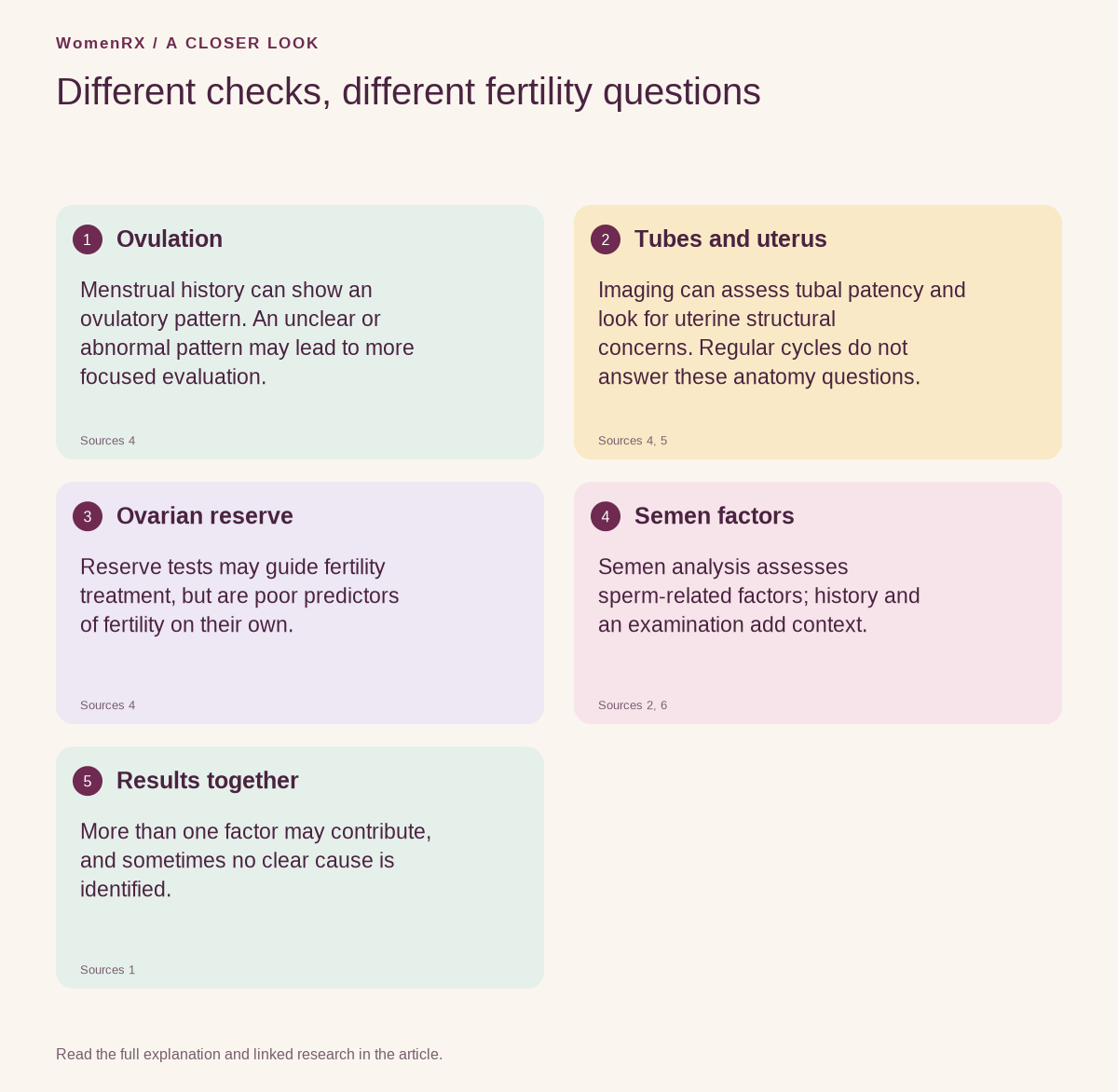
Different checks, different fertility questions
Ovulation: Menstrual history can show an ovulatory pattern. An unclear or abnormal pattern may lead to more focused evaluation.4
Tubes and uterus: Imaging can assess tubal patency and look for uterine structural concerns. Regular cycles do not answer these anatomy questions.45
Ovarian reserve: Reserve tests may guide fertility treatment, but are poor predictors of fertility on their own.4
Semen factors: Semen analysis assesses sperm-related factors; history and an examination add context.26
Results together: More than one factor may contribute, and sometimes no clear cause is identified.1
Read the figure as text
These assessments look at complementary parts of conception; none answers every question alone.- Ovulation: Menstrual history can show an ovulatory pattern. An unclear or abnormal pattern may lead to more focused evaluation.4
- Tubes and uterus: Imaging can assess tubal patency and look for uterine structural concerns. Regular cycles do not answer these anatomy questions.45
- Ovarian reserve: Reserve tests may guide fertility treatment, but are poor predictors of fertility on their own.4
- Semen factors: Semen analysis assesses sperm-related factors; history and an examination add context.26
- Results together: More than one factor may contribute, and sometimes no clear cause is identified.1
More questions, answered
Does a normal menstrual cycle mean the fertility evaluation is complete?
No. Menstrual history can provide useful evidence about ovulation, but it does not assess whether the fallopian tubes are open or what a semen analysis may show. Those are separate parts of a fertility evaluation.452
Does a low ovarian reserve result mean I can’t get pregnant?
Not by itself. ASRM says ovarian reserve is a poor predictor of fertility, although reserve testing can help guide fertility treatment. The result needs to be interpreted alongside the rest of the evaluation.4
Sources you can check
- Infertility | Infertility Treatments | MedlinePlusAccessed 2026-09-25Return to first citation
- The first Australian evidence-based guidelines on male infertility.Katz DJ, O'Donnell L, McLachlan RI, Moss TJ, Boothroyd CV, Jayadev V, Catford SR. · The Medical journal of Australia · 2025Return to first citation
- Personalized biomarkers in male infertility.Parvin A, Shadravan MM, Sadeghpour S, Taheri-Anganeh M, Ghasemnejad-Berenji H. · Clinica chimica acta; international journal of clinical chemistry · 2026Return to first citation
- Fertility evaluation of infertile women: a committee opinion (2021) | American Society for Reproductive Medicine | ASRMAccessed 2026-09-25Return to first citation
- Diagnosis of infertility - NHSAccessed 2026-09-25Return to first citation
- Causes of infertility - NHSAccessed 2026-09-25Return to first citation