What Can Disrupt Ovulation, and How Is It Evaluated?
A changed cycle can point to several different hormone pathways, and your history helps determine which ones need a closer look.
Irregular or absent periods can accompany ovulation problems, but the pattern alone doesn’t identify the cause. Pregnancy is an early possibility to check when a period stops. Other possibilities include PCOS, thyroid or prolactin problems, changes in the brain’s signals to the ovaries, and primary ovarian insufficiency. Evaluation combines your history and an examination with hormone tests chosen for your situation. 10761
Start with what changed
Ovulation is the release of an egg from an ovary. If your periods have become unpredictable, stopped, or you’re having difficulty conceiving, it’s reasonable to wonder whether that release is happening. Your cycle pattern is a useful starting point, not a diagnosis by itself. In a fertility evaluation, a clear menstrual history may be enough to establish an ovulatory pattern; when the history is unclear, a clinician may consider a progesterone blood test, an ovulation predictor kit, or ultrasound. A clearly abnormal pattern calls for looking into its cause, not simply repeating tests to prove the pattern is abnormal. 7
A missed period can be an early sign of pregnancy. When periods have stopped, pregnancy is the first possibility to check before interpreting hormone results as clues to an ovulation disorder. 310
Timing gives that history meaning. Irregular cycles are more common when periods first begin and as menopause approaches. A recent change in contraception can also disturb your usual pattern. 34 If you’ve recently given birth, bleeding or spotting during recovery can resemble a period and may occur off and on for up to six weeks. 2
Different pathways, different clues
PCOS and androgen-related changes. Irregular or widely spaced periods alongside acne, facial hair growth, or scalp hair loss can make androgen excess worth assessing. An American Society for Reproductive Medicine (ASRM) fertility-evaluation opinion recommends considering blood tests for androgens and a condition that can mimic PCOS when androgen signs or infrequent or absent periods are present. Those clues don’t establish PCOS on their own; thyroid problems may also need consideration, as may prolactin testing. 7
Thyroid function and prolactin. Both an overactive and an underactive thyroid can interfere with ovulation. 9 Thyroid-stimulating hormone, or TSH, is usually the first blood test used to assess thyroid function, with other thyroid tests guided by the result. 8 Elevated prolactin can also be associated with infrequent or absent periods and lower estrogen levels. Milk-like nipple discharge can be a clue, but its absence doesn’t rule out elevated prolactin. That’s why prolactin testing may be considered when periods are infrequent or absent, even without discharge. 10 Thyroid testing practices can differ in fertility care, especially around mild, symptom-free abnormalities, so an isolated result needs interpretation in context. 5
A change in signals from the brain. The hypothalamus helps regulate the hormone signals that lead to ovulation. Functional hypothalamic amenorrhea is one possible explanation when periods stop in the setting of stress or excessive physical exertion; it is associated with reduced reproductive hormone signaling and lower estrogen production. 6 This isn’t a conclusion to draw from a busy month or an exercise routine alone. PCOS and hypothalamic amenorrhea can produce similar period patterns and may be difficult to distinguish without considering the full history and findings together. 6
Ovarian function before age 40. Primary ovarian insufficiency, or POI, means the ovaries stop working normally before age 40. 1 A loss of periods with symptoms such as vaginal dryness may bring it into consideration, but symptoms alone can’t establish it. Evaluation can include an examination and hormone blood tests. 1 This distinction matters beyond fertility because low estrogen associated with POI can affect bone health. 1
Medicines and treatment history belong in this picture too. For example, chemotherapy can sometimes damage ovarian function, while some antipsychotic medicines can be associated with missed periods or infertility. These are reasons to review what you take and what treatments you’ve had, not reasons to stop a medicine on your own. 9
What an assessment may involve
The useful question is not simply “Am I ovulating?” It’s “What might explain this pattern, and is anything else affecting conception?” If periods have stopped, an assessment begins by excluding pregnancy. A clinician may then ask when your periods changed, whether they were previously predictable, and about recent childbirth, symptoms, medicines, and treatments. A record of when bleeding starts can help show the pattern. 10349
For absent periods, assessment commonly includes a history and examination, followed by hormone blood tests selected for the situation. FSH and estradiol can help distinguish problems with the ovaries from other causes; TSH checks for thyroid dysfunction, and prolactin checks another possible cause of infrequent or absent periods. Other tests depend on the findings, so not everyone needs the same workup. 10
For example, androgen symptoms can point toward androgen testing. If it remains unclear whether you’re ovulating, a clinician may consider a progesterone blood test, an ovulation predictor kit, or ultrasound. 7 If you’re having difficulty conceiving, ovulation is only one part of the picture. Conditions affecting the uterus or fallopian tubes, as well as sperm factors, can also affect fertility. 79
How treatment depends on the cause
There isn’t one treatment for every irregular cycle. If a thyroid disorder is causing menstrual changes, treatment can address the thyroid condition. Persistently elevated prolactin has a different treatment pathway; ASRM identifies medicines called dopamine agonists as the preferred treatment when another underlying condition has been excluded. 310
For functional hypothalamic amenorrhea, the circumstances behind reduced hormone signaling matter: a review describes periods returning after energy availability improves or emotional stress resolves. 6 POI calls for a different conversation because treatment also needs to address the effects of low estrogen on health; hormone therapy is commonly used to provide estrogen and other hormones the ovaries aren’t making. 1
If you’re trying to conceive and an evaluation finds that you don’t ovulate regularly, a fertility clinician may consider medicine to encourage ovulation, such as clomiphene citrate. Whether that fits depends on the cause and the rest of the fertility evaluation. Ovulation-stimulating medicine isn’t a substitute for finding out why periods changed or checking other possible barriers to conception. 117
You don’t need to decide which hormone pathway fits before seeking care. A lasting change from your usual periods, bleeding between periods, or irregular periods while you’re struggling to conceive are all reasons to arrange an assessment. 3
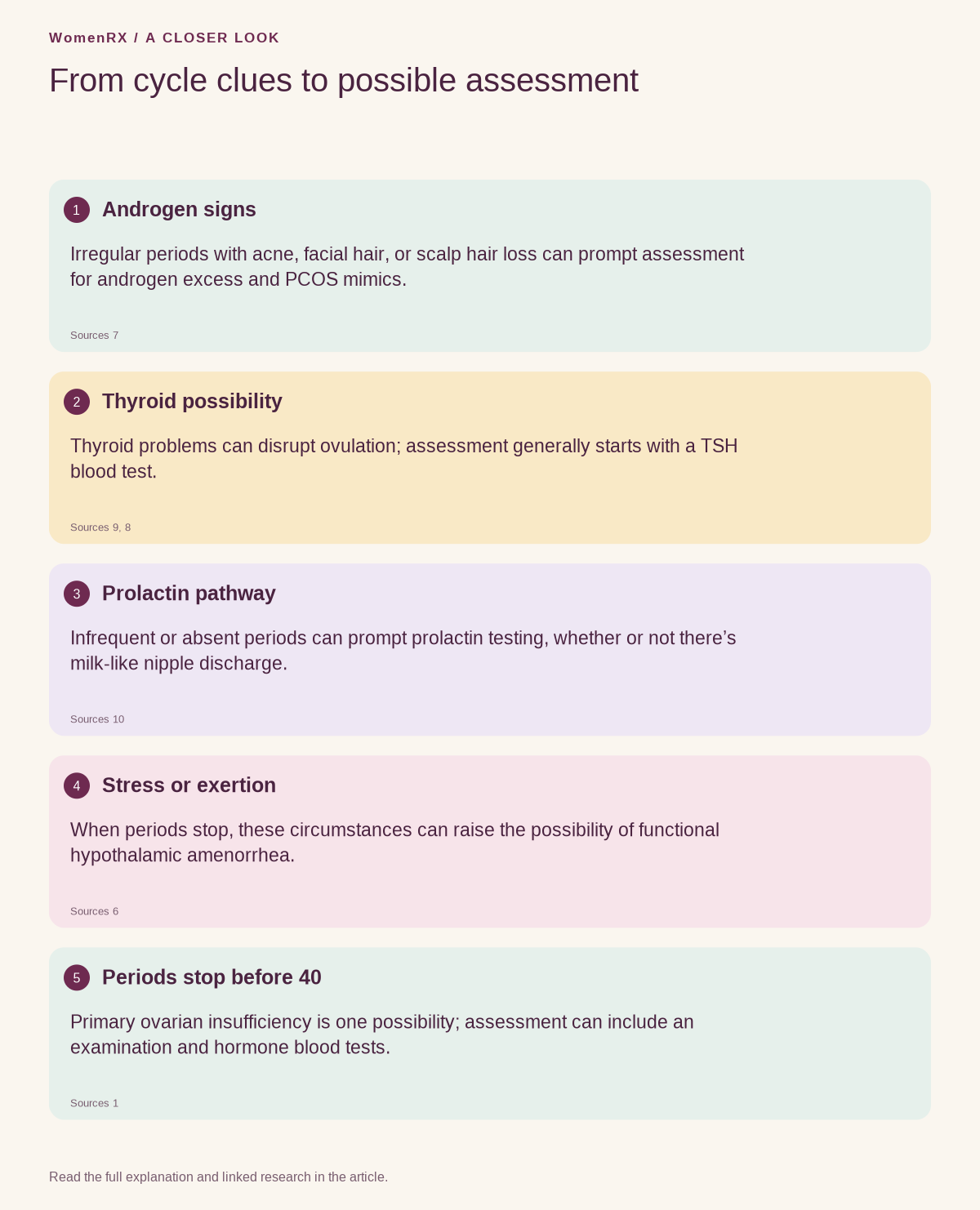
From cycle clues to possible assessment
Androgen signs: Irregular periods with acne, facial hair, or scalp hair loss can prompt assessment for androgen excess and PCOS mimics.7
Thyroid possibility: Thyroid problems can disrupt ovulation; assessment generally starts with a TSH blood test.98
Prolactin pathway: Infrequent or absent periods can prompt prolactin testing, whether or not there’s milk-like nipple discharge.10
Stress or exertion: When periods stop, these circumstances can raise the possibility of functional hypothalamic amenorrhea.6
Periods stop before 40: Primary ovarian insufficiency is one possibility; assessment can include an examination and hormone blood tests.1
Read the figure as text
After pregnancy has been considered when periods stop, these are separate paths a clinician might explore. They aren’t steps to follow in order or a way to diagnose yourself. 10- Androgen signs: Irregular periods with acne, facial hair, or scalp hair loss can prompt assessment for androgen excess and PCOS mimics.7
- Thyroid possibility: Thyroid problems can disrupt ovulation; assessment generally starts with a TSH blood test.98
- Prolactin pathway: Infrequent or absent periods can prompt prolactin testing, whether or not there’s milk-like nipple discharge.10
- Stress or exertion: When periods stop, these circumstances can raise the possibility of functional hypothalamic amenorrhea.6
- Periods stop before 40: Primary ovarian insufficiency is one possibility; assessment can include an examination and hormone blood tests.1
More questions, answered
Do irregular periods always mean I’m not ovulating?
No. A cycle pattern offers clues but doesn’t, by itself, settle what happened in any particular cycle. When the menstrual history leaves ovulation uncertain, a clinician may consider a progesterone blood test, an ovulation predictor kit, or ultrasound. 7
If my periods are irregular, is PCOS the most likely explanation?
Not necessarily. PCOS is one possibility, particularly when there are signs of androgen excess, but thyroid problems and functional hypothalamic amenorrhea can also involve irregular or absent periods. Elevated prolactin is another possible cause, even without nipple discharge. The surrounding symptoms and history help direct the evaluation. 7610
Sources you can check
- Primary Ovarian Insufficiency | POI | MedlinePlusAccessed 2026-09-25Return to first citation
- Postpartum Care: MedlinePlusAccessed 2026-09-25Return to first citation
- Irregular periods - NHSAccessed 2026-09-25Return to first citation
- Period problems - NHSAccessed 2026-09-25Return to first citation
- Thyroid function testing prior to fertility treatment: will we ever agree?Dunbar S, Dhillon-Smith R, Maheshwari A. · Human reproduction (Oxford, England) · 2025Return to first citation
- [Difficulties of differential diagnosis of functional hypothalamic amenorrhea and polycystic ovary syndrome: a systematic review].Absatarova YS, Evseeva YS, Andreeva EN, Sheremetyeva EV, Grigoryan OR, Mikheev RK. · Problemy endokrinologii · 2024Return to first citation
- Fertility evaluation of infertile women: a committee opinion (2021) | American Society for Reproductive Medicine | ASRMAccessed 2026-09-25Return to first citation
- Thyroid Tests: MedlinePlusAccessed 2026-09-25Return to first citation
- Causes of infertility - NHSAccessed 2026-09-25Return to first citation
- Current evaluation of amenorrhea: a committee opinion (2024) | American Society for Reproductive Medicine | ASRMAccessed 2026-09-25Return to first citation
- Treatment for infertility - NHSAccessed 2026-09-26Return to first citation