Trying to Conceive: Which Lifestyle Steps Have Evidence?
Folic acid and preconception care support a healthy pregnancy, while diet studies offer clues, not proof of a fertility fix.
Start with preconception care and folic acid, then focus on avoiding smoking, alcohol, and drugs and discussing any weight-related health concerns. These are pregnancy-preparation priorities, not guaranteed ways to conceive. A generally high-quality diet is reasonable, but its fertility benefit remains uncertain. If you have a condition that could affect pregnancy or you’re concerned about fertility, ask about care without waiting to finish a lifestyle plan. 1 2 3
Start with preparation, not a promise
Lifestyle advice often blurs two different goals: supporting a healthy pregnancy and increasing the chance of conceiving. Those goals can overlap, but they’re not interchangeable. A habit can be worthwhile before pregnancy without being a proven fertility treatment.
For pregnancy preparation, put preconception care first if you have a health condition such as diabetes or high blood pressure, or questions about vaccines or medicines. Getting enough folic acid belongs near the top of the list, too. MedlinePlus also recommends avoiding smoking, alcohol, and drugs and working toward a healthy weight. These steps address health before pregnancy; they aren’t proof that changing any one habit will make conception happen. If weight is a concern, it can be part of a conversation about your health, not a requirement to meet before asking for fertility care. 1 2
Folic acid has a clear, specific role: getting enough before and during pregnancy can prevent major birth defects of the baby’s brain or spine. That makes it a high-priority preconception measure, but it should not be mistaken for a way to boost fertility. 2
What diet research can, and can’t, tell you
The most useful finding is about overall diet quality, not a magic food. In two prospective cohorts of people trying to conceive, some higher-quality dietary patterns were associated with greater fecundability, meaning the chance of conception in a cycle. But the pattern results weren’t consistent across both cohorts: for example, Mediterranean-style and Healthy Eating Index scores were associated with greater fecundability in the North American cohort, while the Danish cohort showed no appreciable association for the Mediterranean score. These observational findings can’t show that changing your diet caused the difference. 3 5
So a varied, nourishing way of eating is a sensible general-health choice if it works for your budget, culture, access, and preferences. There’s no basis here for making a strict diet, buying specialty foods, or blaming yourself for not eating a particular way.
Some popular claims are less convincing. In one cohort, women’s ultra-processed-food intake was not associated with fertility outcomes. A separate cohort study found no association between women’s dietary glycemic index or glycemic load and fertility outcomes. In both studies, diet was reported during pregnancy and time to pregnancy came from questionnaires. Their findings don’t establish that cutting out ultra-processed foods or following a low-glycemic diet will improve female fertility, but they aren’t a decisive test of changing those habits before conception, either. 4 7
Fertility isn’t yours alone to control
Conception involves more than one person and more than lifestyle. In the same cohort that found no fertility association with women’s ultra-processed-food intake, higher intake among male partners was associated with lower fecundability in continuous models. Another study found similar associations for men’s glycemic index and load, while finding no association for women. These are observational findings, not proof that a partner’s diet is a treatment or that one person is responsible for a couple’s fertility. 4 7
Access and social conditions matter, too. Cohort studies have found associations between fecundability and experiences such as discrimination and poverty or social disadvantage. They don’t establish a simple cause or a personal remedy, but they’re a reminder that fertility outcomes aren’t a measure of how well someone has followed lifestyle advice. 5 6
Don’t make lifestyle changes a test you have to pass
If you have a known health condition that could affect pregnancy, preconception care can help you make a plan before pregnancy rather than trying to manage it through lifestyle changes alone. 1 If fertility is already a concern, you don’t need to complete a diet or weight-change plan before asking about evaluation. A condition that may affect pregnancy is a reason to start that conversation early; the right timing for a fertility evaluation depends on your circumstances.
A practical order of priorities is: address relevant health needs before pregnancy; get enough folic acid and discuss avoiding smoking, alcohol, and drugs; choose sustainable habits that support your overall health; and treat fertility claims about particular foods or diets as unproven. None of those steps has to be completed before you raise a fertility concern. 1 2 3
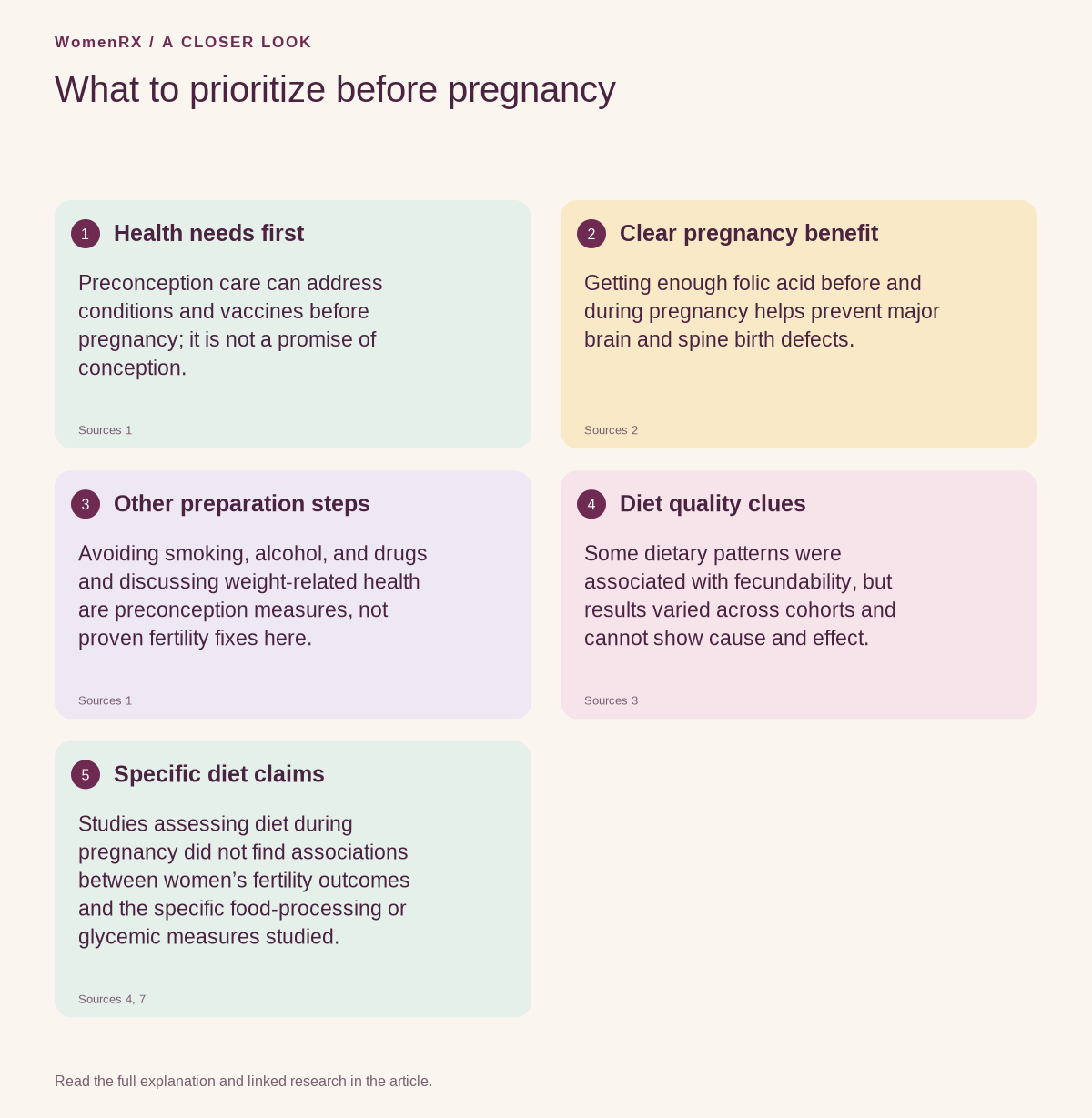
What to prioritize before pregnancy
Health needs first: Preconception care can address conditions and vaccines before pregnancy; it is not a promise of conception.1
Clear pregnancy benefit: Getting enough folic acid before and during pregnancy helps prevent major brain and spine birth defects.2
Other preparation steps: Avoiding smoking, alcohol, and drugs and discussing weight-related health are preconception measures, not proven fertility fixes here.1
Diet quality clues: Some dietary patterns were associated with fecundability, but results varied across cohorts and cannot show cause and effect.3
Specific diet claims: Studies assessing diet during pregnancy did not find associations between women’s fertility outcomes and the specific food-processing or glycemic measures studied.47
Read the figure as text
This evidence map separates preconception priorities from dietary findings that have not established a fertility treatment.- Health needs first: Preconception care can address conditions and vaccines before pregnancy; it is not a promise of conception.1
- Clear pregnancy benefit: Getting enough folic acid before and during pregnancy helps prevent major brain and spine birth defects.2
- Other preparation steps: Avoiding smoking, alcohol, and drugs and discussing weight-related health are preconception measures, not proven fertility fixes here.1
- Diet quality clues: Some dietary patterns were associated with fecundability, but results varied across cohorts and cannot show cause and effect.3
- Specific diet claims: Studies assessing diet during pregnancy did not find associations between women’s fertility outcomes and the specific food-processing or glycemic measures studied.47
More questions, answered
Does folic acid help you get pregnant?
The supported benefit described here is preventing major brain and spine birth defects when you get enough folic acid before and during pregnancy. That is different from evidence that it increases the chance of conception. 2
Should my partner make lifestyle changes too?
Fertility involves both partners, and observational studies have reported associations between men’s dietary measures and fecundability. Those findings don’t prove that a dietary change will improve an individual couple’s chances, but they do argue against treating fertility as solely the woman’s responsibility. 4 7
Sources you can check
- Preconception Care: MedlinePlusAccessed 2026-09-25Return to first citation
- Folic Acid: MedlinePlusAccessed 2026-09-25Return to first citation
- Dietary patterns and fecundability in 2 prospective preconception cohorts.Willis SK, Hatch EE, Laursen AS, Wesselink AK, Mikkelsen EM, Tucker KL, Rothman KJ, Mumford SL, Wise LA. · The American journal of clinical nutrition · 2022Return to first citation
- Periconceptional ultra-processed food consumption in women and men, fertility, and early embryonic development.Lin CHX, Gaillard R, Mulders AGMGJ, Jaddoe VWV, Schipper MC. · Human reproduction (Oxford, England) · 2026Return to first citation
- Fecundability in Association With Everyday and Lifetime Discrimination.Ukah UV, Lovett SM, Boynton-Jarrett R, Abrams J, Wesselink AK, Hoffman MN, Williams DR, Wise LA, Ncube CN. · JAMA network open · 2025Return to first citation
- Poverty and Social Disadvantage in Women and Men and Fertility Outcomes.Boxem AJ, Mulders AGMGJ, van Rossum I, Bekkers EL, Gaillard R, Jaddoe VWV. · JAMA network open · 2025Return to first citation
- Associations of periconception dietary glycemic index and load with fertility in women and men: a study among couples in the general population.Schipper MC, Boxem AJ, Blaauwendraad SM, Mulders AGMGJ, Jaddoe VWV, Gaillard R. · BMC medicine · 2024Return to first citation