Stress, Sleep, and Desire: What to Track
A two-week pattern log can help you see what changes alongside desire without assuming that stress or poor sleep is the cause.
If desire changed during a demanding or sleep-disrupted stretch, notice whether it varies after interrupted nights, on stressful but well-rested days, or when you have more time and privacy. Sleep affects energy and daily functioning, while medicines and health conditions can affect sexual health. A pattern can help you describe the change, but it won’t identify a cause on its own. 1 2
A demanding stretch can leave you tired, preoccupied, or short on time for intimacy. Those experiences may be useful context for understanding a change in desire, but they don’t prove what caused it. Poor-quality sleep can affect energy and daily functioning, and long-term stress can affect mood and health. 1 3
The most useful next step is a short, low-pressure record. You’re looking for patterns to discuss or reflect on, not trying to diagnose yourself or make desire meet a target.
Why one explanation may not fit
Sleep, stress, and desire don’t move in lockstep for everyone. In one small study, 50 women with burning mouth syndrome had lower average desire scores and more sleep and mood difficulties than 50 healthy controls, yet their desire scores weren’t correlated with the other measures assessed. In another small observational study, sleep and sexual-function scores improved during treatment for atopic dermatitis, but the study couldn’t show that one improvement caused the other. Neither study tells us how to identify the cause of a desire change in women generally. 5 4
That’s why it helps to look beyond whether you slept badly or felt stressed. Medicines and health conditions can affect sexual health too. 2
Try a two-week pattern log
Once a day, take a minute to note what the day was like. Keep it simple: a few words or a 0-3 rating is enough if numbers feel useful. The scale is just a personal shorthand, not a validated test.
| What to note | A quick example |
|---|---|
| Sleep | “Woke often,” “rested,” or “sleep interrupted by caregiving” |
| Stress and demands | “Work deadline,” “family responsibilities,” or “quieter day” |
| Energy and mood | “Worn out,” “steady,” “low,” or “more settled” |
| Desire and context | “More,” “less,” or “about the same”; note whether there was time, privacy, or interest in intimacy |
| Other relevant context | A new medicine, health concern, or life-stage context you want to remember |
Caregiving, pregnancy, postpartum life, and perimenopause can be part of someone’s circumstances, but they don’t affect every woman in the same way. If one applies to you, include it as context in your notes rather than treating it as the explanation.
At the end of two weeks, compare different kinds of days rather than looking for a perfect match. For example, does lower desire show up mainly after interrupted nights, even on quieter days? Does it show up on demanding days despite restful sleep? Or does interest seem different when you have time and privacy, regardless of how you slept? You may find no clear pattern at all. Any of those observations gives you a more precise way to describe what’s happening, not a diagnosis or a promise that changing one habit will change desire.
When a health conversation may help
If the change is bothering you, feels persistent, or you’re unsure whether a health issue or medicine may be involved, it’s reasonable to raise it with a clinician. You don’t need to finish the log first. Sexual health can be affected by medicines and chronic conditions, so a change that began around a new medicine or health concern is worth mentioning rather than assuming it’s only stress. 2
Your notes can make the discussion more concrete: when you noticed the change, what else was happening, and whether it seems to vary with sleep, stress, energy, or context. The goal isn’t to find one culprit at any cost. It’s to understand what matters in your situation and whether anything deserves attention.
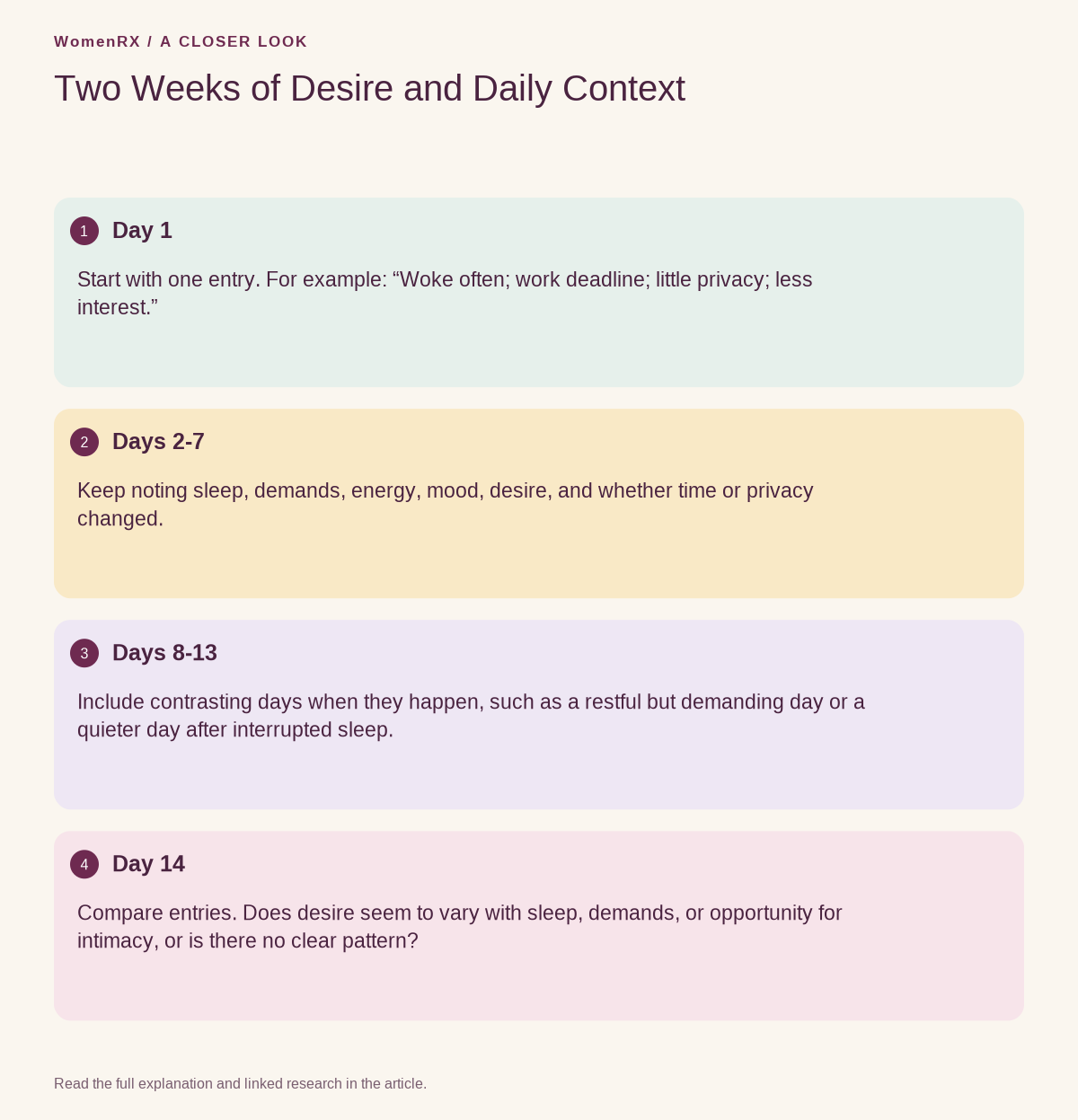
Two Weeks of Desire and Daily Context
Day 1: Start with one entry. For example: “Woke often; work deadline; little privacy; less interest.”
Days 2-7: Keep noting sleep, demands, energy, mood, desire, and whether time or privacy changed.
Days 8-13: Include contrasting days when they happen, such as a restful but demanding day or a quieter day after interrupted sleep.
Day 14: Compare entries. Does desire seem to vary with sleep, demands, or opportunity for intimacy, or is there no clear pattern?
Read the figure as text
Use brief daily entries to compare different kinds of days. The sequence shows how to build a picture over time, not how to prove a cause.- Day 1: Start with one entry. For example: “Woke often; work deadline; little privacy; less interest.”
- Days 2-7: Keep noting sleep, demands, energy, mood, desire, and whether time or privacy changed.
- Days 8-13: Include contrasting days when they happen, such as a restful but demanding day or a quieter day after interrupted sleep.
- Day 14: Compare entries. Does desire seem to vary with sleep, demands, or opportunity for intimacy, or is there no clear pattern?
More questions, answered
Does a two-week log show what caused a change in desire?
No. It can help you notice what changes at the same time and describe your experience, but a pattern alone can’t establish cause.
Should I wait until the two weeks are over to ask about a change?
No. If the change is troubling or you’re concerned that a medicine or health condition may be involved, you can raise it without waiting. Medicines and chronic conditions can affect sexual health. 2
Sources you can check
- Sleep Disorders | MedlinePlusAccessed 2026-09-25Return to first citation
- Sexual Health | MedlinePlusAccessed 2026-09-25Return to first citation
- Stress: MedlinePlusAccessed 2026-09-25Return to first citation
- Improvement of Sexual Function and Sleep Quality in Patients with Atopic Dermatitis Treated with Dupilumab: A Single-Centre Prospective Observational Study.Ureña-Paniego C, Montero-Vílchez T, Sanabria-de-la-Torre R, Soto-Moreno A, Molina-Leyva A, Arias-Santiago S. · International journal of environmental research and public health · 2023Return to first citation
- Sexual desire, mood disorders and sleep disturbances in female BMS patients: A controlled study.Leuci S, Coppola N, Adamo D, Crocetto F, Barone B, Baldares S, Canfora F, Mignogna MD. · Journal of oral pathology & medicine : official publication of the International Association of Oral Pathologists and the American Academy of Oral Pathology · 2023Return to first citation