Hair Shedding During Weight Loss: Is a GLP-1 Medicine the Cause?
Hair shedding can happen during GLP-1 treatment, but timing alone can’t tell whether the medicine, weight loss, or another change is responsible.
A GLP-1 medicine may be associated with hair loss, but current studies can’t show that the medicine itself caused it or separate its effects from weight loss and other factors. Write down when treatment and shedding began, how your weight changed, and any other major health or life changes. That timeline can help a clinician assess possible causes without treating a calendar match as proof. 5 6
The timeline is useful, but it isn’t a verdict
Hair shedding during treatment with a GLP-1 medicine can raise a fair question: is the medicine causing it? Hair-loss reports involving semaglutide, liraglutide, dulaglutide, and tirzepatide have prompted research into a possible association, but that research hasn’t established that the medication itself is the cause. Weight loss and other changes happening around the same time may also matter. 6
A 2025 scoping review found nine studies, including clinical trials, cohort studies, and analyses of safety reports. The studies varied in design, and most didn’t include a dermatologist’s confirmation of the type of hair loss. A separate 2026 cross-sectional survey asked 254 people in Saudi Arabia about GLP-1 use and hair loss. Because it captured people’s reports at one point in time, it can describe an association but can’t establish what caused the shedding. 5 6
So, “It started after I began treatment” is a helpful observation, not proof of a drug effect. The same is true if shedding begins during weight loss. Timing can help organize the possibilities for an assessment, but it can’t settle cause by itself.
What to put on your timeline
Keep a simple record rather than trying to count every hair. Note:
- When you started the medication, and when you first noticed shedding.
- How your weight was changing around that time, including whether weight loss was rapid or substantial.
- Any major illness, restrictive eating, or significant stress around the period before shedding began. These are among the situations associated with temporary hair loss in clinical references. 2 3
- Whether you were pregnant recently or are in the months after giving birth. Postpartum shedding is one possible explanation, although it shouldn’t be assumed to explain every case. 1 4
- Whether the loss seems like general shedding or a change you’d describe as thinning, and whether it’s improving, continuing, or worsening.
Compare those dates rather than assuming they happened in a set order. If shedding began before treatment, the new medicine cannot explain its onset. If weight loss began before treatment, include that earlier change too. If treatment and substantial weight loss began around the same time and shedding followed, the dates alone won’t separate a possible medicine effect from hair loss associated with weight loss. A recent birth, illness, or period of restrictive eating may add another plausible explanation even when shedding also followed treatment. 1 2 3 6
These are practical notes to make a conversation clearer, not a validated test or a way to diagnose the cause at home.
Life stage and other causes deserve a place in the picture
Women can have more than one plausible explanation for hair changes. Postpartum shedding is commonly described a few months after delivery; the American Academy of Dermatology says it often peaks around four months after birth, with most women returning to their usual fullness by their baby’s first birthday. A review of pregnancy-related changes also describes diffuse shedding several months after delivery and regrowth over time. These are general patterns, not a way to determine the cause of your own shedding. 1 4
Other possibilities include female-pattern hair loss, which is described as a potentially lasting type, and temporary hair loss associated with weight loss or iron deficiency. Those possibilities don’t mean you have a particular condition or nutrient deficiency. They’re reasons an assessment may consider your overall history rather than attributing shedding to a GLP-1 medicine automatically. 2
If shedding began after a recent pregnancy, during substantial weight loss, or around another major health change, include that context in your timeline. If none of those apply, that doesn’t rule out other explanations.
When to seek an assessment
Consider making an appointment if the shedding worries you, persists, or is getting worse. A clinician can look at the pattern and your history to consider whether it fits a temporary change, female-pattern hair loss, or another cause. If you think the timing may be connected to a GLP-1 medicine, share your timeline with the clinician managing your treatment and discuss your concerns before making decisions about treatment. The available studies don’t establish a medication-change plan for hair shedding. 2 6
Don’t assume that iron is low or start a supplement on the basis of shedding alone. Iron deficiency is one possible cause of temporary hair loss, but shedding alone doesn’t tell you whether you have it. 2
The most useful conclusion from a timeline may be modest: it shows what changed and when, helping a clinician weigh several possible explanations. It can’t prove that the medicine caused shedding, but it can make the next conversation more specific.
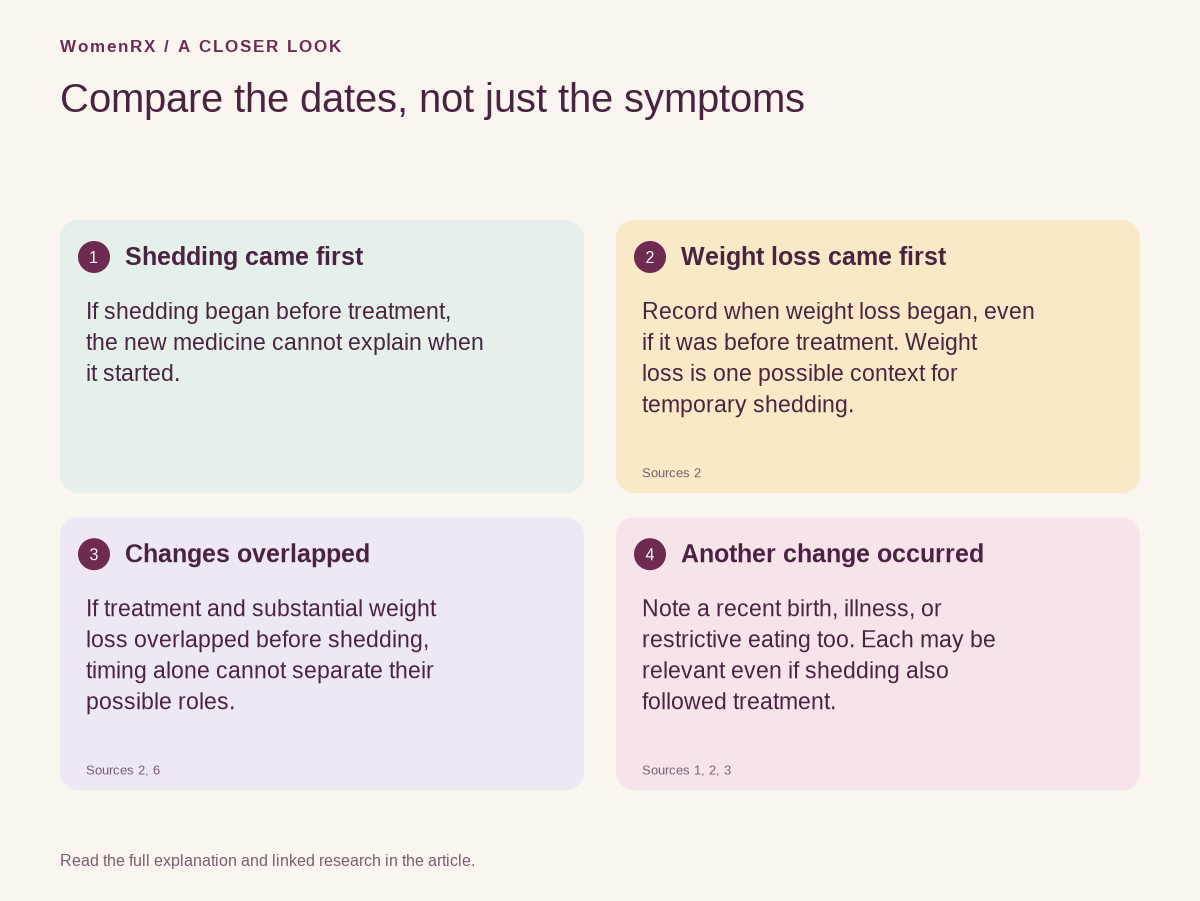
Compare the dates, not just the symptoms
Shedding came first: If shedding began before treatment, the new medicine cannot explain when it started.
Weight loss came first: Record when weight loss began, even if it was before treatment. Weight loss is one possible context for temporary shedding.2
Changes overlapped: If treatment and substantial weight loss overlapped before shedding, timing alone cannot separate their possible roles.26
Another change occurred: Note a recent birth, illness, or restrictive eating too. Each may be relevant even if shedding also followed treatment.123
Read the figure as text
Place treatment, weight change, shedding, and other health changes on your own calendar. Their order can narrow a question without diagnosing the cause.- Shedding came first: If shedding began before treatment, the new medicine cannot explain when it started.
- Weight loss came first: Record when weight loss began, even if it was before treatment. Weight loss is one possible context for temporary shedding.2
- Changes overlapped: If treatment and substantial weight loss overlapped before shedding, timing alone cannot separate their possible roles.26
- Another change occurred: Note a recent birth, illness, or restrictive eating too. Each may be relevant even if shedding also followed treatment.123
More questions, answered
Does shedding mean I should stop my GLP-1 medicine?
The available studies don’t establish whether stopping or changing treatment improves hair shedding. If you’re concerned about a possible connection, share when it began and what else was changing with the clinician managing your treatment before making a treatment decision. 6
Could postpartum shedding be part of the picture?
It could be. Postpartum shedding is commonly described as beginning a few months after delivery, but a postpartum timeline doesn’t prove that it explains your hair changes. Persistent or worrying shedding can have other causes worth assessing. 1 2 4
Sources you can check
- Hair loss in new moms: Dermatologist tipsAccessed 2026-09-25Return to first citation
- Hair loss - NHSAccessed 2026-09-25Return to first citation
- [Review of the post-COVID-19 syndrome associated to acute telogen effluvium].Chávez-Chavira G. · Revista medica del Instituto Mexicano del Seguro Social · 2023Return to first citation
- Physiologic changes of pregnancy: A review of the literature.Motosko CC, Bieber AK, Pomeranz MK, Stein JA, Martires KJ. · International journal of women's dermatology · 2017Return to first citation
- Predictors and Characteristics of Hair Loss Among Users of GLP-1 Receptor Agonists: A Cross-Sectional Analysis.Argobi Y, Jadaan NS, Alshalhoob HB, Alyousef MS, Alotaibi GM, Alwesaibie HS, Alshehri ISM. · Journal of cosmetic dermatology · 2026Return to first citation
- Alopecia as an Emerging Adverse Effect Associated With Glucagon-Like Peptide-1 (GLP-1) Receptor Agonists for Weight Loss: A Scoping Review.Rojas Lopez RF, Lynett Barrera D, Amaya Muñoz MC, Saavedra Diaz MP. · Cureus · 2025Return to first citation