Hair Shedding on GLP-1s: What Might Be Behind It?
Hair shedding has been reported with some GLP-1 medicines, but weight loss and other health or nutrition factors may also contribute.
There is a reported hair-loss signal with GLP-1 medicines, but current evidence can’t reliably separate a direct drug effect from shedding associated with substantial weight loss or other causes. One large electronic-record study in adults with type 2 diabetes found higher relative rates of coded non-scarring hair loss among GLP-1 users than among users of two other drug classes, while noting that the absolute risk was low. 5
Start with what changed, not just the medication
More hair in the shower or brush can feel alarming, especially when it starts after beginning a GLP-1 medicine. The timing is worth recording, but it doesn’t by itself show that the medicine caused the shedding. Hair loss can also accompany illness, stress, thyroid problems, poor nutrition, or certain medicines. Family history and age-related hair loss may be part of the picture too. 1
Research on GLP-1 medicines is still developing. A 2025 systematic review found five studies and described conflicting results: some reported hair loss, while others reported improvement or regrowth. A broader 2026 review included 24 studies but noted that designs and reporting varied. Those findings support taking the concern seriously, not treating a drug-specific cause as settled. 34
What the medication studies can, and can’t, tell you
A large comparative study followed adults with type 2 diabetes in electronic health records. In a target-trial emulation, people starting a GLP-1 receptor agonist had a higher adjusted hazard of a new alopecia diagnosis than people starting an SGLT-2 inhibitor (hazard ratio 1.37) or a DPP-4 inhibitor (1.68). The association was specific to non-scarring alopecia in subtype analyses, and the authors described the absolute risk as low. These are relative comparisons, not a prediction of your personal chance of losing hair. The outcome relied on diagnostic codes, and the associations weakened after a negative-control calibration, so the study cannot prove the medicine caused the loss. 5
Reviews have discussed semaglutide and tirzepatide more often than some other medicines in this group, but that isn’t enough to rank your personal risk by drug. The 2025 review found mixed results, and the 2026 review described limited evidence for several individual medicines. Reports of hair loss and reports of regrowth are not the same as a controlled test of whether a medicine caused either outcome. 34
Weight loss may be part of the picture
A possible explanation is indirect: a period of substantial weight loss may coincide with shedding, rather than the medicine acting directly on a hair follicle. The 2026 review identified rapid weight loss as a possible contributor, particularly in reports of telogen effluvium, a type of shedding. It did not establish that this is the cause in every person taking a GLP-1 medicine. 4
That distinction matters because the next step may differ. If shedding follows a period of fast weight change or much lower food intake, discuss that history and your nutrition with the clinician managing your treatment. If the loss continues or worries you, don’t assume weight change is the whole explanation. Thyroid problems and poor nutrition are among the general causes of hair loss described by MedlinePlus. 1
Build a useful timeline
There isn’t a reliable GLP-1-specific number of weeks or months between starting treatment and shedding. Instead, date the events as they happened: when treatment began or changed, when weight started changing, and when you first noticed shedding. Add illness, major stress, reduced intake, or another medication change wherever it falls in that sequence. This is a way to organize the history, not a validated test of cause. 14
Note what you can see, such as increased hair in the brush, a changing part, or areas where you notice less hair. These observations are useful to share, but they don’t identify a cause on their own. A pattern of thinning you noticed before treatment deserves a place on the timeline alongside newly noticed shedding. If hair loss runs in your family, include that too: female-pattern hair loss is another possibility and usually runs in families. Around menopause, note any thinning you had already noticed rather than assuming every hair change began with the GLP-1 medicine. 12
If relevant, recent childbirth or a concern about your iron intake or levels is also worth including in your health history. Neither detail, by itself, establishes why you’re shedding now.
A practical review can include your medication and dose-change dates, weight-change pattern, appetite and food intake, recent illness or major stress, and any other medicines or known health issues. Ask whether thyroid or nutritional causes fit your situation; don’t assume that a hair supplement is the answer. Treatment depends on the cause, and general hair-loss guidance lists medicines and underlying conditions among possible contributors. 1
Decide what to do about treatment
Tell the prescriber who manages your GLP-1 medicine about the shedding and the timeline, especially if it is continuing or distressing. Discuss the possible tradeoff between a reported but not proven medication-related effect and the benefits you’re seeking from treatment. Don’t make a treatment change based only on timing or a report online; first review other possible causes. The current research supports a careful review, not a confident claim that the medicine is, or isn’t, the cause. 345
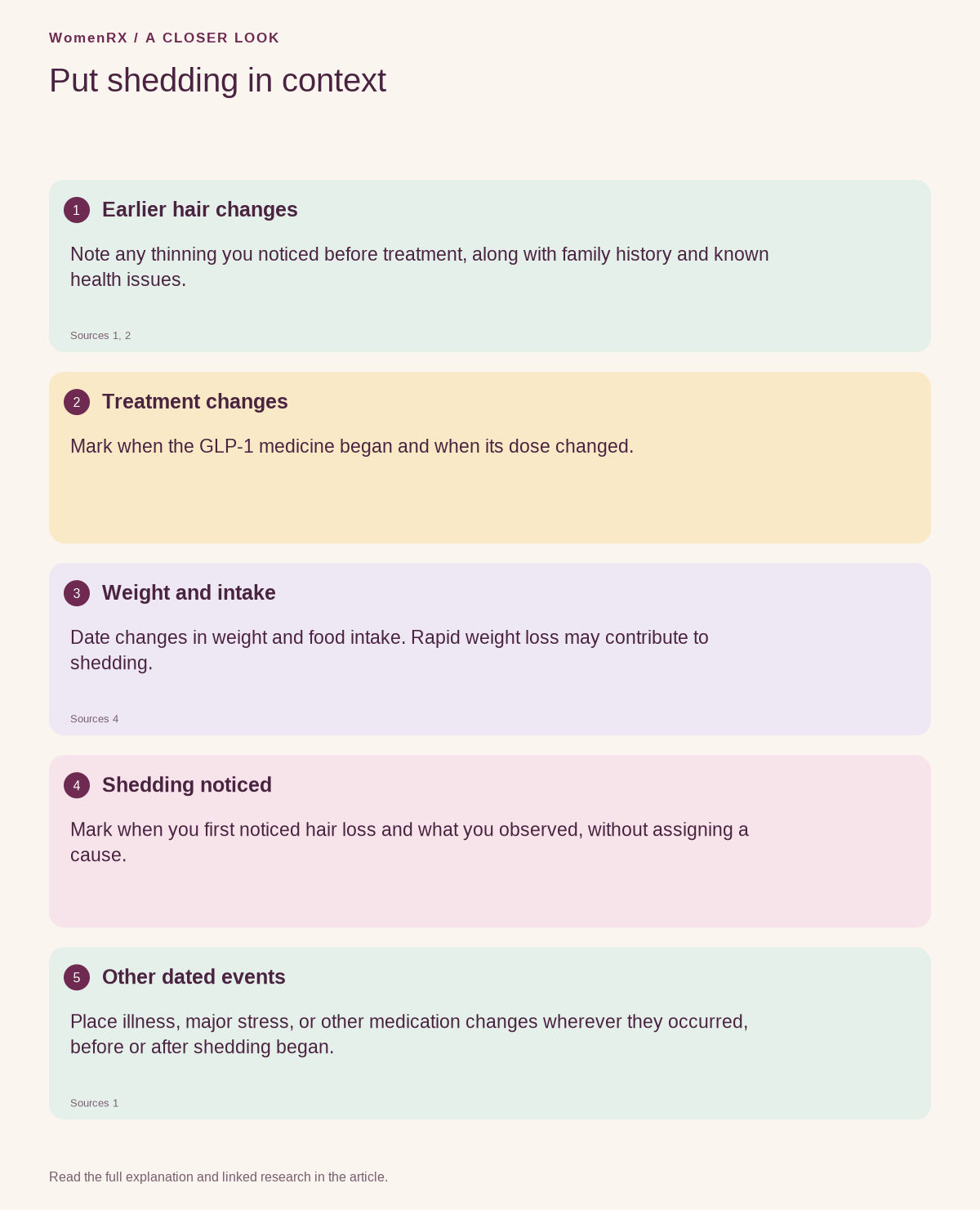
Put shedding in context
Earlier hair changes: Note any thinning you noticed before treatment, along with family history and known health issues.12
Treatment changes: Mark when the GLP-1 medicine began and when its dose changed.
Weight and intake: Date changes in weight and food intake. Rapid weight loss may contribute to shedding.4
Shedding noticed: Mark when you first noticed hair loss and what you observed, without assigning a cause.
Other dated events: Place illness, major stress, or other medication changes wherever they occurred, before or after shedding began.1
Read the figure as text
Date each event and place it where it actually occurred. This personal timeline can guide a treatment review but cannot prove a cause.- Earlier hair changes: Note any thinning you noticed before treatment, along with family history and known health issues.12
- Treatment changes: Mark when the GLP-1 medicine began and when its dose changed.
- Weight and intake: Date changes in weight and food intake. Rapid weight loss may contribute to shedding.4
- Shedding noticed: Mark when you first noticed hair loss and what you observed, without assigning a cause.
- Other dated events: Place illness, major stress, or other medication changes wherever they occurred, before or after shedding began.1
More questions, answered
Does hair shedding mean I should stop my GLP-1 medicine?
Shedding alone doesn’t show that the medicine caused it. Share the timing, weight changes, and other possible triggers with the prescriber managing your treatment before making a change. Current studies find an association in some populations, but they don’t establish the cause for an individual. 45
Is this known to affect women differently?
A 2026 review said women appeared disproportionately affected in the studies it assessed, but the overall evidence remains limited. A large comparative study in adults with type 2 diabetes did not provide a women-specific risk estimate, so it can’t establish whether the relative risk differs for women. 45
Sources you can check
- Hair Loss | Alopecia | Alopecia Areata | MedlinePlusAccessed 2026-09-25Return to first citation
- Hair loss - NHSAccessed 2026-09-25Return to first citation
- Hair Loss Associated With Glucagon-Like Peptide-1 (GLP-1) Receptor Agonist Use: A Systematic Review.Alsuwailem OA, Alanazi R, Almutairi HM, Asiree RH, Almutairi W, Almutairi TM, Zamandar A, Alkhames S. · Cureus · 2025Return to first citation
- GLP-1 therapies and hair loss: A systematic review of current evidence and implications for counseling.Gupta AK, Teasell EM, Economopoulos V, Mirmirani P. · Science progress · 2026Return to first citation
- Risk of hair loss associated with glucagon-like peptide-1 receptor agonists in adults with type 2 diabetes: target trial emulation.Tang H, Zhang B, Lu Y, Zhang D, Liu R, Lu Y, Cotsarelis G, Asch DA, Chen Y. · BMJ (Clinical research ed.) · 2026Return to first citation