Fatigue on a GLP-1 Medicine: What to Review
Feeling unusually tired is a reason to look at what changed, not assume the medicine is the only cause.
Review when the fatigue began, whether it followed a dose or medication change, how nausea or other stomach symptoms are affecting meals and fluids, how you’re sleeping, and any available glucose readings if you have diabetes. Fatigue has many possible causes, including anemia, thyroid problems, pregnancy, and lack of sleep. If it persists for weeks, get it assessed rather than treating it as an inevitable effect of a GLP-1 medicine. 1
Start with the timing
Write down when the tiredness started and whether it varies across the day or followed a change in treatment. Note any nausea, vomiting, diarrhea, appetite change, sleep disruption, or other new symptoms alongside it. This can help separate a possible medication-related pattern from fatigue that began for another reason. A pattern is useful information, not proof of cause.
What a fatigue study can tell you
A meta-analysis of six randomized trials of beinaglutide, one specific GLP-1 receptor agonist, reported similar fatigue risk between treatment and control groups. That result cannot establish the fatigue risk for other medicines in the class. In a separate study of Facebook posts, people mentioned fatigue among other possible adverse events, but social media mentions cannot show that a medicine caused the symptom. 4 3
Check whether eating and drinking have changed
Liraglutide prescribing information says the medicine lowers body weight through decreased calorie intake and describes gastrointestinal side effects that can sometimes be severe. If you’re eating much less than usual, or nausea, vomiting, or diarrhea is making it hard to keep up with food and fluids, include that in your review. Don’t assume the answer is to add a supplement: fatigue can have several causes, and a supplement is not a substitute for finding a deficiency. 2 1
A practical example: if tiredness began around the same time as persistent nausea and smaller meals, the stomach symptoms and changes in intake are worth discussing together. If your intake seems unchanged, keep looking rather than deciding that the medicine explains everything.
Look beyond the medication
Sleep, anemia, thyroid disease, pregnancy, infection, ongoing pain, and mental health conditions are among the many possible causes of fatigue. If you have diabetes, bring any glucose readings that seem unusual and ask how they fit with your symptoms and treatment. Liraglutide can lower blood glucose, but that does not establish that low glucose explains fatigue for every person taking a GLP-1 medicine. 1 2
A full medication review can also help identify whether another medicine or a recent change might be contributing. Bring the names of prescription medicines, over-the-counter products, and supplements rather than stopping or changing treatment on your own.
For women, mention relevant context such as possible pregnancy, recent childbirth, heavy periods, or menopause symptoms. These details help place the fatigue in context; they don’t identify its cause on their own. If thyroid symptoms such as palpitations are also present, mention those too. A published case report described fatigue and palpitations during tirzepatide treatment that were ultimately linked to Graves’ disease, but a single case cannot show that tirzepatide caused the condition or how often this occurs. 5
When to get it assessed
If fatigue continues for several weeks or is interfering with ordinary activities, arrange an assessment. A clinician may ask about sleep, appetite, daily activities, and exercise, examine you, and decide whether tests are appropriate. That evaluation can help distinguish a medication effect from causes such as anemia or thyroid disease. 1
Seek prompt medical assessment for persistent or severe abdominal pain, especially if it spreads to your back, with or without nausea or vomiting. Liraglutide prescribing information identifies this as a possible sign of pancreatitis. 2
A useful review list
Bring a short timeline, your current medicine list, changes in eating or drinking, sleep changes, and any glucose readings if relevant. Add pregnancy possibility, recent childbirth, heavy periods, or menopause symptoms if they apply. The goal is to give your prescriber enough context to decide what needs attention, not to label fatigue as a drug side effect before other explanations are considered.
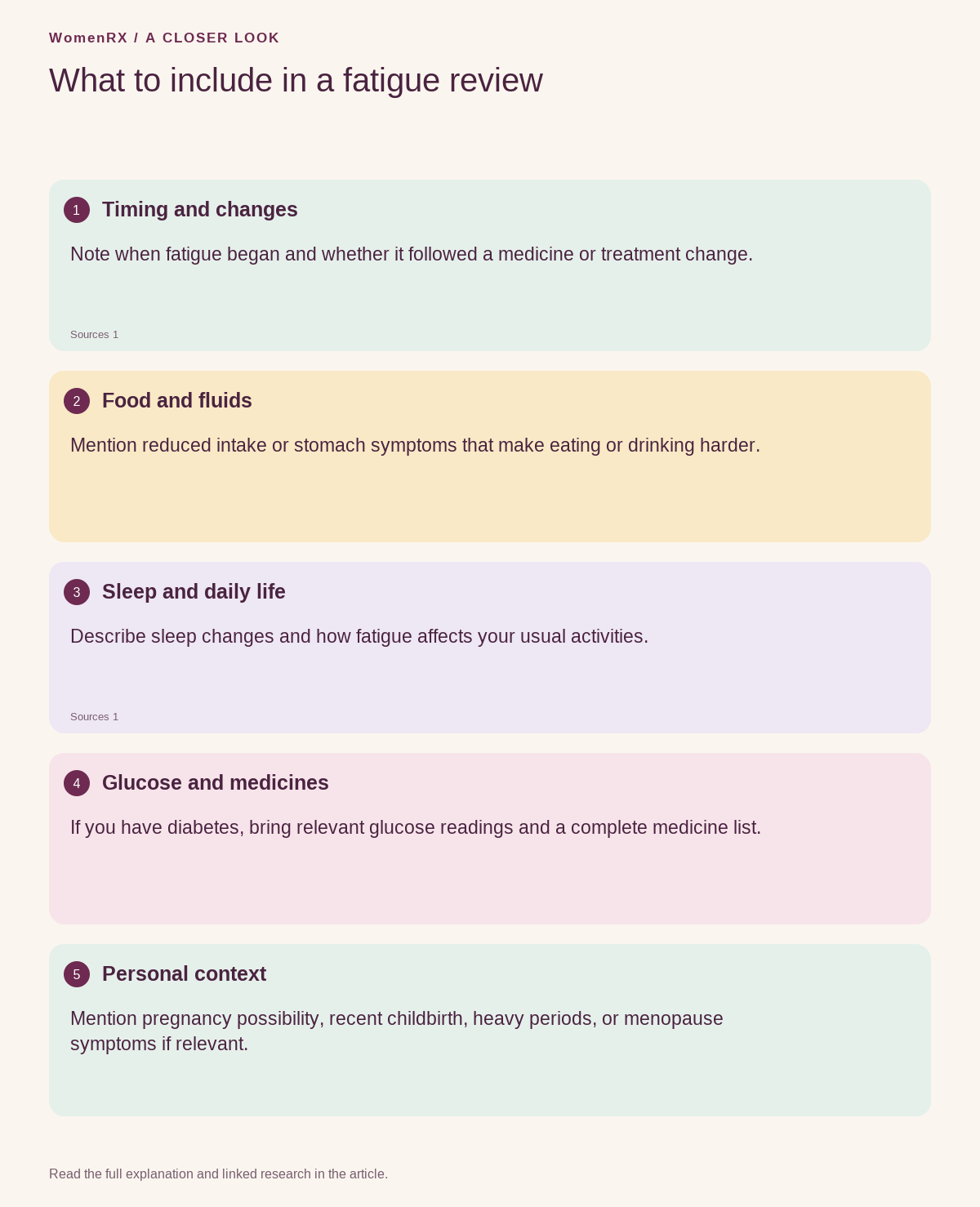
What to include in a fatigue review
Timing and changes: Note when fatigue began and whether it followed a medicine or treatment change.1
Food and fluids: Mention reduced intake or stomach symptoms that make eating or drinking harder.
Sleep and daily life: Describe sleep changes and how fatigue affects your usual activities.1
Glucose and medicines: If you have diabetes, bring relevant glucose readings and a complete medicine list.
Personal context: Mention pregnancy possibility, recent childbirth, heavy periods, or menopause symptoms if relevant.
Read the figure as text
Use these prompts to organize what changed and what may help explain the tiredness. They are conversation prompts, not a diagnostic checklist.- Timing and changes: Note when fatigue began and whether it followed a medicine or treatment change.1
- Food and fluids: Mention reduced intake or stomach symptoms that make eating or drinking harder.
- Sleep and daily life: Describe sleep changes and how fatigue affects your usual activities.1
- Glucose and medicines: If you have diabetes, bring relevant glucose readings and a complete medicine list.
- Personal context: Mention pregnancy possibility, recent childbirth, heavy periods, or menopause symptoms if relevant.
More questions, answered
Does fatigue mean my GLP-1 medicine is causing a problem?
Not necessarily. Fatigue can have many causes, and a symptom that starts during treatment is not by itself proof that the medicine caused it. The trial result for beinaglutide also should not be generalized to every GLP-1 medicine. 1 4
Should I start an iron or vitamin supplement?
Not just because you feel tired. Anemia is one possible cause, but fatigue alone does not show that you have anemia or a nutrient deficiency. An assessment can help determine whether testing or a specific treatment is appropriate. 1
Sources you can check
- Fatigue: MedlinePlusAccessed 2026-09-25Return to first citation
- SAXENDA (LIRAGLUTIDE) INJECTION, SOLUTION [NOVO NORDISK PHARMACEUTICAL INDUSTRIES, LP] | US prescribing information and patient instructionsAccessed 2026-09-25Return to first citation
- Harnessing Facebook to Investigate Real-World Mentions of Adverse Events of Glucagon-Like Peptide-1 Receptor Agonist (GLP-1 RA) Medications: Observational Study of Facebook Posts From 2022 to 2024.Alibilli AS, Jain V, Mane H, Yue X, Ratzki-Leewing A, Merchant JS, Criss S, Nguyen QC, McCoy RG, Nguyen TT. · JMIR infodemiology · 2025Return to first citation
- Effect of beinaglutide, a thrice-daily GLP-1 receptor agonist, on body weight and metabolic parameters: A systematic review and meta-analysis.Kamrul-Hasan ABM, Ganakumar V, Nagendra L, Dutta D, Islam MR, Pappachan JM. · World journal of diabetes · 2025Return to first citation
- Unilateral Graves' Disease Developing During Treatment With Tirzepatide in a Patient With Diabetes: A Case Report.Deto Y, Hasegawa R, Ino S, Shibata S, Ohno K, Itoh T, Matsumoto T, Miki T. · Case reports in endocrinology · 2026Return to first citation