Food Noise on a GLP-1 Medicine: What If It Persists or Returns?
Food thoughts can persist or come back without proving that your medication has failed; what those thoughts feel like matters more than the label you give them.
GLP-1 medicines can reduce appetite and food intake, but they don’t promise to erase every food thought. If thoughts persist or return, distinguish physical hunger from cravings or distress, then look at how you’re eating and whether the treatment is meeting its goals. Those patterns offer more to work with than treating “food noise” as a pass-or-fail test. 1 2 3
“Food noise” can mean several things
You might mean a physical sense of hunger, repeated thoughts about food, strong cravings when you see or smell something, or feeling less satisfied after eating. Those experiences overlap, but they aren’t identical. A recent review describes eating in terms of sensory experience, pleasure, and “wanting” or motivation, and notes that people’s experiences on GLP-1 medicines vary. 3
A liraglutide trial analysis measured specific outcomes such as satiety and how much people ate at a test meal. It did not measure all of these experiences as one combined “food noise” outcome. The phrase can describe how you feel, but it cannot tell you on its own how well treatment is working. 2 3
What the medicine can change, and what it can’t promise
GLP-1 medicines can affect appetite and calorie intake. The US prescribing information for liraglutide used for weight management describes reduced calorie intake as the way it lowers weight. But that doesn’t establish that every person will experience the same change in appetite, cravings, or food thoughts. 1 3
Nor does persistent food noise by itself show that the medicine has stopped working. It doesn’t tell you whether your overall goals are being met, whether the experience has changed over time, or what might be contributing to it. Weight, blood-sugar goals when relevant, eating experience, side effects, and whether treatment is workable for you are separate parts of the picture. Your prescriber can help interpret them together.
What different patterns may tell you
If you’re physically hungry: Notice whether hunger comes alongside a change in how much you’re eating or how satisfied you feel after meals. Hunger is not proof that the medicine has failed. If you’re eating very little yet struggling with hunger or meals, that deserves attention to your eating pattern, not just a search for stronger appetite suppression. 2 4
If cravings or food thoughts persist despite feeling full sooner: Those experiences can differ. The review separates fullness-related experiences from pleasure and food-related motivation, so a change in one need not mean a change in every other part of eating. Consider whether a particular situation brings on the thoughts and whether they’re affecting your eating or daily life. Their presence alone doesn’t settle whether treatment is helping with your other goals. 3
If thoughts return after a quieter period: A change is worth noticing, especially if treatment was interrupted or another part of your routine changed. It does not, by itself, identify the cause or mean you need to change medication. If access or interruptions have made treatment hard to follow as planned, bring that up with the clinician managing it so you can assess the pattern alongside your goals.
If eating has become difficult or the thoughts are distressing: That matters even if appetite suppression seems to be happening. Tell the clinician managing your medication if nausea or other stomach symptoms make meals hard to manage, or if thoughts about food are interfering with daily life. GLP-1 medicines can cause gastrointestinal side effects, sometimes severe; the aim is a plan you can live with, not the quietest possible appetite at any cost. 1
These distinctions aren’t a score or a way to diagnose treatment failure. They do help prevent one sensation from standing in for your whole response. For example, appetite suppression and delayed stomach emptying are often discussed together, but a secondary analysis of a 16-week liraglutide trial found no association between gastric-emptying measurements and appetite measures within the liraglutide-treated group. That finding doesn’t explain what any one person’s appetite or sense of fullness means. 2
Keep nourishment in the picture
Less appetite is not the only outcome worth paying attention to. A perspective on GLP-1 trials points out that dietary intake is often incompletely measured and reported, which limits what research can say about exactly what people eat during treatment. 4 If you’re eating much less, struggling to manage meals, or worried about getting enough nutrition, say so directly. The goal isn’t simply to make food thoughts disappear; it’s to find a treatment plan that supports your health and is manageable in everyday life.
If food thoughts come with fear of eating, restrictive behaviors, or a past eating disorder, mention that context when discussing treatment. That history deserves individual attention rather than assumptions.
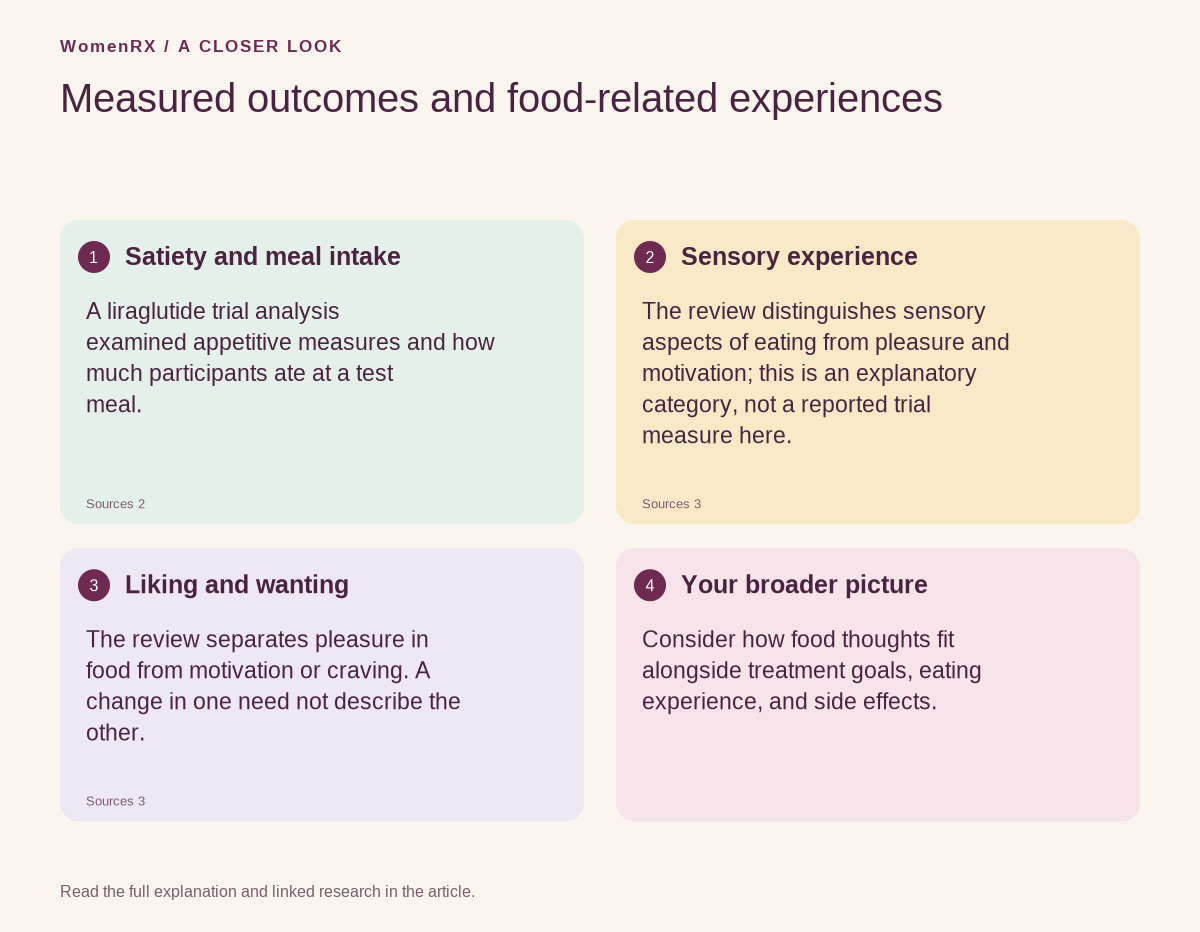
Measured outcomes and food-related experiences
Satiety and meal intake: A liraglutide trial analysis examined appetitive measures and how much participants ate at a test meal.2
Sensory experience: The review distinguishes sensory aspects of eating from pleasure and motivation; this is an explanatory category, not a reported trial measure here.3
Liking and wanting: The review separates pleasure in food from motivation or craving. A change in one need not describe the other.3
Your broader picture: Consider how food thoughts fit alongside treatment goals, eating experience, and side effects.
Read the figure as text
Research measures specific changes in appetite and eating. These distinctions can help you describe what persists or returns.- Satiety and meal intake: A liraglutide trial analysis examined appetitive measures and how much participants ate at a test meal.2
- Sensory experience: The review distinguishes sensory aspects of eating from pleasure and motivation; this is an explanatory category, not a reported trial measure here.3
- Liking and wanting: The review separates pleasure in food from motivation or craving. A change in one need not describe the other.3
- Your broader picture: Consider how food thoughts fit alongside treatment goals, eating experience, and side effects.
More questions, answered
Does food noise mean my GLP-1 medicine isn’t working?
Not by itself. Persistent thoughts may coexist with changes in fullness or food intake. Look at the experience alongside the goals you and your prescriber set, how you’re eating, and whether treatment remains workable for you. 2 3
Why might I still think about food if my appetite is lower?
Satiety, pleasure, sensory experience, and food-related motivation are distinct parts of eating experience. A change in one doesn’t guarantee that all the others will disappear. 3
Sources you can check
- SAXENDA (LIRAGLUTIDE) INJECTION, SOLUTION [NOVO NORDISK PHARMACEUTICAL INDUSTRIES, LP] | US prescribing information and patient instructionsAccessed 2026-09-25Return to first citation
- Appetite Suppression by GLP-1 Receptor Agonists: Role of Delayed Gastric Emptying.Friedman MI, Harmsen WS, Camilleri M. · Obesity (Silver Spring, Md.) · 2026Return to first citation
- Altered eating experience during GLP-1 receptor agonist therapy: a sensory-liking-wanting framework for food preference and nutritional behaviour.Du J, Yang Z, Chen Y. · Frontiers in nutrition · 2026Return to first citation
- Dietary Intake as an Undermeasured Potential Mediator: The Ethical Case for Complete and Transparent Dietary Reporting in GLP-1 Receptor Agonist Trials.Strosahl JN, Ziegler TR, Singh RH. · Nutrients · 2026Return to first citation