Food Noise on GLP-1 Treatment: What a Change Means
Quieter food thoughts are a reported experience on GLP-1 treatment, but hunger, cravings and persistent preoccupation aren’t the same thing.
Yes, some people report that thoughts about food become less persistent or intrusive while taking a GLP-1 medication. Researchers call this experience “food noise,” too, but they’re still working out how best to define and measure it. Studies of appetite, cravings or eating behavior can offer clues without telling you exactly what will happen to your own food thoughts.34
What do you mean by “food noise”?
You might mean that you think about your next meal all afternoon. Or you might mean that a particular food keeps pulling at your attention, even when you’re doing something else. Those experiences can overlap, but they aren’t identical.
Researchers have described food noise as food-related preoccupation that can feel persistent, intrusive and unwanted. A theoretical review reports that some people taking GLP-1 medications describe a welcome reduction in those thoughts. At the same time, researchers haven’t settled whether food noise is a distinct phenomenon or a name for several familiar experiences, such as cravings and food preoccupation. Measurement tools are emerging, but their clinical usefulness is still uncertain.34
That makes your own description more useful than trying to decide whether you have the “right” amount of food noise. For example, “I still get hungry at lunchtime, but I don’t spend the morning thinking about what I’ll eat” describes a change in preoccupation, not necessarily a change in hunger.
What the more familiar research outcomes tell us
Studies and clinical discussions often separate appetite, cravings and eating behavior. Appetite concerns the desire to eat; a craving is a pull toward a particular food; and an eating-behavior measure might ask about episodes of binge eating. None captures every part of an intrusive thought about food. Researchers examining food noise specifically have raised this overlap as a reason to be careful about treating scores on these measures as interchangeable.24
There’s evidence that GLP-1 treatment can affect eating. For example, US prescribing information says liraglutide lowers body weight through decreased calorie intake. That finding doesn’t show whether a particular person thought about food less often or felt less distressed by those thoughts.1
A review of research on GLP-1 medications and binge-eating disorder describes emerging clinical reports of reduced cravings and binge-eating scores. It also says those studies are small and have methodological limitations. Binge-eating disorder is a specific condition, so a change in its symptom scores shouldn’t be read as a prediction about everyone taking these medications for weight management.2
A quieter mind isn’t a test of whether treatment is working
If food thoughts ease, that can be a meaningful change in your day. If they don’t, it doesn’t by itself tell you that treatment has failed. The research on food noise doesn’t yet establish how often it changes, how long a change lasts or a threshold everyone should reach.34
It also can’t tell you which mechanism explains your experience. GLP-1 researchers study appetite and food-reward pathways, but findings from animal experiments or studies of binge-eating symptoms can’t prove why one person’s thoughts feel quieter.23 And eating less isn’t always the same as feeling comfortably satisfied: nausea and other gastrointestinal effects occur with liraglutide, sometimes severely.1
For women, there’s another gap worth keeping in view. This research doesn’t establish whether changes in food preoccupation differ by sex or across menstrual cycling, perimenopause and postmenopause. There’s no sound basis here for promising a different food-noise response at any of those stages.234
The most useful question is what changed for you. Is it physical hunger, interest in a specific food, how often food interrupts your thoughts, or how much you can comfortably eat? Those distinctions give you clearer language for a conversation about your treatment than “my food noise is better” or “it isn’t working.” If eating has become difficult because of persistent or severe stomach symptoms, bring that up directly rather than treating it as a welcome reduction in appetite.1
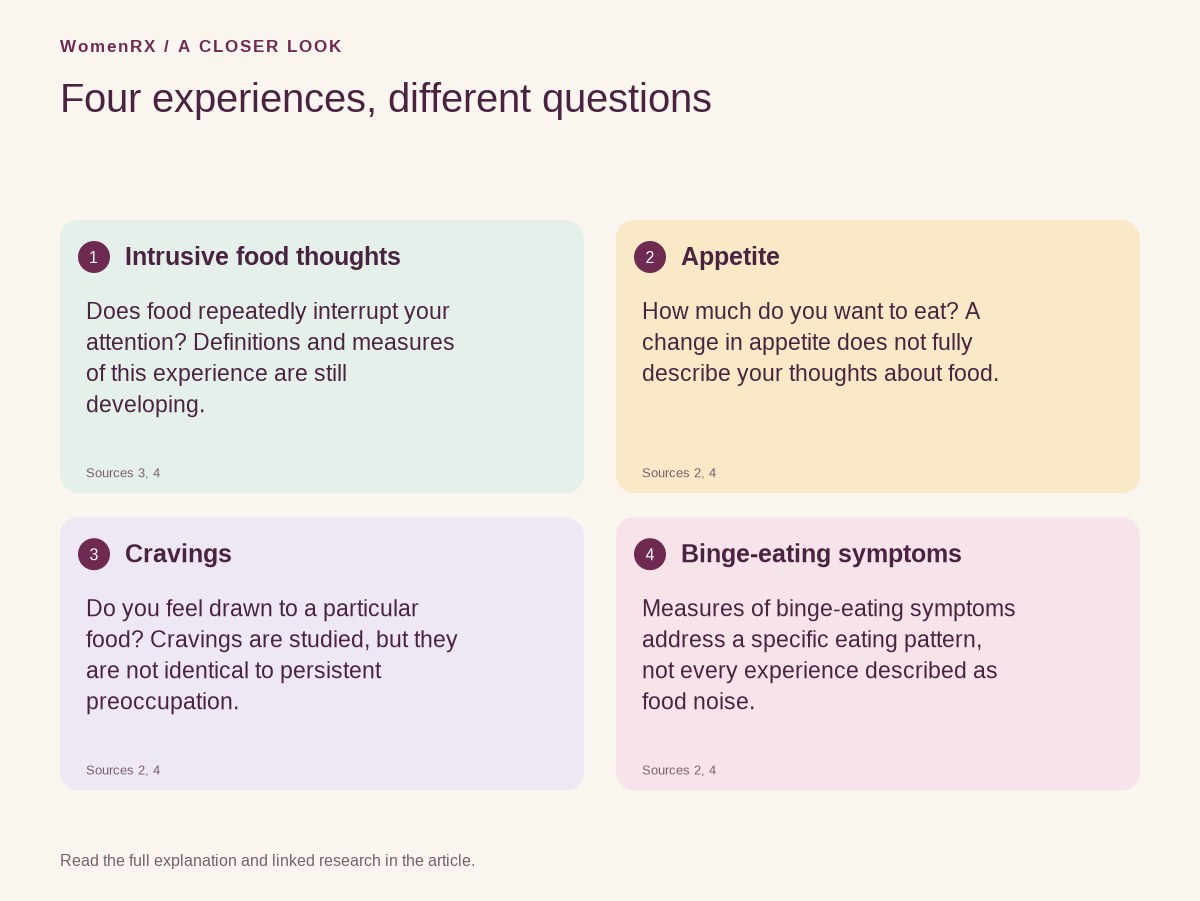
Four experiences, different questions
Intrusive food thoughts: Does food repeatedly interrupt your attention? Definitions and measures of this experience are still developing.34
Appetite: How much do you want to eat? A change in appetite does not fully describe your thoughts about food.24
Cravings: Do you feel drawn to a particular food? Cravings are studied, but they are not identical to persistent preoccupation.24
Binge-eating symptoms: Measures of binge-eating symptoms address a specific eating pattern, not every experience described as food noise.24
Read the figure as text
“Food noise” may overlap with several outcomes researchers discuss, but one outcome cannot stand in for them all.- Intrusive food thoughts: Does food repeatedly interrupt your attention? Definitions and measures of this experience are still developing.34
- Appetite: How much do you want to eat? A change in appetite does not fully describe your thoughts about food.24
- Cravings: Do you feel drawn to a particular food? Cravings are studied, but they are not identical to persistent preoccupation.24
- Binge-eating symptoms: Measures of binge-eating symptoms address a specific eating pattern, not every experience described as food noise.24
More questions, answered
Does having food noise mean I have binge-eating disorder?
No. “Food noise” can describe intrusive or persistent food thoughts, while binge-eating research looks at a more specific pattern of eating and related symptoms. The concepts may overlap, but one term doesn’t establish the other.234
Sources you can check
- SAXENDA (LIRAGLUTIDE) INJECTION, SOLUTION [NOVO NORDISK PHARMACEUTICAL INDUSTRIES, LP] | US prescribing information and patient instructionsAccessed 2026-09-25Return to first citation
- Neurobiological Mechanisms and Therapeutic Potential of Glucagon-like Peptide-1 Receptor Agonists in Binge Eating Disorder: A Narrative Review.Tongta S, Sungkaworn T, Pathomthongtaweechai N. · International journal of molecular sciences · 2025Return to first citation
- Food noise: A theoretical review.Wylie F, Mahmut MK, Francis HM, Davidson T, Stevenson RJ. · Appetite · 2026Return to first citation
- Food noise: Conceptual, methodological, and ethical considerations.Brewis A, Hayashi D, Gualano B, Precinotto ML, Scagliusi FB, Stöckelová T, SturtzSreetharan C, West H, Williams O, Masterson TD. · Appetite · 2026Return to first citation