Does a Desk Job Change GLP-1 Eligibility?
Working at a desk can shape your treatment routine, but it doesn’t by itself determine whether a GLP-1 medicine is appropriate.
A mostly seated workday doesn’t establish eligibility for a GLP-1 medicine. Treatment decisions consider your weight and broader health context; physical activity may be part of that assessment, but it isn’t the whole decision. A desk job is more useful to discuss as a practical factor: your access to breaks, meals, water, and a restroom can affect how treatment fits into your workday. 1 2
Your job is context, not a qualification
A desk job can mean long stretches of sitting, limited control over breaks, or meetings that make it hard to step away. Those details can matter when you’re planning care. They don’t, by themselves, show that you need a GLP-1 medicine or that you qualify for one.
Obesity care can include weight-loss medicines, and treatment planning takes a person’s overall weight and other health conditions into account. A clinician may also ask about weight history and physical activity. That makes workday activity one part of the conversation, not a stand-alone test. 1
BMI may be used to assess risk, but it doesn’t distinguish body fat from muscle and bone, and it can misrepresent body fat in some people. So it helps to discuss your full health picture rather than treating a single number, or your occupation, as the entire decision. 1
Separate the medical decision from the workday plan
It may help to think about two questions separately:
- Is this medicine appropriate for my health situation? That requires an individual assessment. The information here doesn’t establish product-specific eligibility criteria, so ask about the particular medicine being considered and the reason for using it.
- What would make treatment workable during my shifts? Consider the parts of your day you can control and the parts you can’t. Break access, a place to eat, water nearby, restroom access, and a plan for handling symptoms at work are practical topics to raise. These are logistics to plan around, not requirements for eligibility or a prescribed weight-loss routine.
If your schedule is unpredictable, say so. For example, someone who can’t leave a customer-facing station easily may want to discuss how to handle a day when stomach symptoms interfere. That doesn’t mean a particular schedule or meal pattern prevents symptoms; it means the work constraint is worth including in the treatment conversation.
Make a workday plan that fits your actual job
Use this short checklist to identify friction points, not to score yourself:
- Breaks: Can you step away when needed, or are breaks tightly scheduled?
- Food and water: Can you access meals and drinking water during your shift? Treat this as basic planning, not a method proven to prevent medication side effects.
- Restroom access: Could symptoms make it difficult to stay at your workstation? What options do you have if you need to leave briefly?
- Sitting and movement: Are there natural chances to stand or move, or would your work require you to arrange them? Movement can be discussed as part of overall care, but you don’t need to adopt a particular workday routine to prove that treatment is warranted. 1
- Treatment details: Ask what to expect with the specific medicine, what to do if symptoms disrupt work, and which symptoms need prompt attention. Don’t assume all medicines in this class have identical instructions or effects.
These questions can be adapted to your circumstances. Caregiving duties, limited break coverage, mobility needs, or a long commute may also shape what feels realistic. They’re personal planning factors, not evidence that a woman with a desk job needs medication.
What the activity research can, and can’t, tell you
One randomized trial studied 130 adults with obesity who had first lost weight on a low-calorie diet and then entered a one-year weight-maintenance study. The analysis included 80 women, but it did not report separate results for women with desk jobs. In this specific study, liraglutide alone did not appear to change sedentary time; the exercise-plus-liraglutide group had a 41-minute-per-day decrease compared with placebo. This was an exploratory analysis in a particular weight-maintenance setting, not a test of whether desk work changes medication eligibility. 4
That distinction matters: research about activity during treatment doesn’t turn occupation into a medical indication. A separate study protocol is examining sedentary-behavior coaching, resistance training, and semaglutide in people with chronic kidney disease, but it describes a study still in progress, not results that can guide a desk worker’s treatment decision. 3
GLP-1 medicines can be associated with gastrointestinal side effects. In the US prescribing information for Saxenda (liraglutide), severe gastrointestinal reactions were reported in clinical trials, and the label warns about persistent or severe abdominal pain, sometimes radiating to the back, with or without nausea or vomiting. If you have that kind of pain while taking liraglutide, seek prompt medical attention. 2
A useful next move is to bring both sides of the question to your appointment: your health goals and history, plus the real constraints of your workday. Your job may shape the plan. It doesn’t decide whether the medicine is right for you.
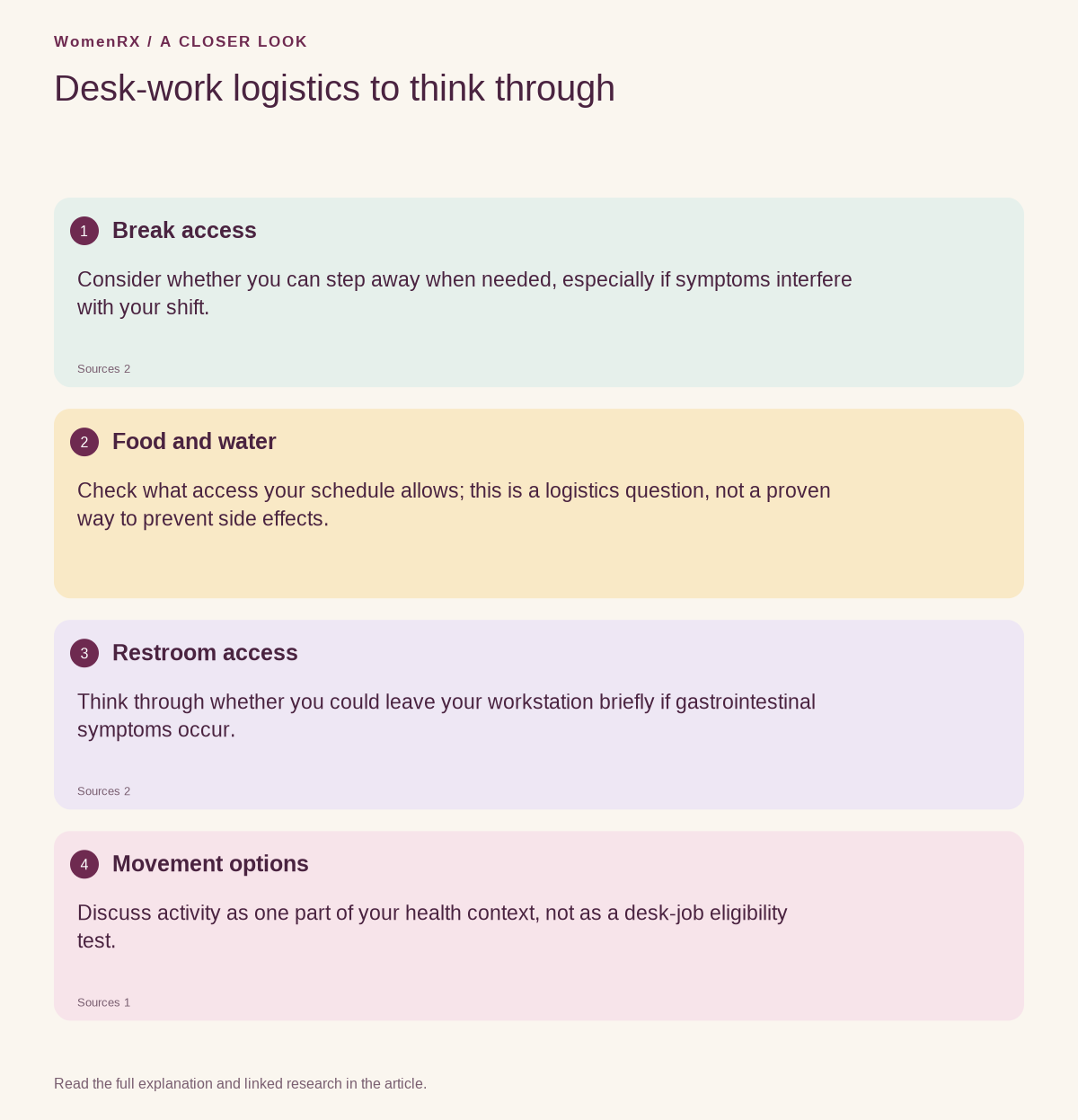
Desk-work logistics to think through
Break access: Consider whether you can step away when needed, especially if symptoms interfere with your shift.2
Food and water: Check what access your schedule allows; this is a logistics question, not a proven way to prevent side effects.
Restroom access: Think through whether you could leave your workstation briefly if gastrointestinal symptoms occur.2
Movement options: Discuss activity as one part of your health context, not as a desk-job eligibility test.1
Read the figure as text
These prompts help identify how treatment might fit into your workday. They are planning topics, not eligibility criteria or a prescribed routine.- Break access: Consider whether you can step away when needed, especially if symptoms interfere with your shift.2
- Food and water: Check what access your schedule allows; this is a logistics question, not a proven way to prevent side effects.
- Restroom access: Think through whether you could leave your workstation briefly if gastrointestinal symptoms occur.2
- Movement options: Discuss activity as one part of your health context, not as a desk-job eligibility test.1
More questions, answered
Do I have to take movement breaks to be considered for treatment?
A workday movement routine is not, by itself, a test of eligibility. Physical activity may be discussed as part of a broader assessment, alongside weight history and other health factors. 1
Should I plan meals or water breaks to prevent side effects?
Meal timing or extra hydration shouldn’t be treated as a proven way to prevent GLP-1 side effects. You can still discuss access to food, water, and a restroom as practical workday concerns, and ask about guidance for the specific medicine you’re considering. 2
Sources you can check
- Obesity: MedlinePlusAccessed 2026-09-25Return to first citation
- SAXENDA (LIRAGLUTIDE) INJECTION, SOLUTION [NOVO NORDISK PHARMACEUTICAL INDUSTRIES, LP] | US prescribing information and patient instructionsAccessed 2026-09-25Return to first citation
- The Sit Less, Interact and Move More (SLIMM-2) Trial: Protocol for a randomized control trial of a sedentary behavior intervention, resistance training and semaglutide on sedentary behavior in persons with chronic kidney disease.Christensen JC, Anand S, Chertow GM, Lyden K, Sarwal A, Bjordahl T, Boucher R, Mohammed A, Oro EG, Akramimoghaddam F, Katkam N, Takyi A, Bissada G, Chakravartula AR, Lee E, Zheng A... · Contemporary clinical trials · 2025Return to first citation
- Exploratory analysis of eating- and physical activity-related outcomes from a randomized controlled trial for weight loss maintenance with exercise and liraglutide single or combination treatment.Jensen SBK, Janus C, Lundgren JR, Juhl CR, Sandsdal RM, Olsen LM, Andresen A, Borg SA, Jacobsen IC, Finlayson G, Stallknecht BM, Holst JJ, Madsbad S, Torekov SS. · Nature communications · 2022Return to first citation