Semaglutide and PCOS: Match the Evidence to Your Goal
Weight and metabolic measures have more direct semaglutide research in PCOS than ovulation or pregnancy outcomes do.
If you have PCOS, the most useful question is what you hope semaglutide will change. PCOS-specific studies report improvements in BMI and some metabolic measures. A smaller trial found more menstrual-cycle recovery and subsequent pregnancies after semaglutide was added to metformin, but it doesn’t establish a reliable fertility benefit or support semaglutide use during pregnancy. 4 5 7
One condition, several different goals
PCOS can involve irregular or absent ovulation, higher androgen levels, and insulin resistance. You may care most about weight or metabolic health, more predictable periods, or becoming pregnant. Those goals overlap, but a change in weight or bleeding pattern doesn’t tell you on its own whether ovulation has changed. 1 6
That distinction is the key to reading semaglutide research. A study that measures BMI answers a different question from one that measures menstrual cycles or pregnancies.
For weight and metabolic health, there is direct PCOS research
A 2025 meta-analysis brought together eight randomized trials involving 526 people with PCOS. Compared with placebo or conventional treatment, semaglutide was associated with a mean BMI that was 2.20 kg/m² lower. The analysis also reported lower total cholesterol, triglycerides, and LDL cholesterol, but no clear difference in HDL cholesterol. Its authors rated the overall evidence moderate to low quality. These are group averages, not a prediction of your individual result. 5
In a separate randomized, open-label trial, 100 women with PCOS and overweight or obesity were assigned to metformin alone or metformin plus semaglutide for 16 weeks; 80 completed the study. The combination group had greater reductions in weight and improvements in some measured metabolic and hormonal outcomes. Because semaglutide was added to metformin, this trial tells us about the combination compared with metformin alone, not semaglutide by itself. 4
These findings make weight and selected metabolic measures the more directly studied PCOS-related goals. They do not show that semaglutide treats every feature of PCOS or that a metabolic improvement will lead to pregnancy. A review that distinguishes between individual medicines describes semaglutide’s PCOS evidence as less developed than liraglutide’s; findings for one GLP-1 medicine shouldn’t be silently transferred to another. 7
For cycles, the signal is promising but specific
The 16-week combination-treatment trial reported a higher rate of menstrual-cycle recovery with semaglutide plus metformin than with metformin alone. That may matter if unpredictable periods are your main concern. But the reported cycle result doesn’t establish that semaglutide alone regulates periods, and a more regular period is not proof of ovulation. Reviews still identify ovulation outcomes as an important research gap. 4 6
For example, if your goal is more predictable bleeding, menstrual recovery is directly relevant. If your goal is conception, you need evidence about ovulation and pregnancy, not just a change in cycle regularity.
For pregnancy, take the trial result seriously without overstating it
In the same trial, the researchers reported natural pregnancy rates of 35% in the group initially assigned to semaglutide plus metformin and 15% in the group initially assigned to metformin alone during weeks 16 to 40. Both groups received metformin alone during that later period. The randomized difference in their first 16 weeks makes the subsequent pregnancy finding a preliminary signal worth studying. The later switch does not erase that comparison. It does mean the result cannot tell us that taking semaglutide while trying to conceive is beneficial or appropriate. This was one small, open-label trial with incomplete follow-up, not a settled fertility result. 4 7
Pregnancy safety is a separate question from whether pregnancies occurred after treatment. US prescribing information for oral semaglutide says the available human pregnancy data are insufficient to evaluate risks such as miscarriage or birth defects, and it describes concerning findings in animal studies. A PCOS-focused review advises discontinuing semaglutide before planned conception. If pregnancy is a near-term goal, discuss that plan with the prescriber before starting or continuing the medicine; don’t treat a change in weight or periods as a medication plan for conception. 3 6
What else belongs in the decision?
The possible benefit for your goal has to be weighed against effects you might experience while taking the medicine. Semaglutide product information describes nausea, vomiting, and diarrhea that can lead to dehydration and, in some reported cases, kidney injury. It also says not to use the medicine if you have a personal or family history of medullary thyroid carcinoma, have multiple endocrine neoplasia syndrome type 2, or have had a serious allergic reaction to semaglutide or its ingredients. These considerations matter whether your main concern is metabolic health or PCOS symptoms. 2 3
The practical dividing line is this: BMI and some metabolic measures have direct semaglutide-specific PCOS findings; menstrual recovery has a smaller combination-treatment finding; and pregnancy has an intriguing result after an initial treatment course, alongside major unanswered questions about fertility benefit and pregnancy safety. 4 5 7
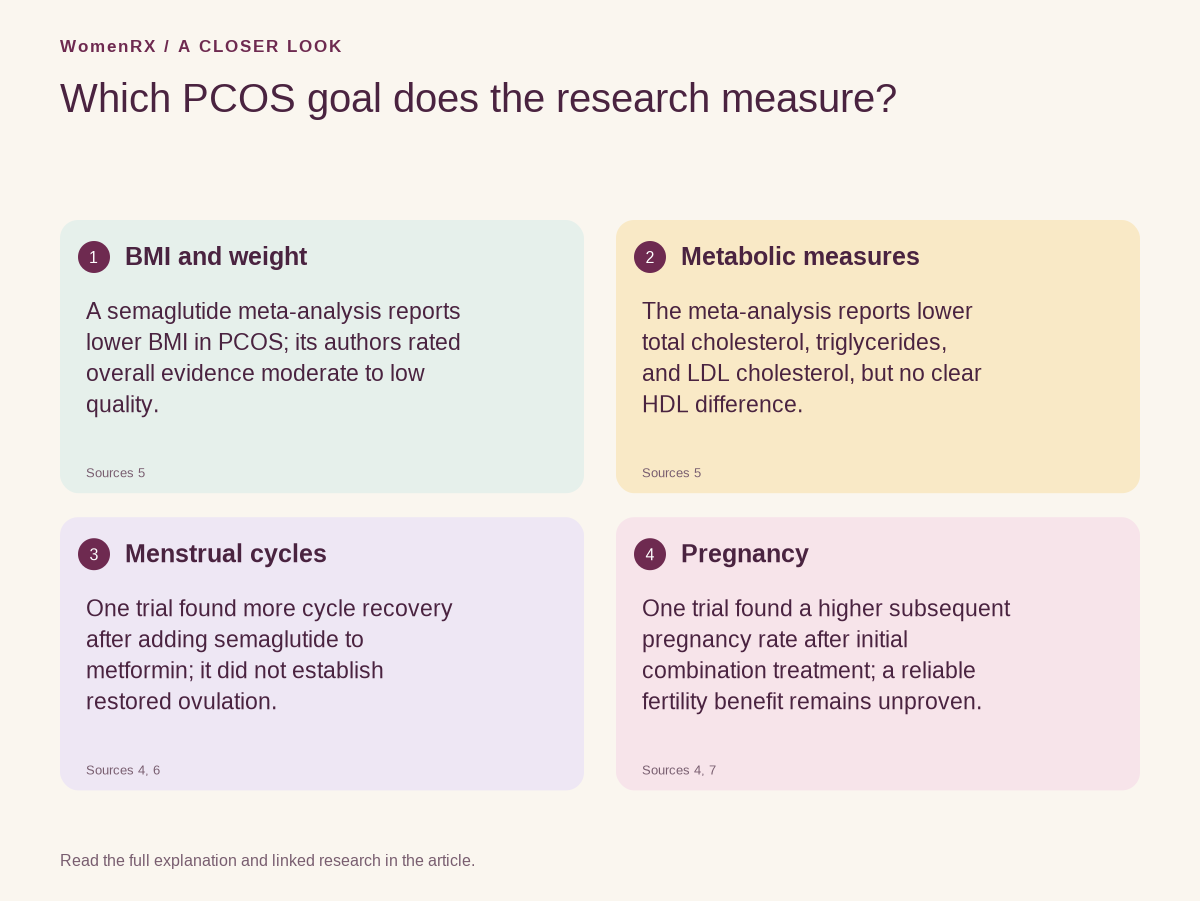
Which PCOS goal does the research measure?
BMI and weight: A semaglutide meta-analysis reports lower BMI in PCOS; its authors rated overall evidence moderate to low quality.5
Metabolic measures: The meta-analysis reports lower total cholesterol, triglycerides, and LDL cholesterol, but no clear HDL difference.5
Menstrual cycles: One trial found more cycle recovery after adding semaglutide to metformin; it did not establish restored ovulation.46
Pregnancy: One trial found a higher subsequent pregnancy rate after initial combination treatment; a reliable fertility benefit remains unproven.47
Read the figure as text
This map separates outcomes measured with semaglutide from conclusions those measurements cannot yet support.- BMI and weight: A semaglutide meta-analysis reports lower BMI in PCOS; its authors rated overall evidence moderate to low quality.5
- Metabolic measures: The meta-analysis reports lower total cholesterol, triglycerides, and LDL cholesterol, but no clear HDL difference.5
- Menstrual cycles: One trial found more cycle recovery after adding semaglutide to metformin; it did not establish restored ovulation.46
- Pregnancy: One trial found a higher subsequent pregnancy rate after initial combination treatment; a reliable fertility benefit remains unproven.47
More questions, answered
Do studies of other GLP-1 medicines answer the semaglutide question?
Not directly. GLP-1 medicines have different amounts of PCOS-specific research. A review found a larger PCOS evidence base for liraglutide than for semaglutide, so a reproductive outcome reported with liraglutide should not be presented as a proven semaglutide benefit. 7
Sources you can check
- PCOS | Polycystic Ovary Syndrome | MedlinePlusAccessed 2026-09-25Return to first citation
- WEGOVY (SEMAGLUTIDE) INJECTION, SOLUTION WEGOVY (SEMAGLUTIDE) TABLET [NOVO NORDISK PHARMACEUTICAL INDUSTRIES, LP] | US prescribing information and patient instructionsAccessed 2026-09-25Return to first citation
- OZEMPIC (ORAL SEMAGLUTIDE) TABLET RYBELSUS (ORAL SEMAGLUTIDE) TABLET [NOVO NORDISK PHARMACEUTICAL INDUSTRIES, LP] | US prescribing information and patient instructionsAccessed 2026-09-25Return to first citation
- Effects of combined metformin and semaglutide therapy on body weight, metabolic parameters, and reproductive outcomes in overweight/obese women with polycystic ovary syndrome: a prospective, randomized, controlled, open-label clinical trial.Chen H, Lei X, Yang Z, Xu Y, Liu D, Wang C, Du H. · Reproductive biology and endocrinology : RB&E · 2025Return to first citation
- Meta-analysis of the effects of semaglutide on body mass index (BMI) and blood lipid levels in polycystic ovary syndrome patients.Chen W, Xu D, Shao X, Song Q, Chen R. · Gynecological endocrinology : the official journal of the International Society of Gynecological Endocrinology · 2025Return to first citation
- Efficacy and Safety of Semaglutide in Patients with Polycystic Ovary Syndrome: A Scoping Review.La Vignera S, Condorelli RA. · Biomedicines · 2026Return to first citation
- Incretin-Based Anti-obesity Medications in Polycystic Ovary Syndrome: The Evidence Map.Jensterle M, Janez A. · Drugs · 2026Return to first citation