Myo-Inositol for PCOS: Match the Evidence to Your Goal
Myo-inositol has been studied for PCOS, but the answer changes depending on whether you want more regular cycles, pregnancy, or help with metabolic concerns.
Myo-inositol may help some measures of PCOS, but the overall evidence is limited and inconclusive. Studies of ovulation, menstrual regularity, fertility treatment, and metabolic health don't establish one reliable benefit across all those goals. If you're trying to conceive, it shouldn't replace a conversation about fertility care. No clinical result here identifies a best commercial supplement. 35
Start with the outcome you care about
A more predictable period, ovulation, and a pregnancy are related, but they aren't the same result. That distinction matters when you read claims about myo-inositol. PCOS can involve irregular or absent ovulation and periods, along with other symptoms that vary from person to person. There isn't one test that diagnoses it. 7
Inositol is studied in several forms, including myo-inositol and D-chiro-inositol, sometimes combined in one product. A systematic review conducted for the international PCOS guideline examined 30 trials involving 2,230 participants. It found possible benefits for some metabolic measures and a potential ovulation benefit for D-chiro-inositol, but concluded that evidence for inositol in PCOS remains limited and inconclusive. A finding for D-chiro-inositol alone doesn't establish the same result for myo-inositol alone or for every blend. 3
For more regular periods: encouraging signals, uncertain expectations
One 12-week trial enrolled 60 women with PCOS and compared a myo-inositol plus D-chiro-inositol combination with metformin. The researchers reported improvements in menstrual regularity in both groups, along with changes in several metabolic and hormonal measures. That is a reason to study the combination further, not a reliable prediction of what will happen to your cycles. It was a small, short trial of a combination, not a test of myo-inositol by itself or of store-bought brands. 1
If your main concern is missed periods, it's also worth being clear about the question you're asking: Do you want to know why your periods are irregular, make them more predictable, or conceive? PCOS can affect ovulation, but irregular periods alone don't tell you which approach best fits your situation. A diagnosis and treatment discussion can account for the other symptoms you have and what you're hoping treatment will do. 7
For ovulation and pregnancy: don't swap one endpoint for another
A small, open-label study assigned 50 women with PCOS who weren't ovulating to myo-inositol alone or myo-inositol plus the milk protein alpha-lactalbumin for three months. The combination group had better reported ovulation and cycle-duration outcomes. That comparison doesn't show that myo-inositol alone reliably induces ovulation, or that either option improves the chance of having a baby. 6
The difference becomes especially important if you're already pursuing fertility treatment. In a randomized study of 60 women with PCOS undergoing intracytoplasmic sperm injection (ICSI), myo-inositol plus folic acid was compared with folic acid alone. Researchers reported improvements in some hormone measurements and embryo-related outcomes. Those are intermediate findings in a specific assisted-reproduction setting, not proof of a live-birth benefit or evidence that the same approach works for someone trying to conceive without ICSI. 2 A later clinical commentary likewise describes fertility evidence as limited and notes that current guidance does not endorse myo-inositol as first-line treatment for PCOS-related infertility. 5
If pregnancy is your goal, a useful question is: What treatment is intended to help me ovulate, and what evidence supports it for my situation? Ask how a supplement would fit alongside, rather than stand in for, that plan. Contemporary PCOS fertility care includes ovulation-induction approaches such as letrozole; a positive result for an embryo measure or a hormone level shouldn't quietly become a promise about pregnancy. 25
For insulin-related concerns or weight: look at what was measured
Inositol may affect some metabolic measures in PCOS, but the systematic review did not find a clear, consistent benefit across outcomes. It also found that metformin may do better than inositol for waist-to-hip ratio and hirsutism, while myo-inositol likely causes fewer gastrointestinal adverse events than metformin. Those effects were typically mild and short-lived. This is a tradeoff to discuss if you're weighing an existing treatment against a supplement, not a reason to assume they're interchangeable. 3
Nor does a change in a blood marker guarantee weight loss. In one six-month trial comparing metformin-based treatment with combinations involving acarbose, including acarbose plus myo-inositol, none of the groups showed a change in BMI. Because the myo-inositol group also took acarbose, its results can't isolate myo-inositol's effect. 4
What the evidence means for choosing a product
A label may highlight a myo-inositol and D-chiro-inositol ratio, particularly 40:1. A 12-week trial used that ratio, but it compared the combination with metformin, not with other ratios or commercial products. It cannot tell you that 40:1 is the best ratio, that a particular brand contains what its label says, or that you'll get the trial's results from a product on a shelf. 1
The most useful decision isn't finding a supplement described as best for PCOS. It's deciding what result would make taking one worthwhile to you, and whether it might delay care better suited to that result. For example, if you're trying to conceive, ask about the plan for ovulation and pregnancy rather than judging success by a hormone result alone. If cycles are your concern, ask how you'll distinguish a meaningful change from the variation you're already seeing. If you're taking metformin, ask what you would gain or give up by changing course. Those are different conversations because PCOS is not one endpoint. 1235
What each PCOS outcome can tell you
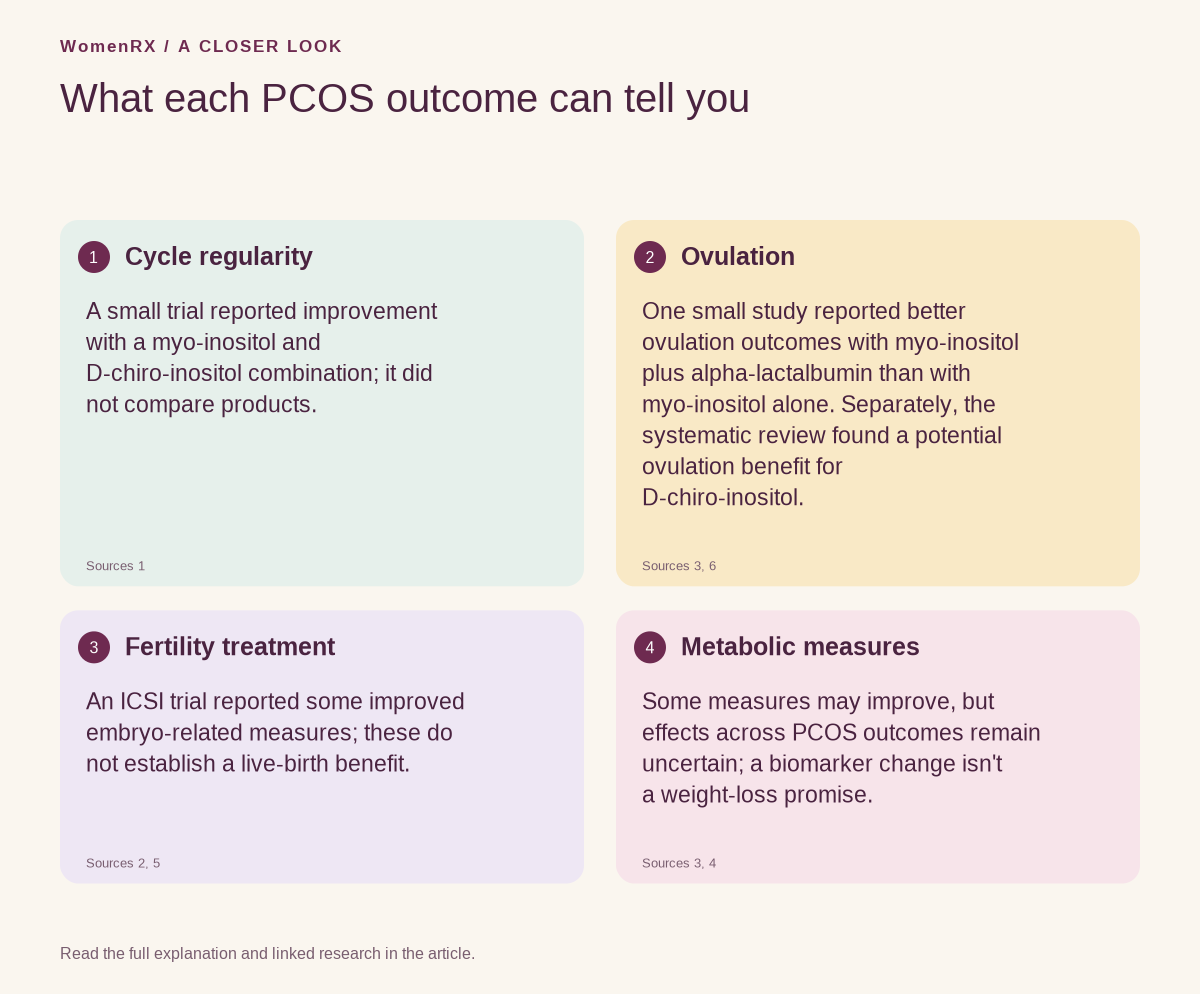
Cycle regularity: A small trial reported improvement with a myo-inositol and D-chiro-inositol combination; it did not compare products.1
Ovulation: One small study reported better ovulation outcomes with myo-inositol plus alpha-lactalbumin than with myo-inositol alone. Separately, the systematic review found a potential ovulation benefit for D-chiro-inositol.36
Fertility treatment: An ICSI trial reported some improved embryo-related measures; these do not establish a live-birth benefit.25
Metabolic measures: Some measures may improve, but effects across PCOS outcomes remain uncertain; a biomarker change isn't a weight-loss promise.34
Read the figure as text
A quick way to keep promising measurements separate from the result you're hoping for.- Cycle regularity: A small trial reported improvement with a myo-inositol and D-chiro-inositol combination; it did not compare products.1
- Ovulation: One small study reported better ovulation outcomes with myo-inositol plus alpha-lactalbumin than with myo-inositol alone. Separately, the systematic review found a potential ovulation benefit for D-chiro-inositol.36
- Fertility treatment: An ICSI trial reported some improved embryo-related measures; these do not establish a live-birth benefit.25
- Metabolic measures: Some measures may improve, but effects across PCOS outcomes remain uncertain; a biomarker change isn't a weight-loss promise.34
More questions, answered
Does a 40:1 myo-inositol to D-chiro-inositol ratio work best?
A small trial studied a 40:1 combination against metformin for 12 weeks. It did not compare ratios, so it cannot establish an optimal formula or identify a best product. 1
Do improved embryo results mean a better chance of a baby?
Not necessarily. An ICSI trial in women with PCOS reported improvements in some embryo-related measures, but those findings don't establish an improvement in live births. 25
Sources you can check
- Comparative efficacy of combined myo-inositol and D-chiro inositol versus metformin across PCOS Phenotypes: enhancing ovarian function, ovulation, and stress response in a prospective clinical trial.Gul M, Khan H, Rauf B, Bukhari SMS, Ehtesham E, Malik MO, Shah FA, Alanazi FE, Shah M. · Naunyn-Schmiedeberg's archives of pharmacology · 2025Return to first citation
- Improvement in biochemical manifestations of the serum and follicular fluid and ICSI outcomes in PCOS patients with myo-inositol administration: prospective randomized research.Yazdanpanah Z, Cheraghi E, Nasrabadi MH, Salehipour M. · Naunyn-Schmiedeberg's archives of pharmacology · 2025Return to first citation
- Inositol for Polycystic Ovary Syndrome: A Systematic Review and Meta-analysis to Inform the 2023 Update of the International Evidence-based PCOS Guidelines.Fitz V, Graca S, Mahalingaiah S, Liu J, Lai L, Butt A, Armour M, Rao V, Naidoo D, Maunder A, Yang G, Vaddiparthi V, Witchel SF, Pena A, Spritzer PM, Li R, Tay C, Mousa A, Teede H, ... · The Journal of clinical endocrinology and metabolism · 2024Return to first citation
- Effectiveness of dual combination therapy of acarbose plus metformin and acarbose plus myo-inositol in ameliorating the metabolic and endocrinologic complications of polycystic ovary syndrome - A randomized controlled trial.Andavar M, Kamaraj R, Mahalingam Vijayakumar T, Murugesan A. · European journal of obstetrics, gynecology, and reproductive biology · 2024Return to first citation
- Myo-inositol in reproductive management of women with PCOS: holy grail for medical practice or demon for scientific evidence?Palomba S, Seminara G, Aversa A. · Reproductive biomedicine online · 2026Return to first citation
- Comparing the Efficacy of Myo-Inositol Plus α-Lactalbumin vs. Myo-Inositol Alone on Reproductive and Metabolic Disturbances of Polycystic Ovary Syndrome.Kamenov Z, Gateva A, Dinicola S, Unfer V. · Metabolites · 2023Return to first citation
- PCOS | Polycystic Ovary Syndrome | MedlinePlusAccessed 2026-09-25Return to first citation